Mathematical finance in the context of Geometric series


Mathematical finance in the context of Geometric series

Mathematical finance Study page number 1 of 1

Play TriviaQuestions Online!

or

Skip to study material about Mathematical finance in the context of "Geometric series"


⭐ Core Definition: Mathematical finance

Mathematical finance, also known as quantitative finance and financial mathematics, is a field of applied mathematics, concerned with mathematical modeling in the financial field.

In general, there exist two separate branches of finance that require advanced quantitative techniques: derivatives pricing on the one hand, and risk and portfolio management on the other.Mathematical finance overlaps heavily with the fields of computational finance and financial engineering. The latter focuses on applications and modeling, often with the help of stochastic asset models, while the former focuses, in addition to analysis, on building tools of implementation for the models. Also related is quantitative investing, which relies on statistical and numerical models (and lately machine learning) as opposed to traditional fundamental analysis when managing portfolios.

↓ Menu
HINT:

πŸ‘‰ Mathematical finance in the context of Geometric series

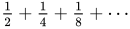
In mathematics, a geometric series is a series summing the terms of an infinite geometric sequence, in which the ratio of consecutive terms is constant. For example, the series is a geometric series with common ratio ⁠⁠, which converges to the sum of ⁠⁠. Each term in a geometric series is the geometric mean of the term before it and the term after it, in the same way that each term of an arithmetic series is the arithmetic mean of its neighbors.

While Greek philosopher Zeno's paradoxes about time and motion (5th century BCE) have been interpreted as involving geometric series, such series were formally studied and applied a century or two later by Greek mathematicians, for example used by Archimedes to calculate the area inside a parabola (3rd century BCE). Today, geometric series are used in mathematical finance, calculating areas of fractals, and various computer science topics.

↓ Explore More Topics
In this Dossier

Mathematical finance in the context of Time series

In mathematics, a time series is a series of data points indexed (or listed or graphed) in time order. Most commonly, a time series is a sequence taken at successive equally spaced points in time. Thus it is a sequence of discrete-time data. Examples of time series are heights of ocean tides, counts of sunspots, and the daily closing value of the Dow Jones Industrial Average.

A time series is very frequently plotted via a run chart (which is a temporal line chart). Time series are used in statistics, actuarial science, signal processing, pattern recognition, econometrics, mathematical finance, weather forecasting, earthquake prediction, electroencephalography, control engineering, astronomy, communications engineering, and largely in any domain of applied science and engineering which involves temporal measurements.

View the full Wikipedia page for Time series
↑ Return to Menu

Mathematical finance in the context of ArXiv

arXiv (pronounced as "archive"β€”the X represents the Greek letter chi βŸ¨Ο‡βŸ©) is an open-access repository of electronic preprints and postprints (known as e-prints) approved for posting after moderation, but not peer reviewed. It consists of scientific papers in the fields of mathematics, physics, astronomy, electrical engineering, computer science, quantitative biology, statistics, mathematical finance, and economics, which can be accessed online. In many fields of mathematics and physics, almost all scientific papers are self-archived on the arXiv repository before publication in a peer-reviewed journal. Some publishers also grant permission for authors to archive the peer-reviewed postprint. Begun on August 14, 1991, arXiv.org passed the half-million-article milestone on October 3, 2008, had hit a million by the end of 2014 and two million by the end of 2021. As of November 2024, the submission rate is about 24,000 articles per month.

View the full Wikipedia page for ArXiv
↑ Return to Menu

Mathematical finance in the context of Quantitative analysis (finance)

Quantitative analysis in finance refers to the application of mathematical and statistical methods to problems in financial markets and investment management. Professionals in this field are known as quantitative analysts or quants.

Quants typically specialize in areas such as derivative structuring and pricing, risk management, portfolio management, and other finance-related activities. The role is analogous to that of specialists in industrial mathematics working in non-financial industries.

View the full Wikipedia page for Quantitative analysis (finance)
↑ Return to Menu