Maria Amalia of Saxony in the context of "Caserta Palace"

Play Trivia Questions online!

or

Skip to study material about Maria Amalia of Saxony in the context of "Caserta Palace"


⭐ Core Definition: Maria Amalia of Saxony

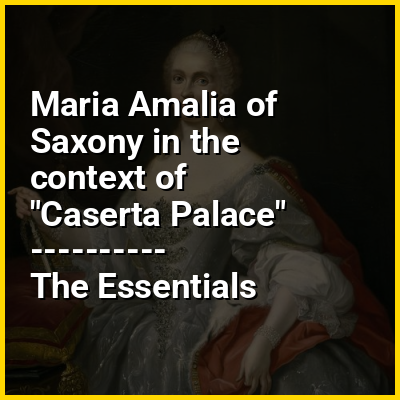
Maria Amalia (Maria Amalia Christina Franziska Xaveria Flora Walburga; 24 November 1724 – 27 September 1760) was Queen of Spain from 10 August 1759 until her death in 1760 as the wife of King Charles III. Previously, she had been Queen of Naples and Sicily since marrying Charles on 19 June 1738. She was born a princess of Poland and Saxony, daughter of King Augustus III of Poland and Princess Maria Josepha of Austria. Maria Amalia and Charles had thirteen children, of whom seven survived into adulthood. A popular consort, Maria Amalia oversaw the construction of the Caserta Palace outside Naples as well as various other projects, and she is known for her influence upon the affairs of state.

↓ Menu

In this Dossier

Maria Amalia of Saxony in the context of Ferdinand I of the Two Sicilies

Ferdinand I (Italian: Ferdinando I; 12 January 1751 – 4 January 1825) was King of the Two Sicilies from 1816 until his death. Before that he had been, since 1759, King of Naples as Ferdinand IV and King of Sicily as Ferdinand III. He was deposed twice from the throne of Naples: once by the revolutionary Parthenopean Republic for six months in 1799, and again by a French invasion in 1806, before being restored in 1815 at the end of the Napoleonic Wars.

Ferdinand was born in Naples as the third son of King Charles VII and Queen Maria Amalia. In August 1759, Charles succeeded his half-brother Ferdinand VI of Spain as King Charles III, but treaty provisions made him ineligible to hold all three crowns. On 6 October, he abdicated his Neapolitan and Sicilian titles in favour of his third son, Ferdinand, because his eldest son Philip had been excluded from succession due to intellectual disability and his second son Charles was heir-apparent to the Spanish throne. Ferdinand was the founder of the cadet House of Bourbon-Two Sicilies.

↑ Return to Menu

Maria Amalia of Saxony in the context of Charles III of Spain

Charles III (Spanish: Carlos Sebastián de Borbón y Farnesio; 20 January 1716 – 14 December 1788) was King of Spain from 1759 until his death in 1788. He was also Duke of Parma and Piacenza as Charles I (1731–1735), King of Naples as Charles VII and King of Sicily as Charles III (or V) (1735–1759). He was the fourth son of Philip V of Spain and the eldest son of Philip's second wife, Elisabeth Farnese. During his reign, Charles was a proponent of enlightened absolutism and regalism in Europe.

In 1731, the 15-year-old Charles became Duke of Parma and Piacenza following the death of his childless grand-uncle Antonio Farnese. In 1734, at the age of 18, he led Spanish troops in a bold and almost entirely bloodless march down Italy to seize the Kingdom of Naples and Kingdom of Sicily and enforce the Spanish claim to their thrones. In 1738, he married the Princess Maria Amalia of Saxony, daughter of Augustus III of Poland, who was an educated, cultured woman. The couple had 13 children, eight of whom reached adulthood. They resided in Naples for 19 years. Charles gained valuable experience in his 25-year rule in Italy, so that he was well prepared as the monarch of the Spanish Empire. His policies in Italy prefigured ones he would put in place in his 30-year rule of Spain.

↑ Return to Menu