House of Bourbon-Two Sicilies in the context of "Ferdinand I of the Two Sicilies"

Play Trivia Questions online!

or

Skip to study material about House of Bourbon-Two Sicilies in the context of "Ferdinand I of the Two Sicilies"

Ad spacer

⭐ Core Definition: House of Bourbon-Two Sicilies

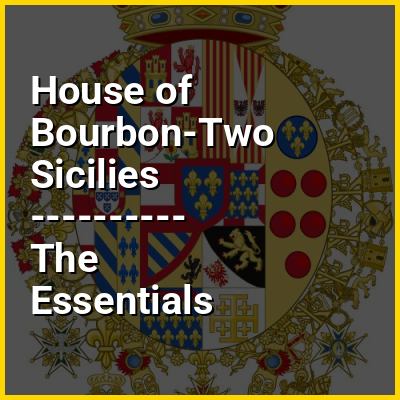
The House of Bourbon-Two Sicilies is a cadet branch of the House of Bourbon that ruled Southern Italy and Sicily for more than a century in the 18th and 19th centuries. It descends from the Capetian dynasty in legitimate male line through Philip, Duke of Anjou (later Philip V of Spain), a younger grandson of Louis XIV of France (1638–1715) who established the Bourbon dynasty in Spain in 1700 as Philip V (1683–1746). In 1759, King Philip's younger grandson was appanaged with the kingdoms of Naples and Sicily, becoming Ferdinand IV and III (1751–1825), respectively, of those realms. His descendants occupied the joint throne, merged as the "Kingdom of the Two Sicilies" in 1816, until 1861, claimed it thereafter from exile, and constitute the extant Bourbon-Two Sicilies family.

The succession of the House of Bourbon-Two Sicilies has, since 1960, been disputed between the senior Calabrian line, which is currently being represented by Prince Pedro, Duke of Calabria (born 1968) and the junior Castro line, which is currently being represented by Prince Carlo, Duke of Castro (born 1963). Efforts of reconciliation were carried out in 2014, but have been followed by continuing arguing in the family as Prince Carlo, Duke of Castro, abolished the law of male primogeniture to absolute primogeniture in 2016, making his eldest daughter heir by going against the tradition of male-line succession within the House of Bourbon-Two Sicilies.
↓ Menu

>>>PUT SHARE BUTTONS HERE<<<

👉 House of Bourbon-Two Sicilies in the context of Ferdinand I of the Two Sicilies

Ferdinand I (Italian: Ferdinando I; 12 January 1751 – 4 January 1825) was King of the Two Sicilies from 1816 until his death. Before that he had been, since 1759, King of Naples as Ferdinand IV and King of Sicily as Ferdinand III. He was deposed twice from the throne of Naples: once by the revolutionary Parthenopean Republic for six months in 1799, and again by a French invasion in 1806, before being restored in 1815 at the end of the Napoleonic Wars.

Ferdinand was born in Naples as the third son of King Charles VII and Queen Maria Amalia. In August 1759, Charles succeeded his half-brother Ferdinand VI of Spain as King Charles III, but treaty provisions made him ineligible to hold all three crowns. On 6 October, he abdicated his Neapolitan and Sicilian titles in favour of his third son, Ferdinand, because his eldest son Philip had been excluded from succession due to intellectual disability and his second son Charles was heir-apparent to the Spanish throne. Ferdinand was the founder of the cadet House of Bourbon-Two Sicilies.

↓ Explore More Topics
In this Dossier

House of Bourbon-Two Sicilies in the context of Kingdom of the Two Sicilies

The Kingdom of the Two Sicilies (Italian: Regno delle Due Sicilie) was a kingdom in Southern Italy from 1816 to 1861 under the control of the House of Bourbon-Two Sicilies, a cadet branch of the Spanish Bourbons. The kingdom was the largest sovereign state by population and land area in Italy before the Italian unification, comprising Sicily and most of the area of today's Mezzogiorno (southern Italy) and covering all of the Italian peninsula south of the Papal States.

The kingdom was formed when the Kingdom of Sicily merged with the Kingdom of Naples, which was officially also known as the Kingdom of Sicily. Since both kingdoms were named Sicily, they were collectively known as the "Two Sicilies" (Utraque Sicilia, literally "both Sicilies"), and the unified kingdom adopted this name. The king of the Two Sicilies was overthrown by Giuseppe Garibaldi in 1860, after which the people voted in a plebiscite to join the Kingdom of Sardinia. The annexation of the Kingdom of the Two Sicilies completed the first phase of Italian unification, and the new Kingdom of Italy was proclaimed in 1861.

↑ Return to Menu

House of Bourbon-Two Sicilies in the context of Expedition of the Thousand

The Expedition of the Thousand (Italian: Spedizione dei Mille) was an event of the unification of Italy that took place in 1860. A corps of volunteers led by Giuseppe Garibaldi sailed from Quarto al Mare near Genoa and landed in Marsala, Sicily, in order to conquer the Kingdom of the Two Sicilies, ruled by the Spanish House of Bourbon-Two Sicilies. The name of the expedition derives from the initial number of participants, which was around 1,000 people.

The Garibaldians, with the contribution of southern volunteers and reinforcements to the expedition, increased in number, creating the Southern Army. After a campaign of a few months with some victorious battles against the Bourbon army, the Thousand and the newborn southern army managed to conquer the entire Kingdom of the Two Sicilies. The expedition was a success and concluded with a plebiscite that brought Naples and Sicily into the Kingdom of Piedmont-Sardinia, the last territorial conquest before the proclamation of the Kingdom of Italy on 17 March 1861. The Expedition of the Thousand was the only desired action that was jointly decided by the four "Fathers of the Fatherland": Giuseppe Mazzini, Giuseppe Garibaldi, King Victor Emmanuel II, and Camillo Benso, Count of Cavour, pursuing divergent goals. Mazzini, of republican political belief, wanted to liberate Southern Italy and Rome, while Garibaldi wanted to conquer, in the name of Victor Emmanuel II, the Kingdom of the Two Sicilies and continue towards Rome to complete the Italian unification, while Cavour wanted to prevent the conquest of Rome to avoid a conflict with his French ally, Napoleon III, who protected the Papal States.

↑ Return to Menu

House of Bourbon-Two Sicilies in the context of History of Sicily

The history of Sicily has been influenced by numerous ethnic groups. It has seen Sicily controlled by powers, including Carthaginian, Greek, Roman, Vandal and Ostrogoth, Byzantine, Arab, Norman, Aragonese, Spanish, Austrians, but also experiencing important periods of independence, as under the indigenous Sicanians, Elymians, Sicels, the Greek-Siceliotes (in particular Syracuse with its sovereigns), and later as County of Sicily, and Kingdom of Sicily. The Kingdom was founded in 1130 by Roger II, belonging to the Siculo-Norman family of Hauteville. During this period, Sicily was prosperous and politically powerful, becoming one of the wealthiest states in all of Europe. As a result of the dynastic succession, the Kingdom passed into the hands of the Hohenstaufen. At the end of the 13th century, with the War of the Sicilian Vespers between the crowns of Anjou and Aragon, the island passed to the latter. In the following centuries the Kingdom entered into the personal union with the Spaniard and Bourbon crowns, while preserving effective independence until 1816. Sicily was merged with the Kingdom of Italy in 1861.Although today an Autonomous Region, with special statute, of the Republic of Italy, it has its own distinct culture.

Sicily is both the largest region of the modern state of Italy and the largest island in the Mediterranean Sea. Its central location and natural resources ensured that it has been considered a crucial strategic location due in large part to its importance for Mediterranean trade routes. Cicero and al-Idrisi described respectively Syracuse and Palermo as the greatest and most beautiful cities of the Hellenic World and of the Middle Ages.

↑ Return to Menu

House of Bourbon-Two Sicilies in the context of Prince Leopold, Count of Syracuse

Prince Leopold of the Two Sicilies (22 May 1813, in Palermo – 4 December 1860, in Pisa) was a prince of the Two Sicilies and was known as the Count of Syracuse.

↑ Return to Menu

House of Bourbon-Two Sicilies in the context of Royal Palace of Caserta

The Royal Palace of Caserta (Italian: Reggia di Caserta [ˈrɛddʒa di kaˈzɛrta, - kaˈsɛrta]; Neapolitan: Reggia 'e Caserta [ˈrɛdːʒ(ə) e kaˈsertə]) is a former royal residence in Caserta, Campania, 35 kilometres (22 mi) north of Naples in southern Italy, constructed by the House of Bourbon-Two Sicilies as their main residence as kings of Naples. The complex is the largest palace erected in Europe during the 18th century. In 1997, the palace was designated a UNESCO World Heritage Site; its nomination described it as "the swan song of the spectacular art of the Baroque, from which it adopted all the features needed to create the illusions of multidirectional space". The Royal Palace of Caserta is the largest former royal residence in the world, over 2 million m in volume covering an area of 47,000 m and a floorspace of 138,000 square metres distributed across five floors.

↑ Return to Menu

House of Bourbon-Two Sicilies in the context of Prince Pedro, Duke of Calabria

Prince Pedro of Bourbon-Two Sicilies, Duke of Calabria, Grandee of Spain (Spanish: Pedro Juan María Alejo Saturnino de Todos los Santos; born 16 October 1968), is the only son of Infante Carlos, Duke of Calabria, and Princess Anne of Orléans. As primogeniture heir of the kings of the Two Sicilies, he is the principal claimant to the headship of the Royal House of Bourbon-Two Sicilies, which ruled the Kingdom of the Two Sicilies before the unification of Italy.

↑ Return to Menu

House of Bourbon-Two Sicilies in the context of Prince Carlo, Duke of Castro

Prince Carlo of Bourbon-Two Sicilies, Duke of Castro (born 24 February 1963) is one of two claimants to the headship of the House of Bourbon-Two Sicilies.

↑ Return to Menu

House of Bourbon-Two Sicilies in the context of Teatro di San Carlo

The Real Teatro di San Carlo ("Royal Theatre of Saint Charles"), as originally named by the Bourbon monarchy but today known simply as the Teatro (di) San Carlo, is a historic opera house in Naples, Italy, connected to the Royal Palace and adjacent to the Piazza del Plebiscito. It is the oldest continuously active venue for opera in the world, having opened in 1737, decades before either Milan's La Scala or Venice's La Fenice.

The opera season runs from late November to July, with the ballet season from December to early June. The house once had a seating capacity of 3,285, but has now been reduced to 1,386 seats. Given its size, structure and antiquity, it was the model for theatres that were later built in Europe.

↑ Return to Menu