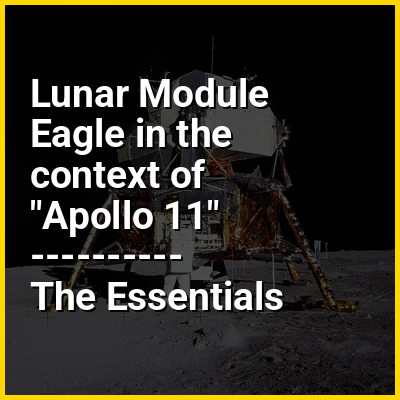
Apollo 11 was the first spaceflight to land humans on the Moon, conducted by NASA from July 16 to 24, 1969. Commander Neil Armstrong and Lunar Module Pilot Edwin "Buzz" Aldrin landed the Lunar Module Eagle on July 20 at 20:17 UTC, and Armstrong became the first person to step onto the surface about six hours later, at 02:56 UTC on July 21. Aldrin joined him 19 minutes afterward, and together they spent about two and a half hours exploring the site they had named Tranquility Base upon landing. They collected 47.5 pounds (21.5 kg) of lunar material to bring back to Earth before re-entering the Lunar Module. In total, they were on the Moon’s surface for 21 hours, 36 minutes before returning to the Command Module Columbia, which remained in lunar orbit, piloted by Michael Collins.
Apollo 11 was launched by a Saturn V rocket from Kennedy Space Center in Florida, on July 16 at 13:32 UTC (9:32 am EDT, local time). It was the fifth crewed mission of the Apollo program. The Apollo spacecraft consisted of three parts: the command module (CM), which housed the three astronauts and was the only part to return to Earth; the service module (SM), which provided propulsion, electrical power, oxygen, and water to the command module; and the Lunar Module (LM), which had two stages—a descent stage with a large engine and fuel tanks for landing on the Moon, and a lighter ascent stage containing a cabin for two astronauts and a small engine to return them to lunar orbit.