Logical conjunction in the context of Duality principle (Boolean algebra)


Logical conjunction in the context of Duality principle (Boolean algebra)

Logical conjunction Study page number 1 of 2

Play TriviaQuestions Online!

or

Skip to study material about Logical conjunction in the context of "Duality principle (Boolean algebra)"


⭐ Core Definition: Logical conjunction

In logic, mathematics and linguistics, and () is the truth-functional operator of conjunction or logical conjunction. The logical connective of this operator is typically represented as or or (prefix) or or in which is the most modern and widely used.

The and of a set of operands is true if and only if all of its operands are true, i.e., is true if and only if is true and is true.

↓ Menu
HINT:

In this Dossier

Logical conjunction in the context of Logic

Logic is the study of correct reasoning. It includes both formal and informal logic. Formal logic is the study of deductively valid inferences or logical truths. It examines how conclusions follow from premises based on the structure of arguments alone, independent of their topic and content. Informal logic is associated with informal fallacies, critical thinking, and argumentation theory. Informal logic examines arguments expressed in natural language whereas formal logic uses formal language. When used as a countable noun, the term "a logic" refers to a specific logical formal system that articulates a proof system. Logic plays a central role in many fields, such as philosophy, mathematics, computer science, and linguistics.

Logic studies arguments, which consist of a set of premises that leads to a conclusion. An example is the argument from the premises "it's Sunday" and "if it's Sunday then I don't have to work" leading to the conclusion "I don't have to work." Premises and conclusions express propositions or claims that can be true or false. An important feature of propositions is their internal structure. For example, complex propositions are made up of simpler propositions linked by logical vocabulary like (and) or (if...then). Simple propositions also have parts, like "Sunday" or "work" in the example. The truth of a proposition usually depends on the meanings of all of its parts. However, this is not the case for logically true propositions. They are true only because of their logical structure independent of the specific meanings of the individual parts.

View the full Wikipedia page for Logic
↑ Return to Menu

Logical conjunction in the context of Propositional calculus

Propositional logic is a branch of logic. It is also called statement logic, sentential calculus, propositional calculus, sentential logic, or sometimes zeroth-order logic. Sometimes, it is called first-order propositional logic to contrast it with System F, but it should not be confused with first-order logic. It deals with propositions (which can be true or false) and relations between propositions, including the construction of arguments based on them. Compound propositions are formed by connecting propositions by logical connectives representing the truth functions of conjunction, disjunction, implication, biconditional, and negation. Some sources include other connectives, as in the table below.

Unlike first-order logic, propositional logic does not deal with non-logical objects, predicates about them, or quantifiers. However, all the machinery of propositional logic is included in first-order logic and higher-order logics. In this sense, propositional logic is the foundation of first-order logic and higher-order logic.

View the full Wikipedia page for Propositional calculus
↑ Return to Menu

Logical conjunction in the context of Nonclassical logic

Non-classical logics (and sometimes alternative logics or non-Aristotelian logics) are formal systems that differ in a significant way from standard logical systems such as propositional and predicate logic. There are several ways in which this is commonly the case, including by way of extensions, deviations, and variations. The aim of these departures is to make it possible to construct different models of logical consequence and logical truth.

Philosophical logic is understood to encompass and focus on non-classical logics, although the term has other meanings as well. In addition, some parts of theoretical computer science can be thought of as using non-classical reasoning, although this varies according to the subject area. For example, the basic boolean functions (e.g. AND, OR, NOT, etc) in computer science are very much classical in nature, as is clearly the case given that they can be fully described by classical truth tables. However, in contrast, some computerized proof methods may not use classical logic in the reasoning process.

View the full Wikipedia page for Nonclassical logic
↑ Return to Menu

Logical conjunction in the context of Boolean algebra (structure)

In abstract algebra, a Boolean algebra or Boolean lattice is a complemented distributive lattice. This type of algebraic structure captures essential properties of both set operations and logic operations. A Boolean algebra can be seen as a generalization of a power set algebra or a field of sets, or its elements can be viewed as generalized truth values. It is also a special case of a De Morgan algebra and a Kleene algebra (with involution).

Every Boolean algebra gives rise to a Boolean ring, and vice versa, with ring multiplication corresponding to conjunction or meet ∧, and ring addition to exclusive disjunction or symmetric difference (not disjunction ∨). However, the theory of Boolean rings has an inherent asymmetry between the two operators, while the axioms and theorems of Boolean algebra express the symmetry of the theory described by the duality principle.

View the full Wikipedia page for Boolean algebra (structure)
↑ Return to Menu

Logical conjunction in the context of Boolean logic

In mathematics and mathematical logic, Boolean algebra is a branch of algebra. It differs from elementary algebra in two ways. First, the values of the variables are the truth values true and false, usually denoted by 1 and 0, whereas in elementary algebra the values of the variables are numbers. Second, Boolean algebra uses logical operators such as conjunction (and) denoted as , disjunction (or) denoted as , and negation (not) denoted as ¬. Elementary algebra, on the other hand, uses arithmetic operators such as addition, multiplication, subtraction, and division. Boolean algebra is therefore a formal way of describing logical operations in the same way that elementary algebra describes numerical operations.

Boolean algebra was introduced by George Boole in his first book The Mathematical Analysis of Logic (1847), and set forth more fully in his An Investigation of the Laws of Thought (1854). According to Huntington, the term Boolean algebra was first suggested by Henry M. Sheffer in 1913, although Charles Sanders Peirce gave the title "A Boolian [sic] Algebra with One Constant" to the first chapter of his "The Simplest Mathematics" in 1880. Boolean algebra has been fundamental in the development of digital electronics, and is provided for in all modern programming languages. It is also used in set theory and statistics.

View the full Wikipedia page for Boolean logic
↑ Return to Menu

Logical conjunction in the context of De Morgan's laws

In propositional logic and Boolean algebra, De Morgan's laws, also known as De Morgan's theorem, are a pair of transformation rules that are both valid rules of inference. They are named after Augustus De Morgan, a 19th-century British mathematician. The rules allow the expression of conjunctions and disjunctions purely in terms of each other via negation.

View the full Wikipedia page for De Morgan's laws
↑ Return to Menu

Logical conjunction in the context of Exportation (logic)

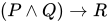
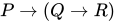
Exportation is a valid rule of replacement in propositional logic. The rule allows conditional statements having conjunctive antecedents to be replaced by statements having conditional consequents and vice versa in logical proofs. It is the rule that:

Where "" is a metalogical symbol representing "can be replaced in a proof with." In strict terminology, is the law of exportation, for it "exports" a proposition from the antecedent of to its consequent. Its converse, the law of importation, , "imports" a proposition from the consequent of to its antecedent.

View the full Wikipedia page for Exportation (logic)
↑ Return to Menu

Logical conjunction in the context of Tautology (rule of inference)

In propositional logic, tautology is either of two commonly used rules of replacement. The rules are used to eliminate redundancy in disjunctions and conjunctions when they occur in logical proofs. They are:

The principle of idempotency of disjunction:

View the full Wikipedia page for Tautology (rule of inference)
↑ Return to Menu

Logical conjunction in the context of Vacuous truth

In mathematics and logic, a vacuous truth is a conditional or universal statement (specifically a universal statement that can be converted to a conditional statement) that is true because the antecedent cannot be satisfied.

It is sometimes said that a statement is vacuously true because it does not really say anything. For example, the statement "all cell phones in the room are turned off" (alternatively said "for all x in this room, if x is a cellphone then x is turned off") will be true when no cell phones are present in the room. In this case, the statement "all cell phones in the room are turned on" would also be vacuously true, as would the conjunction of the two: "all cell phones in the room are turned on and all cell phones in the room are turned off", which would otherwise be incoherent and false.

View the full Wikipedia page for Vacuous truth
↑ Return to Menu