Rule of replacement in the context of "Exportation (logic)"

Play Trivia Questions online!

or

Skip to study material about Rule of replacement in the context of "Exportation (logic)"


⭐ Core Definition: Rule of replacement

In logic, a rule of replacement is a transformation rule that may be applied to only a particular segment of an expression. A logical system may be constructed so that it uses either axioms, rules of inference, or both as transformation rules for logical expressions in the system. Whereas a rule of inference is always applied to a whole logical expression, a rule of replacement may be applied to only a particular segment. Within the context of a logical proof, logically equivalent expressions may replace each other. Rules of replacement are used in propositional logic to manipulate propositions.

Common rules of replacement include de Morgan's laws, commutation, association, distribution, double negation, transposition, material implication, logical equivalence, exportation, and tautology.

↓ Menu

👉 Rule of replacement in the context of Exportation (logic)

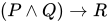
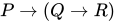
Exportation is a valid rule of replacement in propositional logic. The rule allows conditional statements having conjunctive antecedents to be replaced by statements having conditional consequents and vice versa in logical proofs. It is the rule that:

Where "" is a metalogical symbol representing "can be replaced in a proof with." In strict terminology, is the law of exportation, for it "exports" a proposition from the antecedent of to its consequent. Its converse, the law of importation, , "imports" a proposition from the consequent of to its antecedent.

↓ Explore More Topics
In this Dossier

Rule of replacement in the context of Associative property

In mathematics, the associative property is a property of some binary operations that rearranging the parentheses in an expression will not change the result. In propositional logic, associativity is a valid rule of replacement for expressions in logical proofs.

Within an expression containing two or more occurrences in a row of the same associative operator, the order in which the operations are performed does not matter as long as the sequence of the operands is not changed. That is (after rewriting the expression with parentheses and in infix notation if necessary), rearranging the parentheses in such an expression will not change its value. Consider the following equations:

↑ Return to Menu

Rule of replacement in the context of Material implication (rule of inference)

where "" is a metalogical symbol representing "can be replaced in a proof with", P and Q are any given logical statements, and can be read as "(not P) or Q". To illustrate this, consider the following statements:

↑ Return to Menu

Rule of replacement in the context of Tautology (rule of inference)

In propositional logic, tautology is either of two commonly used rules of replacement. The rules are used to eliminate redundancy in disjunctions and conjunctions when they occur in logical proofs. They are:

The principle of idempotency of disjunction:

↑ Return to Menu