Light commercial vehicle in the context of "Trucks"

Play Trivia Questions online!

or

Skip to study material about Light commercial vehicle in the context of "Trucks"

Ad spacer

⭐ Core Definition: Light commercial vehicle

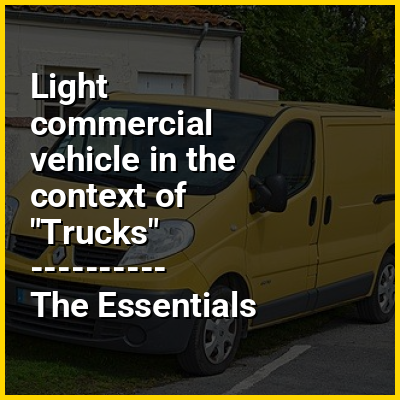
A light commercial vehicle (LCV) in the European Union is a commercial carrier vehicle with a gross vehicle weight of no more than 3.5 metric tons (tonnes) or no more than 4.5 tonnes in Australia and New Zealand. The LCV designation is also occasionally used in both Canada and Ireland (where the term commercial van is more commonly used).

In the UK, light haulage is a restricted-weight delivery service where the maximum permitted gross vehicle weight rating without the need of an operator's license is also up to 3.5 tonnes. Usually light haulage excludes a distribution center as most deliveries are direct. A delivery may consist of a single, multiple or priority urgent load and can be either same day or next day delivery. The vehicle (as long as it doesn't exceed the 3.5 T gross vehicle weight) does not require a tachograph and can also be driven by people with a regular car license without the need for an Operator's License. The speed restriction is higher than heavy goods vehicles: 60 MPH on dual carriageways and up to 70 MPH on motorways.
↓ Menu

>>>PUT SHARE BUTTONS HERE<<<

👉 Light commercial vehicle in the context of Trucks

A truck (North American and Australian English) or lorry (British English) is a motor vehicle designed to transport freight, carry specialized payloads, or perform other utilitarian work. Trucks vary greatly in size, power, and configuration, but the vast majority feature body-on-frame construction, with a cabin that is independent of the payload portion of the vehicle. Smaller varieties may be mechanically similar to some automobiles. Commercial trucks can be very large and powerful and may be configured to be mounted with specialized equipment, such as in the case of refuse trucks, fire trucks, concrete mixers, and suction excavators. In American English, a commercial vehicle without a trailer or other articulation is formally a "straight truck" while one designed specifically to pull a trailer is not a truck but a "tractor".

The majority of trucks currently in use are powered by diesel engines, although small- to medium-size trucks with gasoline engines exist in North America. Electrically powered trucks are more popular in China and Europe than elsewhere. In the European Union, vehicles with a gross combination mass of up to 3.5 t (3.4 long tons; 3.9 short tons) are defined as light commercial vehicles, and those over as large goods vehicles.

↓ Explore More Topics
In this Dossier

Light commercial vehicle in the context of List of countries by motor vehicle production

This is a list of countries by motor vehicle production based on International Organization of Motor Vehicle Manufacturers and other data from 2016 and earlier. Figures include passenger cars, light commercial vehicles, minibuses, trucks, buses and coaches.

↑ Return to Menu

Light commercial vehicle in the context of Opel Manufacturing Poland

Opel Manufacturing Poland Sp. z o.o. (formerly General Motors Manufacturing Poland Sp. z o.o.) is an automobile manufacturer in Poland. It assembles light commercial vehicles in a factory in Gliwice and builds engines in Tychy. Opel Manufacturing Poland is a subsidiary of Opel Automobile GmbH in Rüsselsheim, Germany which in turn is a subsidiary of Stellantis.

This is not to be confused with the Opel sales company Opel Poland Sp. z o.o. with seat in Warsaw, appearing publicly as Opel Polska.

↑ Return to Menu

Light commercial vehicle in the context of Mercedes-Benz

Mercedes-Benz (German pronunciation: [mɛʁˌtseːdəs ˈbɛnts, -dɛs -] ), commonly referred to simply as Mercedes and occasionally as Benz, is a German automotive brand that was founded in 1926. Mercedes-Benz AG (a subsidiary of the Mercedes-Benz Group, established in 2019) is based in Stuttgart, Baden-Württemberg, Germany. Mercedes-Benz AG manufactures luxury vehicles and light commercial vehicles, all branded under the Mercedes-Benz name. From November 2019 onwards, the production of Mercedes-Benz-branded heavy commercial vehicles (trucks and buses) has been managed by Daimler Truck, which separated from the Mercedes-Benz Group to form an independent entity at the end of 2021.

In 2018, Mercedes-Benz became the world’s largest premium vehicle brand, with a sales volume of 2.31 million passenger cars.

↑ Return to Menu

Light commercial vehicle in the context of Large goods vehicle

A large goods vehicle (LGV), or heavy goods vehicle (HGV), in the European Union (EU) is any lorry with a gross combination mass (GCM) of over 3,500 kg (7,700 lb). Sub-category N2 is used for vehicles between 3,500 kg and 12,000 kg (26,000 lb) and N3 for all goods vehicles over 12,000 kg as defined in Directive 2001/116/EC. The term medium goods vehicle is used within parts of the UK government to refer to goods vehicles of between 3,500 and 7,500 kg which according to the EU are also "large goods vehicles."

Commercial carrier vehicles of up to 3,500 kg are referred to as light commercial vehicles and come into category N1.

↑ Return to Menu

Light commercial vehicle in the context of Light truck

Light truck or light-duty truck is a US classification for vehicles with a gross vehicle weight up to 8,500 pounds (3,860 kg) and a payload capacity up to 4,000 pounds (1,814 kg). Similar goods vehicle classes in the European Union, Asia and Africa are termed light commercial vehicles and are limited to a gross vehicle weight of up to 3,500 kg (7,720 pounds). Australia and New Zealand are limited to a gross vehicle weight of up to 4,500 kg (9,920 pounds).

↑ Return to Menu

Light commercial vehicle in the context of Volkswagen Commercial Vehicles

Volkswagen Commercial Vehicles (VWCV; German: Volkswagen Nutzfahrzeuge [ˈfɔlksˌvaːɡn̩ ˈnʊtsˌfaːɐ̯tsɔʏɡə], abbreviated VWN [ˌfaʊveːˈʔɛn]) is a German marque of light commercial vehicles, owned by Volkswagen Group. It is headquartered in Hannover, Lower Saxony, Germany. Originally part of Volkswagen Passenger Cars (business area), it has operated as a separate marque since 1995.

↑ Return to Menu