Joseph Nye in the context of "John F. Kennedy School of Government"

Play Trivia Questions online!

or

Skip to study material about Joseph Nye in the context of "John F. Kennedy School of Government"


⭐ Core Definition: Joseph Nye

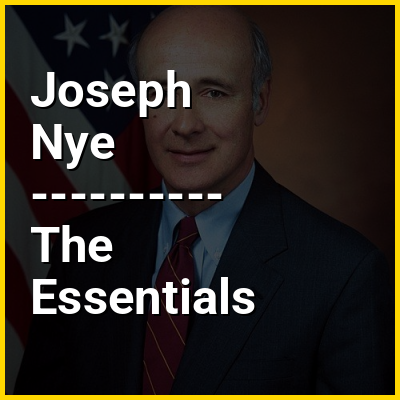
Joseph Samuel Nye Jr. (January 19, 1937 – May 6, 2025) was an American political scientist. He and Robert Keohane co-founded the international relations theory of neoliberalism, which they developed in their 1977 book Power and Interdependence. Together with Keohane, he developed the concepts of asymmetrical and complex interdependence. They also explored transnational relations and world politics in an edited volume in the 1970s. More recently, he pioneered the theory of soft power. His notion of "smart power" ("the ability to combine hard and soft power into a successful strategy") became popular with the use of this phrase by members of the Clinton Administration and the Obama Administration. These theories from Nye are very commonly seen in courses across the U.S., such as I.B. D.P. Global Politics.

Nye was the Dean of the John F. Kennedy School of Government at Harvard University, where he later held the position of University Distinguished Service Professor, emeritus. In October 2014, US Secretary of State John Kerry appointed Nye to the Foreign Affairs Policy Board. He was also a member of the Defense Policy Board. He was a Harvard faculty member since 1964. He was a fellow of the American Academy of Arts & Sciences, a foreign fellow of the British Academy, and a member of the American Academy of Diplomacy.
↓ Menu

In this Dossier

Joseph Nye in the context of Soft power

In politics (and particularly in international politics), soft power is the ability to co-opt rather than coerce (in contrast with hard power). It involves shaping the preferences of others through appeal and attraction. Soft power is non-coercive, using culture, political values, and foreign policies to enact change. In 2012, Joseph Nye of Harvard University explained that with soft power, "the best propaganda is not propaganda", further explaining that during the Information Age, "credibility is the scarcest resource".

Nye popularised the term in his 1990 book, Bound to Lead: The Changing Nature of American Power.

↑ Return to Menu

Joseph Nye in the context of Hard power

In politics, hard power is the use of military and economic means to influence the behavior or interests of other political bodies. This form of political power is often aggressive (coercion), and is most immediately effective when imposed by one political body upon another of less military and/or economic power. Hard power contrasts with soft power, which comes from diplomacy, culture and history.

According to Joseph Nye, hard power involves "the ability to use the carrots and sticks of economic and military might to make others follow your will". Here, "carrots" stand for inducements such as the reduction of trade barriers, the offer of an alliance or the promise of military protection. On the other hand, "sticks" represent threats - including the use of coercive diplomacy, the threat of military intervention, or the implementation of economic sanctions. Ernest Wilson describes hard power as the capacity to coerce "another to act in ways in which that entity would not have acted otherwise".

↑ Return to Menu

Joseph Nye in the context of Alexander Wendt

Alexander Wendt (born 12 June 1958) is an American political scientist and a founding figure of social constructivism in the field of international relations, and a key contributor to quantum social science. Wendt and academics such as Nicholas Onuf, Peter J. Katzenstein, Emanuel Adler, Michael Barnett, Kathryn Sikkink, John Ruggie, Martha Finnemore and others have, within a relatively short period, established constructivism as one of the major schools of thought in the field.

A 2017 Teaching, Research, and International Policy (TRIP) survey of 1,400 international relations scholars worldwide ranked Wendt as the most influential scholar in the field over the past 20 years. Earlier TRIP surveys in 2006 and 2011 also recognized his work as among the most impactful in the discipline. Wendt’s scholarship has garnered over 50,000 citations on Google Scholar, making him one of the most cited researchers in international relations, alongside figures like Joseph Nye and James Fearon.

↑ Return to Menu

Joseph Nye in the context of Complex interdependence

Complex interdependence in international relations and international political economy is a concept put forth by Robert Keohane and Joseph Nye in the 1970s to describe the emerging nature of the global political economy. The concept entails that relations between states are becoming increasingly deep and complex. These increasingly complex webs of economic interdependence undermine state power and elevate the influence of transnational non-state actors. These complex relationships can be explored through both the liberal and realism lenses and can later explain the debate of power from complex interdependence.

↑ Return to Menu

Joseph Nye in the context of Smart power

In international relations, the term smart power refers to the combination of hard power and soft power strategies. It is defined by the Center for Strategic and International Studies as "an approach that underscores the necessity of a strong military, but also invests heavily in alliances, partnerships, and institutions of all levels to expand one's influence and establish legitimacy of one's action."

Joseph Nye, former Assistant Secretary of Defense for International Security Affairs under the Clinton administration and author of several books on smart power strategy, suggests that the most effective strategies in foreign policy today require a mix of hard and soft power resources. Employing only hard power or only soft power in a given situation will usually prove inadequate. Nye utilizes the example of terrorism, arguing that combatting terrorism demands smart power strategy. He advises that simply utilizing soft power resources to change the hearts and minds of the Taliban government would be ineffective and requires a hard power component. In developing relationships with the mainstream Muslim world, however, soft power resources are necessary and the use of hard power would have damaging effects.

↑ Return to Menu