
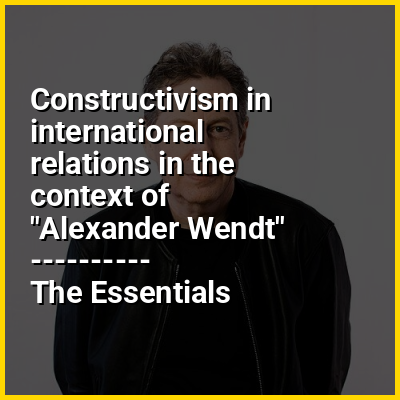
Alexander Wendt (born 12 June 1958) is an American political scientist and a founding figure of social constructivism in the field of international relations, and a key contributor to quantum social science. Wendt and academics such as Nicholas Onuf, Peter J. Katzenstein, Emanuel Adler, Michael Barnett, Kathryn Sikkink, John Ruggie, Martha Finnemore and others have, within a relatively short period, established constructivism as one of the major schools of thought in the field.
A 2017 Teaching, Research, and International Policy (TRIP) survey of 1,400 international relations scholars worldwide ranked Wendt as the most influential scholar in the field over the past 20 years. Earlier TRIP surveys in 2006 and 2011 also recognized his work as among the most impactful in the discipline. Wendt’s scholarship has garnered over 50,000 citations on Google Scholar, making him one of the most cited researchers in international relations, alongside figures like Joseph Nye and James Fearon.