Javits Center in the context of "Hudson Yards, Manhattan"

Play Trivia Questions online!

or

Skip to study material about Javits Center in the context of "Hudson Yards, Manhattan"

Ad spacer

⭐ Core Definition: Javits Center

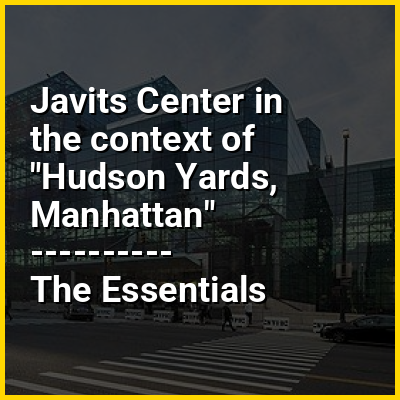
The Jacob K. Javits Convention Center, commonly known as the Javits Center, is a large convention center on Eleventh Avenue between 34th Street and 38th Street in Hell's Kitchen, Manhattan, New York City. It was designed by architect James Ingo Freed of Pei Cobb Freed & Partners. The space frame structure was constructed from 1979 to 1986 and was named to honor Jacob Javits, the United States Senator for New York. When the Javits Center opened, it replaced the New York Coliseum at Columbus Circle as the city's major convention facility; the Coliseum was subsequently demolished and replaced by Time Warner Center.

The Javits Center is operated and maintained by the New York Convention Center Operating Corporation, a New York State public-benefit corporation. As of 2021, the Javits Center has a total interior area of 3.3 million square feet (310,000 m). It is billed as one of the busiest convention centers in the United States. It has undergone expansions throughout its history, with the most recent expansion being completed in 2021 and adding 1.2 million square feet to the building. Plans have also been made for the Javits Center to have panels providing solar power.
↓ Menu

>>>PUT SHARE BUTTONS HERE<<<

👉 Javits Center in the context of Hudson Yards, Manhattan

Hudson Yards is a neighborhood on the West Side of Midtown Manhattan in New York City, bounded roughly by 30th Street in the south, 41st Street in the north, the West Side Highway in the west, and Eighth Avenue in the east. The area is the site of a large-scale redevelopment program that is being planned, funded, and constructed under a set of agreements among the State of New York, City of New York, and Metropolitan Transportation Authority (MTA), with the aim of expanding the Midtown Manhattan business district westward to the Hudson River. The program includes a major rezoning of the Far West Side, an extension of the New York City Subway's 7 and <7>​ trains to a new subway station at 34th Street and 11th Avenue, a renovation and expansion of the Javits Center, and a financing plan to fund the various components. The various components are being planned by the New York City Department of City Planning and New York City Economic Development Corporation.

The largest of the projects made possible by the rezoning is the 28-acre (11 ha) multiuse Hudson Yards real estate development by Related Companies and Oxford Properties, which is being built over the West Side Rail Yard. Construction began in 2012 with the groundbreaking for 10 Hudson Yards, and is projected to be completed by 2024. According to its master plan, created by Kohn Pedersen Fox Associates, the Hudson Yards development would include 16 skyscrapers to be constructed in two phases. Architects including Skidmore, Owings, and Merrill, Thomas Heatherwick, Roche-Dinkeloo, and Diller Scofidio + Renfro contributed designs for individual structures. Major office tenants include or will include Tapestry, Equinox Fitness, and BlackRock.

↓ Explore More Topics
In this Dossier

Javits Center in the context of 34th Street (Manhattan)

34th Street is a major crosstown street in the New York City borough of Manhattan. It runs the width of Manhattan Island from the West Side Highway on the West Side to FDR Drive on the East Side. 34th Street is used as a crosstown artery between New Jersey to the west and Queens to the east, connecting the Lincoln Tunnel to New Jersey with the Queens–Midtown Tunnel to Long Island.

Several notable buildings are located directly along 34th Street, including the Empire State Building, Macy's Herald Square, and Javits Center. Other structures, such as Pennsylvania Station, are located within one block of 34th Street. The street is served by the crosstown M34/M34A bus routes and contains several subway stops.

↑ Return to Menu

Javits Center in the context of High Line

The High Line is a 1.45-mile-long (2.33 km) elevated linear park, greenway, and rail trail created on a former New York Central Railroad spur on the West Side of Manhattan in New York City. The High Line's design is a collaboration between James Corner Field Operations, Diller Scofidio + Renfro, and Piet Oudolf. The abandoned spur has been redesigned as a "living system" drawing from multiple disciplines which include landscape architecture, urban design, and ecology. The High Line was inspired by the 4.7 km (2.9 mi) long Coulée verte (tree-lined walkway), another elevated park in Paris completed in 1993.

The park is built on an abandoned, southern viaduct section of the New York Central Railroad's West Side Line. Originating in the Meatpacking District, the park runs from Gansevoort Street—three blocks below 14th Street—through Chelsea to the northern edge of the West Side Yard on 34th Street near the Javits Center. The West Side Line formerly extended south to a railroad terminal at Spring Street, just north of Canal Street, and north to 35th Street at the site of the Javits Center. Due to a decline in rail traffic along the rest of the viaduct, it was effectively abandoned in 1980 when the construction of the Javits Center required the demolition of the viaduct's northernmost portion. The southern portion of the viaduct was demolished in segments during the late 20th century.

↑ Return to Menu

Javits Center in the context of Alternate care site

An alternate care site (ACS) is a medical treatment facility established in a non-traditional setting during a public-health crisis (or other event causing strain on local medical resources) as a means of providing additional capacity to deliver medical care within a given area. The term encompasses both civilian-operated medical facilities established in non-traditional places such as hotels, gymnasiums, and convention centers, or other "structure[s] of opportunity," as well as military field medical units being used for public-health purposes. Usually, the option of establishing an ACS becomes relevant once the scale of an emergency extends beyond a single metropolitan area. Though commonly established (or, at a minimum, overseen) by public-health authorities, ACSes can also be established by private entities, such as large employers. ACSes have been widely used as part of the response to the COVID-19 pandemic, and in other recent crises such as the Western African Ebola virus epidemic.

↑ Return to Menu