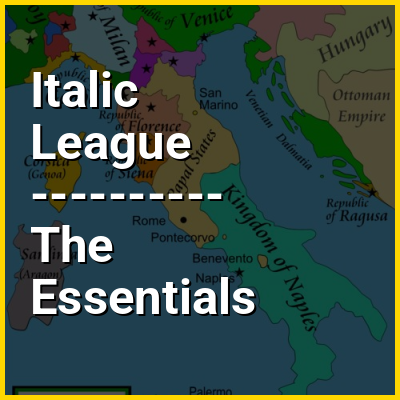
The Italic League or Most Holy League was an international agreement concluded in Venice on 30 August 1454, between the Papal States, the Republic of Venice, the Duchy of Milan, the Republic of Florence, and the Kingdom of Naples, following the Treaty of Lodi a few months previously. The next forty years were marked by peace and economic expansion based on a balance of power within Italy. The decline of the League brought about the Italian Wars.
HINT:
In this Dossier
- ⭐ Core Definition: Italic League
- Italic League in the context of Italian Wars
- Italic League in the context of Lorenzo de' Medici
- Italic League in the context of Habsburg–Valois wars
Italic League in the context of Italian Wars
The Italian Wars were a series of conflicts fought between 1494 and 1559, mostly in the Italian Peninsula, later expanding into Flanders, the Rhineland and Mediterranean Sea. The primary belligerents were the Valois kings of France, on one side, and their Habsburg opponents in the Holy Roman Empire and Spain on the other. Numerous Italian states participated at different stages, some on both sides, with limited involvement from England, and the Ottoman Empire.
The 1454 Italic League achieved a balance of power in Italy, but disintegrated after the death of its chief architect, Lorenzo de' Medici, in 1492. Combined with the ambition of Ludovico Sforza, its collapse allowed Charles VIII of France to invade Naples in 1494, which drew in Spain and the Holy Roman Empire. Although Charles was forced to withdraw in 1495, ongoing political divisions among the Italian states made them a battleground in the struggle for European domination between France and the Habsburgs.
View the full Wikipedia page for Italian WarsItalic League in the context of Lorenzo de' Medici
Lorenzo di Piero de' Medici (Italian: [loˈrɛntso de ˈmɛːditʃi]), known as Lorenzo the Magnificent (Italian: Lorenzo il Magnifico; 1 January 1449 – 8 April 1492), was an Italian statesman, the de facto ruler of the Florentine Republic, and the most powerful patron of Renaissance culture in Italy. Lorenzo held the balance of power within the Italic League, an alliance of states that stabilized political conditions on the Italian Peninsula for decades, and his life coincided with the mature phase of the Italian Renaissance and the golden age of Florence. As a patron, he is best known for his sponsorship of artists such as Botticelli and Michelangelo. On the foreign policy front, Lorenzo manifested a clear plan to stem the territorial ambitions of Pope Sixtus IV, in the name of the balance of the Italic League of 1454. For these reasons, Lorenzo was the subject of the Pazzi conspiracy (1478), in which his brother Giuliano was assassinated. The Peace of Lodi of 1454 that he supported among the various Italian states collapsed with his death. He is buried in the Medici Chapel in Florence.
View the full Wikipedia page for Lorenzo de' MediciItalic League in the context of Habsburg–Valois wars
The Italian Wars were a series of conflicts fought between 1494 and 1559 in the Italian Peninsula, with subsidiary theatres in Flanders, the Rhineland and Mediterranean Sea. A product of the long-running French–Habsburg rivalry, its primary belligerents were France versus the Holy Roman Empire and Spain, supported by numerous Italian states at different stages, along with England, and the Ottoman Empire.
The collapse of the Italic League in 1492 allowed Charles VIII of France to invade Naples in 1494, which drew in Spain and the Holy Roman Empire. Although he was forced to withdraw in 1495, ongoing political divisions among the Italian states made them a battleground in the struggle for European domination between France and the Habsburgs.
View the full Wikipedia page for Habsburg–Valois wars