Iona in the context of "Kenneth MacAlpin"

Play Trivia Questions online!

or

Skip to study material about Iona in the context of "Kenneth MacAlpin"


⭐ Core Definition: Iona

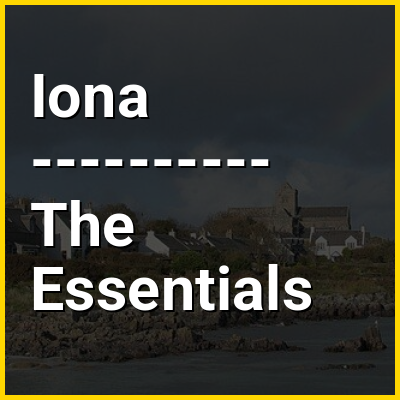
Iona (/ˈnə/; Scottish Gaelic: Ì Chaluim Chille [ˈiː ˈxal̪ˠɪm ˈçiʎə] , sometimes simply Ì) is an island in the Inner Hebrides, off the Ross of Mull on the western coast of Scotland. It is mainly known for Iona Abbey, though there are other buildings on the island. Iona Abbey was a centre of Gaelic monasticism for three centuries and is today known for its relative tranquility and natural environment. It is a tourist destination and a place for spiritual retreats. Its modern Scottish Gaelic name means "Iona of (Saint) Columba" (formerly anglicised as "Icolmkill").

Iona's resident population is about 180. In March 1980, the Hugh Fraser Foundation donated much of the main island (and its off-lying islands) to the current owner, the National Trust for Scotland. The abbey and some church buildings are owned by the Iona Cathedral Trust.
↓ Menu

👉 Iona in the context of Kenneth MacAlpin

Kenneth MacAlpin (Medieval Gaelic: Cináed mac Ailpin; Scottish Gaelic: Coinneach mac Ailpein; 810 – 13 February 858) or Kenneth I was King of Dál Riada (841–850), and King of the Picts (848–858), of likely Gaelic origin. According to the traditional account, he inherited the throne of Dál Riada from his father Alpín mac Echdach, founder of the Alpínid dynasty. Kenneth I conquered the kingdom of the Picts in 843–850 and began a campaign to seize all of Scotland and assimilate the Picts, for which he was posthumously nicknamed An Ferbasach ("The Conqueror"). He fought the Britons of the Kingdom of Strathclyde and the invading Vikings from Scandinavia. Forteviot became the capital of his kingdom and Kenneth relocated relics, including the Stone of Scone from the abandoned abbey on Iona, to his new domain.

Kenneth I is traditionally considered the founder of Scotland, which was then known as Alba in Gaelic, although like his immediate successors, he bore the title of King of the Picts. It was Donald II that first bore the title of King of Alba as recorded by the Annals of Ulster and the Chronicon Scotorum. One chronicle calls Kenneth the first Scottish lawgiver but there is no information about the laws he passed.

↓ Explore More Topics
In this Dossier

Iona in the context of Christianity in Anglo-Saxon England

In the seventh century the pagan Anglo-Saxons were converted to Christianity (Old English: Crīstendōm) mainly by missionaries sent from Rome. Irish missionaries from Iona, who were proponents of Celtic Christianity, were influential in the conversion of Northumbria, but after the Synod of Whitby in 664, the Anglo-Saxon church gave its allegiance to the Pope.

↑ Return to Menu

Iona in the context of Columba

Columba (/kəˈlʌmbəˌ ˈkɒlʌmbə/) or Colmcille (7 December 521 – 9 June 597 AD) was an Irish abbot and missionary evangelist credited with spreading Christianity in what is today Scotland at the start of the Hiberno-Scottish mission. He founded the important abbey on Iona, which became a dominant religious and political institution in the region for centuries. He is the patron saint of Derry. He was highly regarded by both the Gaels of Dál Riata and the Picts, and is remembered today as a Catholic saint and one of the Twelve Apostles of Ireland.

Columba studied under some of Ireland's most prominent church figures and founded several monasteries in the country. Around 563 AD he and his twelve companions crossed to Dunaverty near Southend, Argyll, in Kintyre before settling in Iona in Scotland, then part of the Ulster kingdom of Dál Riata, where they founded a new abbey as a base for spreading Christianity among the pagan Northern Pictish kingdoms. He remained active in Irish politics, though he spent most of the remainder of his life in Scotland. Three surviving early-medieval Latin hymns are attributed to him.

↑ Return to Menu

Iona in the context of Synod of Whitby

The Synod of Whitby was a Christian administrative gathering held in Northumbria in 664, wherein King Oswiu ruled that his kingdom would calculate Easter and observe the monastic tonsure according to the customs of Rome rather than the customs practised by Irish monks at Iona and its satellite institutions. The synod was summoned at Hilda's double monastery of Streonshalh (Streanæshalch), later called Whitby Abbey, in modern day Yorkshire.

↑ Return to Menu

Iona in the context of Adomnán

Adomnán or Adamnán of Iona (Old Irish: [ˈaðəβ̃ˌnaːn]; Latin: Adamnanus, Adomnanus; c. 624 – 704), also known as Eunan (/ˈjnən/ YOO-nən; from Naomh Adhamhnán), was an abbot of Iona Abbey (r. 679–704), hagiographer, statesman, canon jurist, and saint. He was the author of the Life of Columba (Latin: Vita Columbae), probably written between 697 and 700. This biography is by far the most important surviving work written in early-medieval Scotland, and is a vital source for our knowledge of the Picts, and an insight into the life of Iona and the early-medieval Gaelic monk.

Adomnán promulgated the Law of Adomnán or "Law of Innocents" (Latin: Lex Innocentium). He also wrote the treatise De Locis Sanctis ('On Holy Places'), an account of the great Christian holy places and centres of pilgrimage. Adomnán got much of his information from a Frankish bishop called Arculf, who had personally visited Egypt, Rome, Constantinople and the Holy Land, and visited Iona afterwards.

↑ Return to Menu

Iona in the context of A Journey to the Western Islands of Scotland

A Journey to the Western Islands of Scotland (1775) is a travel narrative by Samuel Johnson about an eighty-three-day journey through Scotland, in particular the islands of the Hebrides, in the late summer and autumn of 1773. The sixty-three-year-old Johnson was accompanied by his thirty-two-year-old friend of many years James Boswell, who was also keeping a record of the trip, published in 1785 as A Journal of a Tour to the Hebrides. The two narratives are often published as a single volume, which is beneficial for comparing two perspectives of the same events, although they are very different in approach---Johnson focused on Scotland, and Boswell focused on Johnson. (Boswell went on to write a famous biography of Johnson.) In that biography, Boswell gave the itinerary of the trip as beginning at Edinburgh after landing at Berwick upon Tweed, then to St Andrews, Aberdeen, Inverness, and Fort Augustus. From there they went on to the islands of the Hebrides: Skye, Raasay, Coll, Mull, Inch Kenneth, and Iona. Returning to the mainland in Argyll they visited Inverary, Loch Lomond, Dumbarton, Glasgow, Loudoun, Auchinleck in Ayrshire (Boswell's family home), and Hamilton, and then finished the journey by returning to Edinburgh. Boswell summarised the trip as, "[Johnson] thus saw the four Universities of Scotland, its three principal cities, and as much of the Highland and insular life as was sufficient for his philosophical contemplation."

↑ Return to Menu

Iona in the context of Iona Abbey

Iona Abbey is an abbey located on the island of Iona, just off the Isle of Mull on the West Coast of Scotland.

It is one of the oldest Christian religious centres in Western Europe. The abbey was a focal point for the spread of Christianity throughout Scotland and marks the foundation of a monastic community by St. Columba, when Iona was part of the Kingdom of Dál Riata. Saint Aidan served as a monk at Iona, before helping to reestablish Christianity in Northumberland, on the island of Lindisfarne.

↑ Return to Menu

Iona in the context of Loarn mac Eirc

Loarn mac Eirc was a possible king of Dál Riata who may have lived in the 5th century. He was buried on Iona. Loarn's main significance is as the eponymous ancestor of Cenél Loairn, a kindred whose name is preserved in Lorne.

The Duan Albanach and the Senchus Fer n-Alban and other genealogies name Loarn's father as Erc son of Eochaid Muinremuir. Loarn appears in Irish traditions as 'King of Alba' in the eighth- to twelfth-century tale "Of The Miracles of Cairnech Here" in the Lebhor Bretnach, the Irish version of the Historia Brittonum, and in the tenth- to twelfth-century tale Aided Muirchertach mac Erca. In these tales, mac Erca spends time with Loarn, his grandfather, before murdering him by setting him aflame.

↑ Return to Menu