Inverse function in the context of Bijective function


Inverse function in the context of Bijective function

Inverse function Study page number 1 of 2

Play TriviaQuestions Online!

or

Skip to study material about Inverse function in the context of "Bijective function"


⭐ Core Definition: Inverse function

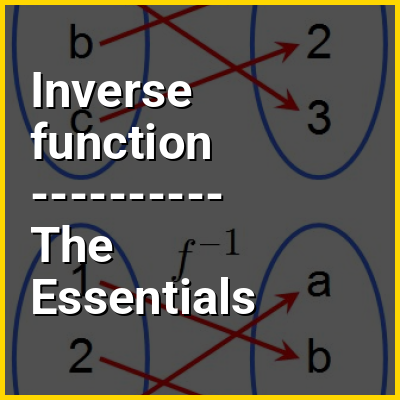
In mathematics, the inverse function of a function f (also called the inverse of f) is a function that undoes the operation of f. The inverse of f exists if and only if f is bijective, and if it exists, is denoted by

For a function , its inverse admits an explicit description: it sends each element to the unique element such that f(x) = y.

↓ Menu
HINT:

In this Dossier

Inverse function in the context of Integral

In mathematics, an integral is the continuous analog of a sum, and is used to calculate areas, volumes, and their generalizations. Integration, the process of computing an integral, is one of the two fundamental operations of calculus, the other being differentiation. Integration was initially used to solve problems in mathematics and physics, such as finding the area under a curve, or determining displacement from velocity. Usage of integration expanded to a wide variety of scientific fields thereafter.

A definite integral computes the signed area of the region in the plane that is bounded by the graph of a given function between two points in the real line. Conventionally, areas above the horizontal axis of the plane are positive while areas below are negative. Integrals also refer to the concept of an antiderivative, a function whose derivative is the given function; in this case, they are also called indefinite integrals. The fundamental theorem of calculus relates definite integration to differentiation and provides a method to compute the definite integral of a function when its antiderivative is known; differentiation and integration are inverse operations.

View the full Wikipedia page for Integral
↑ Return to Menu

Inverse function in the context of Quantile

In statistics and probability, quantiles are cut points dividing the range of a probability distribution into continuous intervals with equal probabilities or dividing the observations in a sample in the same way. There is one fewer quantile than the number of groups created. Common quantiles have special names, such as quartiles (four groups), deciles (ten groups), and percentiles (100 groups). The groups created are termed halves, thirds, quarters, etc., though sometimes the terms for the quantile are used for the groups created, rather than for the cut points.

q-quantiles are values that partition a finite set of values into q subsets of (nearly) equal sizes. There are q − 1 partitions of the q-quantiles, one for each integer k satisfying 0 < k < q. In some cases the value of a quantile may not be uniquely determined, as can be the case for the median (2-quantile) of a uniform probability distribution on a set of even size. Quantiles can also be applied to continuous distributions, providing a way to generalize rank statistics to continuous variables (see percentile rank). When the cumulative distribution function of a random variable is known, the q-quantiles are the application of the quantile function (the inverse function of the cumulative distribution function) to the values {1/q, 2/q, …, (q − 1)/q}.

View the full Wikipedia page for Quantile
↑ Return to Menu

Inverse function in the context of Exponential growth

Exponential growth occurs when a quantity grows as an exponential function of time. The quantity grows at a rate directly proportional to its present size. For example, when it is 3 times as big as it is now, it will be growing 3 times as fast as it is now.

In more technical language, its instantaneous rate of change (that is, the derivative) of a quantity with respect to an independent variable is proportional to the quantity itself. Often the independent variable is time. Described as a function, a quantity undergoing exponential growth is an exponential function of time, that is, the variable representing time is the exponent (in contrast to other types of growth, such as quadratic growth). Exponential growth is the inverse of logarithmic growth.

View the full Wikipedia page for Exponential growth
↑ Return to Menu

Inverse function in the context of Exponential function

In mathematics, the exponential function is the unique real function which maps zero to one and has a derivative everywhere equal to its value. The exponential of a variable is denoted or , with the two notations used interchangeably. It is called exponential because its argument can be seen as an exponent to which a constant number e ≈ 2.718, the base, is raised. There are several other definitions of the exponential function, which are all equivalent although being of very different nature.

The exponential function converts sums to products: it maps the additive identity 0 to the multiplicative identity 1, and the exponential of a sum is equal to the product of separate exponentials, . Its inverse function, the natural logarithm, or , converts products to sums: .

View the full Wikipedia page for Exponential function
↑ Return to Menu

Inverse function in the context of Algebraic curve

In mathematics, an affine algebraic plane curve is the zero set of a polynomial in two variables. A projective algebraic plane curve is the zero set in a projective plane of a homogeneous polynomial in three variables. An affine algebraic plane curve can be completed in a projective algebraic plane curve by homogenizing its defining polynomial. Conversely, a projective algebraic plane curve of homogeneous equation h(x, y, t) = 0 can be restricted to the affine algebraic plane curve of equation h(x, y, 1) = 0. These two operations are each inverse to the other; therefore, the phrase algebraic plane curve is often used without specifying explicitly whether it is the affine or the projective case that is considered.

If the defining polynomial of a plane algebraic curve is irreducible, then one has an irreducible plane algebraic curve. Otherwise, the algebraic curve is the union of one or several irreducible curves, called its components, that are defined by the irreducible factors.

View the full Wikipedia page for Algebraic curve
↑ Return to Menu

Inverse function in the context of Geometric transformation

In mathematics, a geometric transformation is any bijection of a set to itself (or to another such set) with some salient geometrical underpinning, such as preserving distances, angles, or ratios (scale). More specifically, it is a function whose domain and range are sets of points – most often a real coordinate space, or – such that the function is bijective so that its inverse exists. The study of geometry may be approached by the study of these transformations, such as in transformation geometry.

View the full Wikipedia page for Geometric transformation
↑ Return to Menu

Inverse function in the context of Isomorphic

In mathematics, an isomorphism is a structure-preserving mapping or morphism between two structures of the same type that can be reversed by an inverse mapping. Two mathematical structures are isomorphic if an isomorphism exists between them, and this is often denoted as . The word is derived from Ancient Greek ἴσος (isos) 'equal' and μορφή (morphe) 'form, shape'.

The interest in isomorphisms lies in the fact that two isomorphic objects have the same properties (excluding further information such as additional structure or names of objects). Thus isomorphic structures cannot be distinguished from the point of view of structure only, and may often be identified. In mathematical jargon, one says that two objects are the same up to an isomorphism. A common example where isomorphic structures cannot be identified is when the structures are substructures of a larger one. For example, all subspaces of dimension one of a vector space are isomorphic and cannot be identified.

View the full Wikipedia page for Isomorphic
↑ Return to Menu

Inverse function in the context of Data transformation (statistics)

In statistics, data transformation is the application of a deterministic mathematical function to each point in a data set—that is, each data point zi is replaced with the transformed value yi = f(zi), where f is a function. Transforms are usually applied so that the data appear to more closely meet the assumptions of a statistical inference procedure that is to be applied, or to improve the interpretability or appearance of graphs.

Nearly always, the function that is used to transform the data is invertible, and generally is continuous. The transformation is usually applied to a collection of comparable measurements. For example, if we are working with data on peoples' incomes in some currency unit, it would be common to transform each person's income value by the logarithm function.

View the full Wikipedia page for Data transformation (statistics)
↑ Return to Menu

Inverse function in the context of Bijection

In mathematics, a bijection, bijective function, or one-to-one correspondence is a function between two sets such that each element of the second set (the codomain) is the image of exactly one element of the first set (the domain). Equivalently, a bijection is a relation between two sets such that each element of either set is paired with exactly one element of the other set.

A function is bijective if it is invertible; that is, a function is bijective if and only if there is a function the inverse of f, such that each of the two ways for composing the two functions produces an identity function: for each in and for each in

View the full Wikipedia page for Bijection
↑ Return to Menu

Inverse function in the context of Logarithm

In mathematics, the logarithm of a number is the exponent by which another fixed value, the base, must be raised to produce that number. For example, the logarithm of 1000 to base 10 is 3, because 1000 is 10 to the 3rd power: 1000 = 10 = 10 × 10 × 10. More generally, if x = b, then y is the logarithm of x to base b, written logb x, so log10 1000 = 3. As a single-variable function, the logarithm to base b is the inverse of exponentiation with base b.

The logarithm base 10 is called the decimal or common logarithm and is commonly used in science and engineering. The natural logarithm has the number e ≈ 2.718 as its base; its use is widespread in mathematics and physics because of its very simple derivative. The binary logarithm uses base 2 and is widely used in computer science, information theory, music theory, and photography. When the base is unambiguous from the context or irrelevant it is often omitted, and the logarithm is written log x.

View the full Wikipedia page for Logarithm
↑ Return to Menu

Inverse function in the context of Nth root

In mathematics, an nth root of a number x is a number r which, when raised to the power of n, yields x: The positive integer n is called the index or degree, and the number x of which the root is taken is the radicand. A root of degree 2 is called a square root and a root of degree 3, a cube root. Roots of higher degree are referred by using ordinal numbers, as in fourth root, twentieth root, etc. The computation of an nth root is a root extraction.

The nth root of x is written as using the radical symbol . The square root is usually written as , with the degree omitted. Taking the nth root of a number, for fixed , is the inverse of raising a number to the nth power, and can be written as a fractional exponent:

View the full Wikipedia page for Nth root
↑ Return to Menu

Inverse function in the context of Three-dimensional rotation

In mechanics and geometry, the 3D rotation group, often denoted SO(3), is the group of all rotations about the origin of three-dimensional Euclidean space under the operation of composition.

By definition, a rotation about the origin is a transformation that preserves the origin, Euclidean distance (so it is an isometry), and orientation (i.e., handedness of space). Composing two rotations results in another rotation, every rotation has a unique inverse rotation, and the identity map satisfies the definition of a rotation. Owing to the above properties (along composite rotations' associative property), the set of all rotations is a group under composition.

View the full Wikipedia page for Three-dimensional rotation
↑ Return to Menu

Inverse function in the context of Homeomorphism

In mathematics and more specifically in topology, a homeomorphism (from Greek roots meaning "similar shape", named by Henri Poincaré), also called topological isomorphism, or bicontinuous function, is a bijective and continuous function between topological spaces that has a continuous inverse function. Homeomorphisms are the isomorphisms in the category of topological spaces—that is, they are the mappings that preserve all the topological properties of a given space. Two spaces with a homeomorphism between them are called homeomorphic, and from a topological viewpoint they are the same.

Very roughly speaking, a topological space is a geometric object, and a homeomorphism results from a continuous deformation of the object into a new shape. Thus, a square and a circle are homeomorphic to each other, but a sphere and a torus are not. However, this description can be misleading. Some continuous deformations do not produce homeomorphisms, such as the deformation of a line into a point. Some homeomorphisms do not result from continuous deformations, such as the homeomorphism between a trefoil knot and a circle. Homotopy and isotopy are precise definitions for the informal concept of continuous deformation.

View the full Wikipedia page for Homeomorphism
↑ Return to Menu

Inverse function in the context of Quantile function

In probability and statistics, a probability distribution's quantile function is the inverse of its cumulative distribution function. That is, the quantile function of a distribution is the function such that for any random variable and probability .

The quantile function is also called the percentile function (after the percentile), percent-point function, inverse cumulative distribution function or inverse distribution function.

View the full Wikipedia page for Quantile function
↑ Return to Menu