Real coordinate space in the context of "Geometric transformation"

Play Trivia Questions online!

or

Skip to study material about Real coordinate space in the context of "Geometric transformation"

Ad spacer

⭐ Core Definition: Real coordinate space

In mathematics, the real coordinate space or real coordinate n-space, of dimension n, denoted R or , is the set of all ordered n-tuples of real numbers, that is the set of all sequences of n real numbers, also known as coordinate vectors.Special cases are called the real line R, the real coordinate plane R, and the real coordinate three-dimensional space R.With component-wise addition and scalar multiplication, it is a real vector space.

The coordinates over any basis of the elements of a real vector space form a real coordinate space of the same dimension as that of the vector space. Similarly, the Cartesian coordinates of the points of a Euclidean space of dimension n, E (Euclidean line, E; Euclidean plane, E; Euclidean three-dimensional space, E) form a real coordinate space of dimension n.

↓ Menu

>>>PUT SHARE BUTTONS HERE<<<

👉 Real coordinate space in the context of Geometric transformation

In mathematics, a geometric transformation is any bijection of a set to itself (or to another such set) with some salient geometrical underpinning, such as preserving distances, angles, or ratios (scale). More specifically, it is a function whose domain and range are sets of points – most often a real coordinate space, or – such that the function is bijective so that its inverse exists. The study of geometry may be approached by the study of these transformations, such as in transformation geometry.

↓ Explore More Topics
In this Dossier

Real coordinate space in the context of Domain (mathematical analysis)

In mathematical analysis, a domain or region is a non-empty, connected, and open set in a topological space. In particular, it is any non-empty connected open subset of the real coordinate space R or the complex coordinate space C. A connected open subset of coordinate space is frequently used for the domain of a function.

The basic idea of a connected subset of a space dates from the 19th century, but precise definitions vary slightly from generation to generation, author to author, and edition to edition, as concepts developed and terms were translated between German, French, and English works. In English, some authors use the term domain, some use the term region, some use both terms interchangeably, and some define the two terms slightly differently; some avoid ambiguity by sticking with a phrase such as non-empty connected open subset.

↑ Return to Menu

Real coordinate space in the context of Complex coordinate space

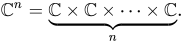
In mathematics, the n-dimensional complex coordinate space (or complex n-space) is the set of all ordered n-tuples of complex numbers, also known as complex vectors. The space is denoted , and is the n-fold Cartesian product of the complex line with itself. Symbolically,orThe variables are the (complex) coordinates on the complex n-space. The special case , called the complex coordinate plane, is not to be confused with the complex plane, a graphical representation of the complex line.

Complex coordinate space is a vector space over the complex numbers, with componentwise addition and scalar multiplication. The real and imaginary parts of the coordinates set up a bijection of with the 2n-dimensional real coordinate space, . With the standard Euclidean topology, is a topological vector space over the complex numbers.

↑ Return to Menu

Real coordinate space in the context of Random field

In physics and mathematics, a random field is a random function over an arbitrary domain (usually a multi-dimensional space such as ). That is, it is a function that takes on a random value at each point (or some other domain). It is also sometimes thought of as a synonym for a stochastic process with some restriction on its index set. That is, by modern definitions, a random field is a generalization of a stochastic process where the underlying parameter need no longer be real or integer valued "time" but can instead take values that are multidimensional vectors or points on some manifold.

↑ Return to Menu

Real coordinate space in the context of Lattice (group)

In geometry and group theory, a lattice in the real coordinate space is an infinite set of points in this space with these properties:

  • Coordinate-wise addition or subtraction of two points in the lattice produces another lattice point.
  • The lattice points are all separated by some minimum distance.
  • Every point in the space is within some maximum distance of a lattice point.

One of the simplest examples of a lattice is the square lattice, which consists of all points in the plane whose coordinates are both integers, and its higher-dimensional analogues the integer lattices .

↑ Return to Menu

Real coordinate space in the context of Kelvin–Stokes theorem

Stokes' theorem, also known as the Kelvin–Stokes theorem after Lord Kelvin and George Stokes, the fundamental theorem for curls, or simply the curl theorem, is a theorem in vector calculus on three-dimensional Euclidean space and real coordinate space, . Given a vector field, the theorem relates the integral of the curl of the vector field over some surface, to the line integral of the vector field around the boundary of the surface. The classical theorem of Stokes can be stated in one sentence:

Stokes' theorem is a special case of the generalized Stokes theorem. In particular, a vector field on can be considered as a 1-form in which case its curl is its exterior derivative, a 2-form.

↑ Return to Menu