Horemheb in the context of "KV57"

Play Trivia Questions online!

or

Skip to study material about Horemheb in the context of "KV57"

Ad spacer

⭐ Core Definition: Horemheb

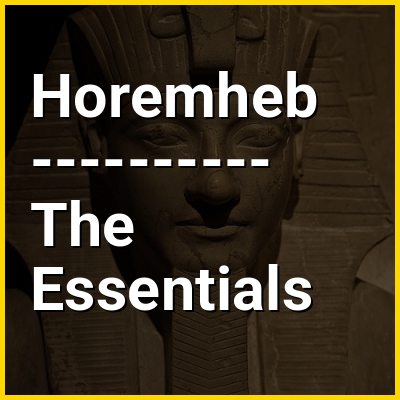
Horemheb, also spelled Horemhab, Haremheb or Haremhab (Ancient Egyptian: ḥr-m-ḥb, meaning "Horus is in Jubilation"), was the last pharaoh of the 18th Dynasty of Egypt (1550–1292 BC). He ruled for at least 14 years between 1319 BC and 1292 BC. He had no relation to the preceding royal family other than by marriage to Mutnedjmet, who is thought (though disputed) to have been the daughter of his predecessor, Ay; he is believed to have been of common birth.

Before he became pharaoh Horemheb was the commander-in-chief of the army under the reigns of Tutankhamun and Ay. After his accession to the throne, he reformed the Egyptian state and it was during his reign that official action against the preceding Amarna rulers began, which is why he is considered the ruler who restabilized his country after the troublesome and divisive Amarna Period.
↓ Menu

>>>PUT SHARE BUTTONS HERE<<<

👉 Horemheb in the context of KV57

Tomb KV57 is the royal tomb of Horemheb, the last pharaoh of the Eighteenth Dynasty and is located in the Valley of the Kings, Egypt.

The tomb was located by Edward Ayrton in February 1908 for Theodore Davis. Due to its location in the valley floor, the tomb was filled with debris that had washed down during occasional flash-flooding. The tomb is markedly different from previous Eighteenth Dynasty royal tombs as it has a straightened axis, and has painted reliefs instead of murals; the Book of Gates also appears for the first time. The king's red granite sarcophagus was found with its lid broken, though otherwise intact. The tomb contained the remains of several burials, none of them conclusively belonging to Horemheb.

↓ Explore More Topics
In this Dossier

Horemheb in the context of Nineteenth Dynasty of Egypt

The Nineteenth Dynasty of Egypt (notated Dynasty XIX), also known as the Ramessid dynasty, is classified as the second Dynasty of the Ancient Egyptian New Kingdom period, lasting from 1292 BC to 1189 BC. The 19th Dynasty and the 20th Dynasty furthermore together constitute an era known as the Ramesside period. This Dynasty was founded by Vizier Ramesses I, whom Pharaoh Horemheb chose as his successor to the throne.

↑ Return to Menu

Horemheb in the context of Ramesses I

Menpehtyre Ramesses I (or Ramses) was the founding pharaoh of ancient Egypt's 19th Dynasty. The dates for his short reign are not completely known but the timeline of late 1292–1290 BC is frequently cited as well as 1295–1294 BC. While Ramesses I was the founder of the 19th Dynasty, his brief reign mainly serves to mark the transition between the reign of Horemheb, who had stabilized Egypt in the late 18th Dynasty, and the rule of the powerful pharaohs of his own dynasty, in particular his son Seti I, and grandson Ramesses II.

↑ Return to Menu

Horemheb in the context of Amarna Period

The Amarna Period was an era of Egyptian history during the later half of the Eighteenth Dynasty when the royal residence of the pharaoh and his queen shifted from the old capital of Thebes (Waset) to Akhetaten (literally "Horizon of the Aten") in what is now modern Amarna. This move occurred during the reign of Amenhotep IV, who changed his name to Akhenaten (1353–1336 BC) in order to reflect the dramatic change of Egypt's polytheistic religion into one where the sun disc Aten was worshipped over all other gods. Toward the end of Akhenaten's reign, he had a mysterious co-regent, Smenkhkare, about which very little is known; similarly, Neferneferuaten, a female ruler (perhaps the wife of Smenkhkare, or even Nefertiti herself?) also exercised influence.

Akhenaten, Smenkhkare, and Neferneferuaten were succeeded by Akhenaten's son Tutankhamun, only around nine years old. The Egyptian pantheon was swiftly restored under his reign. Due to his youth, his viziers and advisors appear to have done most of the job of governance. Much of the government moved to Memphis, Egypt during Tutankhamun's reign, reducing Akhetaten's importance. Both of Tutankhamun's daughters predeceased him, and he died without an heir; he was succeeded as Pharoh by Ay. Ay's short reign of three years was followed by Horemheb, who ordered the city of Akhetaten torn down. Horemheb excised as much of the Amarna Period as he could from official histories and monuments, considering it an aberration. According to Horemheb's revised monuments, he directly succeeded Amenhotep III, essentially erasing 30 years of history.

↑ Return to Menu

Horemheb in the context of Maya (Egyptian)

Maya was an important figure during the reign of Pharaohs Tutankhamun, Ay and Horemheb of the Eighteenth Dynasty of Ancient Egypt. Maya's titles include: Fan-bearer on the Right Side of the King, Overseer of the treasuries, chief of the works in the necropolis, and leader of the festival of Amun in Karnak.

↑ Return to Menu

Horemheb in the context of Ay (pharaoh)

Ay was the penultimate pharaoh of ancient Egypt's 18th Dynasty. He held the throne of Egypt for a brief four-year period in the late 14th century BC. Prior to his rule, he was a close advisor to two, and perhaps three, other pharaohs of the dynasty. It is speculated that he was the power behind the throne during child ruler Tutankhamun's reign, although there is no evidence for this aside from Tutankhamun's youthfulness. His prenomen Kheperkheperure means "Everlasting are the Manifestations of Ra", while his nomen Ay it-netjer reads as "Ay, Father of the God". Records and monuments that can be clearly attributed to Ay are rare, both because his reign was short and because his successor, Horemheb, instigated a campaign of damnatio memoriae against him and the other pharaohs associated with the unpopular Amarna Period.

↑ Return to Menu

Horemheb in the context of Nefertiti y Aquenatos

Nefertiti y Aquenatos (English: Nefertiti and Akhenaten) is a 1973 Mexican television short film directed by Raúl Araiza. It stars Geraldine Chaplin as Nefertiti, Salah Zulfikar as Horemheb and John Gavin as Akhenaten. The film was produced by Telesistema Mexicano S.A.

↑ Return to Menu

Horemheb in the context of Mutnedjmet

Mutnedjmet, also spelled Mutnodjmet, Mutnedjemet, etc. (Ancient Egyptian: mw.t-nḏm.t), was an ancient Egyptian queen, the Great Royal Wife of Horemheb, the last ruler of the 18th Dynasty. The name, Mutnedjmet, translates as: "The sweet Mut" or "Mut is sweet." She was the second wife of Horemheb after Amenia who died before Horemheb became pharaoh.

↑ Return to Menu