Hippodrome of Constantinople in the context of "Demarchos"

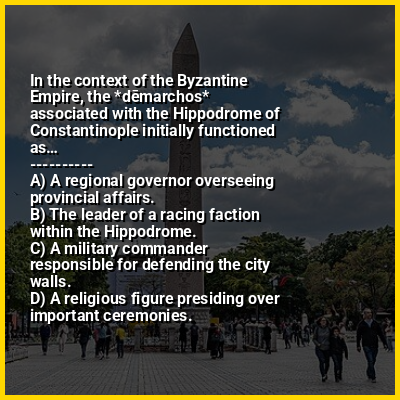
⭐ In the context of the Byzantine Empire, the *dēmarchos* associated with the Hippodrome of Constantinople initially functioned as…

Ad spacer

⭐ Core Definition: Hippodrome of Constantinople

The Hippodrome of Constantinople (Greek: Ἱππόδρομος τῆς Κωνσταντινουπόλεως, romanizedHippódromos tēs Kōnstantinoupóleōs; Latin: Circus Maximus Constantinopolitanus; Turkish: Hipodrom) was a circus that was the sporting and social centre of Constantinople, capital of the Byzantine Empire. Today it is a square in Istanbul, Turkey, known as Sultanahmet Square (Turkish: Sultanahmet Meydanı).

The word hippodrome comes from the Greek hippos (ἵππος), horse, and dromos (δρόμος), path or way. For this reason, it is sometimes also called Atmeydanı ("Horse Square") in Turkish. Horse racing and chariot racing were popular pastimes in the ancient world and hippodromes were common features of Greek cities in the Hellenistic, Roman, and Byzantine eras.

↓ Menu

>>>PUT SHARE BUTTONS HERE<<<

👉 Hippodrome of Constantinople in the context of Demarchos

The dēmarchos (Greek: δήμαρχος, lit.'archon of the deme'; plural δήμαρχοι, dēmarchoi), anglicized as Demarch, is a title historically given to officials related to civic administration. In ancient Athens the title was given to the elected chief magistrate of each of the demes of Attica. In later literature, the term was used as a translation of the Roman office of tribunus plebis. In the Byzantine Empire the dēmarchos was the leader of one of the racing factions (then known as "demes") of the Hippodrome of Constantinople. Largely concerned with ceremonial in the early centuries, from the 11th century the title was applied to various administrative positions in Constantinople, until the end of the empire. In modern usage, the term is used for the mayor of a municipality.

↓ Explore More Topics
In this Dossier

Hippodrome of Constantinople in the context of Constantinople

Constantinople (see other names) was a historical city located on the Bosporus that served as the capital of the Roman (including its eastern continuation), Latin, and Ottoman empires between its consecration in 330 and the formal abolishment of the Ottoman sultanate in 1922. Initially, as New Rome, Constantinople was founded in 324 during the reign of Constantine the Great on the site of the existing settlement of Byzantium and in 330 became the capital of the Roman Empire. Following the collapse of the Western Roman Empire in the late 5th century, Constantinople remained the capital of the Eastern Roman Empire (also known as the Byzantine Empire; 330–1204 and 1261–1453), the Latin Empire (1204–1261), and the Ottoman Empire (1453–1922). In the aftermath of the Turkish War of Independence, the Turkish capital moved to Ankara. Although the city had been known as Istanbul since 1453, it was officially renamed Istanbul on 28 March 1930. As of October 2025, it is the most populous city in Europe, with a population of more than 16 million residents, straddling the Bosporus Strait and lying in both Europe and Asia, and is the financial center of Turkey.

In 324, following the reunification of the Eastern and Western Roman Empires, the ancient city of Byzantium was selected to serve as the new capital of the Roman Empire, and the city was renamed Nova Roma, or 'New Rome', by Emperor Constantine the Great. On 11 May 330, it was renamed Constantinople and dedicated to Constantine. Shortly afterward, in 474 AD, the Great Fire of Constantinople erupted and consequently devastated the region. Constantinople is generally considered to be the center and the "cradle of Orthodox Christian civilization." From the mid-5th century to the early 13th century, Constantinople was the largest and wealthiest city in Europe. The city became famous for its architectural masterpieces, such as Hagia Sophia, the cathedral of the Eastern Orthodox Church, which served as the seat of the Ecumenical Patriarchate; the sacred Imperial Palace, where the emperors lived; the Hippodrome; the Golden Gate of the Land Walls; and opulent aristocratic palaces. The University of Constantinople was founded in the 5th century and contained artistic and literary treasures before it was sacked in 1204 and 1453, including its vast Imperial Library. which contained more than 100,000 volumes. The city was the home of the Ecumenical Patriarch of Constantinople and guardian of Christendom's holiest relics, such as the Crown of Thorns and the True Cross.
↑ Return to Menu

Hippodrome of Constantinople in the context of Great Palace of Constantinople

The Great Palace of Constantinople (Greek: Μέγα Παλάτιον, Méga Palátion; Latin: Palatium Magnum), also known as the Sacred Palace (Greek: Ἱερὸν Παλάτιον, Hieròn Palátion; Latin: Sacrum Palatium), was the large imperial Byzantine palace complex located in the south-eastern end of the peninsula today making up the Fatih district of Istanbul (formerly Constantinople), in modern Turkey. It served as the main imperial residence of the Eastern Roman emperors until 1081 and was the centre of imperial administration for over 690 years. Only a few remnants and fragments of its foundations have survived into the present day.

↑ Return to Menu

Hippodrome of Constantinople in the context of Coronation of the Byzantine emperor

The coronation (Greek: στέψιμον, romanizedstépsimon, or στεφάνωσις, stephánosis) was the main symbolic act of accession to the throne of a Byzantine emperor, co-emperor, or empress. Founded on Roman traditions of election by the Senate or acclamation by the army, the ceremony evolved over time from a relatively simple, ad hoc affair to a complex ritual.

In the 5th–6th centuries the coronation became gradually standardized, with the new emperor appearing before the people and army at the Hippodrome of Constantinople, where he was crowned and acclaimed. During the same time, religious elements, notably the presence of the patriarch of Constantinople, became prominent in what was previously a purely military or civilian ceremony. From the early 7th century on, the coronation ceremony usually took place in a church, chiefly the Hagia Sophia, the patriarchal cathedral of Constantinople. The association of the coronation ceremony with Constantinople and the Hagia Sophia became so close that even emperors who had been proclaimed, and crowned, outside the capital as military rebels or usurpers, usually repeated their coronation in the capital once they had won power.

↑ Return to Menu

Hippodrome of Constantinople in the context of Boukoleon Palace

The Palace of Boukoleon (Greek: Βουκολέων) or Bucoleon was one of the Byzantine palaces in Constantinople (present-day Istanbul in Turkey). The palace is located on the shore of the Sea of Marmara, to the south of the Hippodrome and east of the Little Hagia Sophia.

↑ Return to Menu

Hippodrome of Constantinople in the context of Wreaths and crowns in antiquity

In classical and late antiquity wreaths or crowns (Ancient Greek: στέφανος, romanizedstéphanos, lit.'wreath', 'crown'; Latin: corona, lit.'wreath', 'garland', 'chaplet') usually made of vegetation or precious metals were worn on ceremonial occasions and were awarded for various achievements. The symbolism of these different types of wreaths depended on their composition; different crowns were worn and awarded for different purposes. Such wreaths or crowns were represented in classical architecture, in ancient Greek art and sculpture, and in Roman art and sculpture. As well as being awarded for merit and military conduct, they were worn by orators, priests performing sacrifices, by the chorus in ancient Greek drama, and by attendees of a symposium.

From Archaic Greece until late antiquity, wreaths were the prizes competed for at the Panhellenic Games – the Olympic, Pythian, Nemean, and Isthmian Games – the "crown games", each with a different vegetation crown awarded. In the military of ancient Rome, wreaths were among the traditional Roman military decorations; as a result of the revival in ancient artistic and literary models in the Renaissance they are frequently encountered in Western art and heraldry.

↑ Return to Menu

Hippodrome of Constantinople in the context of 700s (decade)

The 700s decade ran from January 1, 700, to December 31, 709.

  • The Wariʼ people invade and occupy the Cuzco Valley (modern Peru) in the southern highlands (approximate date).
  • The Moche culture in the northern part of modern day Peru collapses, largely due to environmental problems and/or political and social unrest (approximate date).
  • July 18 – Emperor Monmu dies after a 10-year reign. He is succeeded by his aunt Genmei, who becomes the 43rd empress of Japan. She is the sister of former empress Jitō, and the niece and wife of late emperor Tenmu.
↑ Return to Menu