Herodian tetrarchy in the context of "Roman Syria"

Play Trivia Questions online!

or

Skip to study material about Herodian tetrarchy in the context of "Roman Syria"

Ad spacer

⭐ Core Definition: Herodian tetrarchy

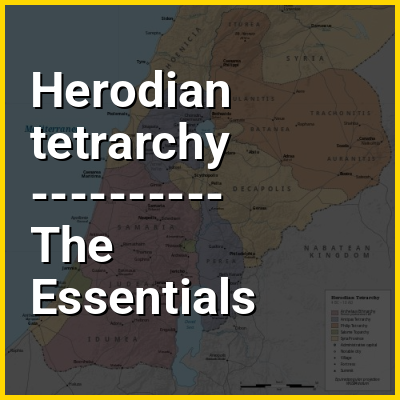
The Herodian tetrarchy was a regional division of a client state of Rome, formed following the death of Herod the Great in 4 BCE. The client kingdom was divided between Herod's sister Salome I and his sons Herod Archelaus, Herod Antipas, and Philip. Upon the deposition of Herod Archelaus in 6 CE, his territories were transformed into a Roman province. With the death of Salome I in 10 CE, her domain was also incorporated into a province.

Other parts of the Herodian tetrarchy continued to function under Herodians. Philip ruled over territories north and east of the Jordan River until 34 CE. His domain was later incorporated into the Province of Syria. Herod Antipas ruled Galilee and Perea until 39 CE. The last notable Herodian ruler with some level of independence was King Herod Agrippa I. He was given the territory of Judea with its capital Jerusalem. With his death in 44 CE, the provincial status of Judea was restored for good.
↓ Menu

>>>PUT SHARE BUTTONS HERE<<<
In this Dossier

Herodian tetrarchy in the context of Jewish Christianity

Jewish Christians were the followers of a Jewish religious sect that emerged in Roman Judea during the late Second Temple period, under the Herodian tetrarchy (1st century AD). These Jews believed that Jesus was the prophesied Messiah and they continued their adherence to Jewish law. Jewish Christianity is the historical foundation of Early Christianity, which later developed into Nicene Christianity (which comprises the Roman Catholic, Eastern Orthodox, Oriental Orthodox, and Protestant traditions) and other Christian denominations.

Christianity started with Jewish eschatological expectations, and it developed into the worship of Jesus as the result of his earthly ministry in Galilee and Jerusalem, his crucifixion, and the post-resurrection experiences of his followers. Jewish Christians drifted apart from Second Temple Judaism, and their form of Judaism eventually became a minority strand within mainstream Judaism, as it had almost disappeared by the 5th century AD. Jewish–Christian gospels are lost except for fragments, so there is a considerable amount of uncertainty about the scriptures which were used by this group of Christians.

↑ Return to Menu

Herodian tetrarchy in the context of Historicity of Jesus

The historicity of Jesus is the debate "on the fringes of scholarship" and in popular culture regarding whether Jesus historically existed or was a purely mythological figure. Mainstream New Testament scholarship ignores the non-existence hypothesis and its arguments, as the question of historicity was generally settled in scholarship in the early 20th century, and the general consensus among modern scholars is that a Jewish man named Jesus of Nazareth existed in the Herodian Kingdom of Judea and the subsequent Herodian tetrarchy in the 1st century AD, upon whose life and teachings Christianity was later constructed. However, scholars distinguish between the 'Christ of faith' as presented in the New Testament and the subsequent Christian theology, and a minimal 'Jesus of history', of whom almost nothing can be known.

There is no scholarly consensus concerning the historicity of most elements of Jesus's life as described in the Bible, and only two key events of the biblical story of Jesus's life are widely accepted as historical, based on the criterion of embarrassment, namely his baptism by John the Baptist and his crucifixion by the order of Pontius Pilate. Furthermore, the historicity of supernatural elements like his purported miracles and resurrection are deemed to be solely a matter of 'faith' or of 'theology', or lack thereof.

↑ Return to Menu

Herodian tetrarchy in the context of Herodian dynasty

The Herodian dynasty was a royal dynasty of Idumaean (Edomite) descent, ruling the Herodian Kingdom of Judea and later the Herodian tetrarchy as a vassal state of the Roman Empire. The Herodian dynasty began with Herod the Great who assumed the throne of Judea, with Roman support, bringing down the century-old Hasmonean Kingdom. His kingdom lasted until his death in 4 BC, when it was divided among his sons and sister as a tetrarchy, which lasted for about 10 years. Most of those tetrarchies, including Judea proper, were incorporated into Judaea Province from 6 BC, though limited Herodian de facto kingship continued until Agrippa I's death in 44 AD and nominal title of kingship continued until c. 92 or 100 AD, when the last Herodian monarch, king Agrippa II, died and Rome assumed full power over his de jure domain.

↑ Return to Menu

Herodian tetrarchy in the context of Jewish Christian

Jewish Christians were the followers of a Jewish religious sect that emerged in Roman Judea during the late Second Temple period, under the Herodian tetrarchy (1st century AD). These Jews believed that Jesus was the prophesied Messiah and they continued their adherence to Jewish law. Jewish Christianity is the historical foundation of Early Christianity, which later developed into Nicene Christianity (which comprises the Roman Catholic, Eastern Orthodox, Oriental Orthodox, and Protestant traditions) and other Christian denominations.

Christianity started with Jewish eschatological expectations, and it developed into the worship of Jesus as the result of his earthly ministry in Galilee and Jerusalem, his crucifixion, and the post-crucifixion experiences of his followers. Jewish Christians drifted apart from Second Temple Judaism, and their form of Judaism eventually became a minority strand within mainstream Judaism, as it had almost disappeared by the 5th century AD. Jewish–Christian gospels are lost except for fragments, so there is a considerable amount of uncertainty about the scriptures which were used by this group of Christians.

↑ Return to Menu

Herodian tetrarchy in the context of Herodian Kingdom of Judea

The Herodian kingdom was a client state of the Roman Republic, later Roman Empire, ruled from 37 to 4 BCE by Herod the Great, who was appointed "King of the Jews" by the Roman Senate. When Herod died, the kingdom was divided among his sons into the Herodian tetrarchy.

The Herodian kingdom included the regions of Judea, Samaria, Idumaea, and Galilee, as well as several regions east of the Jordan RiverPerea, Batanaea, Auranitis, and Trachonitis.

↑ Return to Menu

Herodian tetrarchy in the context of Roman administration of Judaea (AD 6–135)

The administration of Judaea as a province of Rome from 6 to 135 was carried out primarily by a series of Roman prefects, procurators, and legates pro praetore. The first of these administrators coincided or were intertwined with the ostensible rule by the Herodian tetrarchy. The Roman administrators were as follows:

"Hadrian stationed an extra legion in Judaea, renaming it Syria Palaestina." This was following the defeat of the Bar Kokhba Revolt in 135. The Syria-based legion, Legio III Gallica, took part in the quelling of the revolt from 132 to 136, and in the aftermath, the emperor Hadrian renamed the province of Judea and its extra legion Syria Palaestina. The province of Syria Palaestina was divided into Palaestina Prima and Palaestina Salutaris in about 357, and by 409 Palaestina Prima had been further split into a smaller Palaestina Prima and Palaestina Secunda, while Salutaris was named Tertia or Salutaris. Palæstina Prima or Palaestina I existed from the late 4th century until it was temporarily lost to the Sassanid Empire (Persian Empire) in 614, but re-conquered in 628 and finally until the Muslim conquest of the Levant in the 630s.

↑ Return to Menu