Grand Unified Theory in the context of "Unified field theory"

Play Trivia Questions online!

or

Skip to study material about Grand Unified Theory in the context of "Unified field theory"

Ad spacer

>>>PUT SHARE BUTTONS HERE<<<

👉 Grand Unified Theory in the context of Unified field theory

In physics, a Unified Field Theory (UFT) is a type of field theory that allows all fundamental forces of nature, including gravity, and all elementary particles to be written in terms of a single physical field. According to quantum field theory, particles are themselves the quanta of fields. Different fields in physics include vector fields such as the electromagnetic field, spinor fields whose quanta are fermionic particles such as electrons, and tensor fields such as the metric tensor field that describes the shape of spacetime and gives rise to gravitation in general relativity. Unified field theories attempt to organize these fields into a single mathematical structure.

For over a century, the unified field theory has remained an open line of research. The term was coined by Albert Einstein, who attempted to unify his general theory of relativity with electromagnetism. Einstein attempted to create a classical unified field theory. Among other difficulties, this required a new explanation of particles as singularities or solitons instead of field quanta. Later attempts to unify general relativity with other forces incorporate quantum mechanics. The concept of a "Theory of Everything" or Grand Unified Theory are closely related to unified field theory. A theory of everything attempts to create a complete picture of all events in nature. Grand Unified Theories do not attempt to include the gravitational force and can therefore operate entirely within quantum field theory. The goal of a unified field theory has led to significant progress in theoretical physics.
↓ Explore More Topics
In this Dossier

Grand Unified Theory in the context of Baryon number

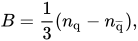
In particle physics, the baryon number (B) is an additive quantum number of a system. It is defined aswhere is the number of quarks, and is the number of antiquarks. Baryons (three quarks) have B = +1, mesons (one quark, one antiquark) have B = 0, and antibaryons (three antiquarks) have B = −1. Exotic hadrons like pentaquarks (four quarks, one antiquark) and tetraquarks (two quarks, two antiquarks) are also classified as baryons and mesons depending on their baryon number. In the Standard Model B conservation is an accidental symmetry which means that it appears in the Standard Model but is often violated when going beyond it. Physics beyond the Standard Model theories that contain baryon number violation are, for example, Standard Model with extra dimensions, Supersymmetry, Grand Unified Theory and String theory.

↑ Return to Menu

Grand Unified Theory in the context of Grand unification epoch

In physical cosmology, the grand unification epoch is a poorly understood period in the evolution of the early universe following the Planck epoch and preceding inflation. This places it between about 10 seconds after the Big Bang and 10 seconds, when the temperature of the universe was comparable to the characteristic temperatures of grand unified theories. However, these theories have not been successful producing quantitative agreement with the results of modern astrophysical observations.

If the grand unification energy is taken to be 10 GeV, this corresponds to temperatures higher than 10 K. During this period, three of the four fundamental interactionselectromagnetism, the strong interaction, and the weak interaction—were unified as the electronuclear force. Gravity had separated from the electronuclear force at the end of the Planck era. During the grand unification epoch, physical characteristics such as mass, charge, flavour and colour charge were meaningless.

↑ Return to Menu

Grand Unified Theory in the context of Georgi–Glashow model

In particle physics, the Georgi–Glashow model is a particular Grand Unified Theory (GUT) proposed by Howard Georgi and Sheldon Glashow in 1974. In this model, the Standard Model gauge groups SU(3) × SU(2) × U(1) are combined into a single simple gauge group SU(5). The unified group SU(5) is then thought to be spontaneously broken into the Standard Model subgroup below a very high energy scale called the grand unification scale.

Since the Georgi–Glashow model combines leptons and quarks into single irreducible representations, there exist interactions which do not conserve baryon number, although they still conserve the quantum number B – L associated with the symmetry of the common representation. This yields a mechanism for proton decay, and the rate of proton decay can be predicted from the dynamics of the model. However, proton decay has not yet been observed experimentally, and the resulting lower limit on the lifetime of the proton contradicts the predictions of this model. Nevertheless, the elegance of the model has led particle physicists to use it as the foundation for more complex models which yield longer proton lifetimes, particularly SO(10) in basic and SUSY variants.

↑ Return to Menu

Grand Unified Theory in the context of Minimal Supersymmetric Standard Model

The Minimal Supersymmetric Standard Model (MSSM) is an extension to the Standard Model that realizes supersymmetry. MSSM is the minimal supersymmetrical model as it considers only "the [minimum] number of new particle states and new interactions consistent with "Reality". Supersymmetry pairs bosons with fermions, so every Standard Model particle has a (yet undiscovered) superpartner. If discovered, such superparticles could be candidates for dark matter, and could provide evidence for grand unification or the viability of string theory. The failure to find evidence for MSSM using the Large Hadron Collider has strengthened an inclination to abandon it.

↑ Return to Menu