Gottlob Frege in the context of Philosophy of mathematics


Gottlob Frege in the context of Philosophy of mathematics

Gottlob Frege Study page number 1 of 2

Play TriviaQuestions Online!

or

Skip to study material about Gottlob Frege in the context of "Philosophy of mathematics"


⭐ Core Definition: Gottlob Frege

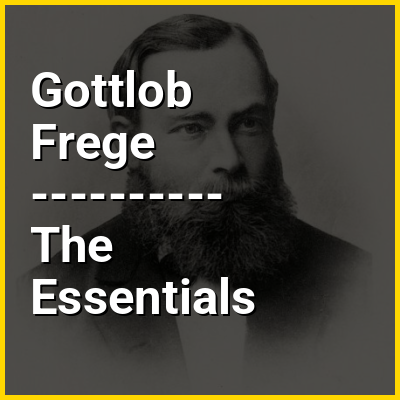
Friedrich Ludwig Gottlob Frege (/ˈfrɡə/; German: [ˈɡɔtloːp ˈfreːɡə]; 8 November 1848 – 26 July 1925) was a German philosopher, logician, and mathematician. He was a mathematics professor at the University of Jena, and is understood by many to be the father of analytic philosophy, concentrating on the philosophy of language, logic, and mathematics. Though he was largely ignored during his lifetime, Giuseppe Peano (1858–1932), Bertrand Russell (1872–1970), and, to some extent, Ludwig Wittgenstein (1889–1951) introduced his work to later generations of philosophers. Frege is widely considered to be one of the greatest logicians since Aristotle, and one of the most profound philosophers of mathematics ever.

His contributions include the development of modern logic in the Begriffsschrift and work in the foundations of mathematics. His book the Foundations of Arithmetic is the seminal text of the logicist project, and is cited by Michael Dummett as where to pinpoint the linguistic turn. His philosophical papers "On Sense and Reference" and "The Thought" are also widely cited. The former argues for two different types of meaning and descriptivism. In Foundations and "The Thought", Frege argues for Platonism against psychologism or formalism, concerning numbers and propositions respectively.
↓ Menu
HINT:

In this Dossier

Gottlob Frege in the context of Bertrand Russell

Bertrand Arthur William Russell, 3rd Earl Russell (18 May 1872 – 2 February 1970), was a British philosopher, logician, mathematician, and public intellectual. He influenced mathematics, logic, set theory, and various areas of analytic philosophy.

He was one of the early 20th century's prominent logicians and a founder of analytic philosophy, along with his predecessor Gottlob Frege, his friend and colleague G. E. Moore, and his student and protégé Ludwig Wittgenstein. Russell with Moore led the British "revolt against idealism". Together with his former teacher Alfred North Whitehead, Russell wrote Principia Mathematica, a milestone in the development of classical logic and a major attempt to reduce the whole of mathematics to logic (see logicism). Russell's article "On Denoting" has been considered a "paradigm of philosophy".

View the full Wikipedia page for Bertrand Russell
↑ Return to Menu

Gottlob Frege in the context of Philosophy of language

Philosophy of language is the philosophical study of the nature of language. It investigates the relationship between language, language users, and the world. Investigations may include inquiry into the nature of meaning, intentionality, reference, the constitution of sentences, concepts, learning, and thought.

Gottlob Frege and Bertrand Russell were pivotal figures in analytic philosophy's "linguistic turn". These writers were followed by Ludwig Wittgenstein (Tractatus Logico-Philosophicus), the Vienna Circle, logical positivists, and Willard Van Orman Quine.

View the full Wikipedia page for Philosophy of language
↑ Return to Menu

Gottlob Frege in the context of Analytic philosophy

Analytic philosophy is a broad movement and methodology within contemporary Western philosophy, especially anglophone philosophy, focused on: analysis as a philosophical method; clarity of prose; rigor in arguments; and making use of formal logic, mathematics, and to a lesser degree the natural sciences. It is further characterized by the linguistic turn, or a concern with language and meaning. Analytic philosophy has developed several new branches of philosophy and logic, notably philosophy of language, philosophy of mathematics, philosophy of science, modern predicate logic and mathematical logic.

The proliferation of analysis in philosophy began around the turn of the 20th century and has been dominant since the latter half of the 20th century. Central figures in its historical development are Gottlob Frege, Bertrand Russell, G. E. Moore, and Ludwig Wittgenstein. Other important figures in its history include Franz Brentano, the logical positivists (especially Rudolf Carnap), the ordinary language philosophers, W. V. O. Quine, and Karl Popper. After the decline of logical positivism, Saul Kripke, David Lewis, and others led a revival in metaphysics.

View the full Wikipedia page for Analytic philosophy
↑ Return to Menu

Gottlob Frege in the context of Declarative sentence

Propositions are the meanings of declarative sentences, objects of beliefs, and bearers of truth values. They explain how different sentences, like the English "Snow is white" and the German "Schnee ist weiß", can have identical meaning by expressing the same proposition. Similarly, they ground the fact that different people can share a belief by being directed at the same content. True propositions describe the world as it is, while false ones fail to do so. Researchers distinguish types of propositions by their informational content and mode of assertion, such as the contrasts between affirmative and negative propositions, between universal and existential propositions, and between categorical and conditional propositions.

Many theories of the nature and roles of propositions have been proposed. Realists argue that propositions form part of reality, a view rejected by anti-realists. Non-reductive realists understand propositions as a unique kind of entity, whereas reductive realists analyze them in terms of other entities. One proposal sees them as sets of possible worlds, reflecting the idea that understanding a proposition involves grasping the circumstances under which it would be true. A different suggestion focuses on the individuals and concepts to which a proposition refers, defining propositions as structured entities composed of these constituents. Other accounts characterize propositions as specific kinds of properties, relations, or states of affairs. Philosophers also debate whether propositions are abstract objects outside space and time, psychological entities dependent on mental activity, or linguistic entities grounded in language. Paradoxes challenge the different theories of propositions, such as the liar's paradox. The study of propositions has its roots in ancient philosophy, with influential contributions from Aristotle and the Stoics, and later from William of Ockham, Gottlob Frege, and Bertrand Russell.

View the full Wikipedia page for Declarative sentence
↑ Return to Menu

Gottlob Frege in the context of Verificationism

Verificationism, also known as the verification principle or the verifiability criterion of meaning, is a doctrine in philosophy and the philosophy of language which holds that a declarative sentence is cognitively meaningful only if it is either analytic or tautological (true or false in virtue of its logical form and definitions) or at least in principle verifiable by experience. On this view, many traditional statements of metaphysics, theology, and some of ethics and aesthetics are said to lack truth value or factual content, even though they may still function as expressions of emotions or attitudes rather than as genuine assertions. Verificationism was typically formulated as an empiricist criterion of cognitive significance: a proposed test for distinguishing meaningful, truth-apt sentences from "nonsense".

As a self-conscious movement, verificationism was a central thesis of logical positivism (or logical empiricism), developed in the 1920s and 1930s by members of the Vienna Circle and their allies in early analytic philosophy. Drawing on earlier empiricism and positivism (especially David Hume, Auguste Comte and Ernst Mach), on pragmatism (notably C. S. Peirce and William James), and on the logical and semantic innovations of Gottlob Frege and the early Wittgenstein, these philosophers sought a "scientific" conception of philosophy in which meaningful discourse would either consist in empirical claims ultimately testable by observation or in analytic truths of logic and mathematics. The verification principle was intended to explain why many traditional metaphysical disputes seemed irresolvable, to demarcate science from pseudo-science and speculative metaphysics, and to vindicate the special status of the natural sciences by taking empirical testability as the paradigm of serious inquiry.

View the full Wikipedia page for Verificationism
↑ Return to Menu

Gottlob Frege in the context of Vienna Circle

The Vienna Circle (German: Wiener Kreis) of logical empiricism was a group of elite philosophers and scientists drawn from the natural and social sciences, logic and mathematics who met regularly from 1924 to 1936 at the University of Vienna, chaired by Moritz Schlick. The Vienna Circle had a profound influence on 20th-century philosophy, especially philosophy of science and analytic philosophy.

The philosophical position of the Vienna Circle was called logical empiricism (German: logischer Empirismus), logical positivism or neopositivism. It was influenced by Ernst Mach, David Hilbert, French conventionalism (Henri Poincaré and Pierre Duhem), Gottlob Frege, Bertrand Russell, Ludwig Wittgenstein and Albert Einstein. The Vienna Circle was pluralistic and committed to the ideals of the Enlightenment. It was unified by the aim of making philosophy scientific with the help of modern logic. Main topics were foundational debates in the natural and social sciences, logic and mathematics; the modernization of empiricism by modern logic; the search for an empiricist criterion of meaning; the critique of metaphysics and the unification of the sciences in the unity of science.

View the full Wikipedia page for Vienna Circle
↑ Return to Menu

Gottlob Frege in the context of Sense and reference

In the philosophy of language, the distinction between sense and reference was an idea of the German philosopher and mathematician Gottlob Frege in 1892 (in his paper "On Sense and Reference"; German: "Über Sinn und Bedeutung"), reflecting the two ways he believed a singular term may have meaning.

The reference (or "referent"; Bedeutung) of a proper name is the object it means or indicates (bedeuten), whereas its sense (Sinn) is what the name expresses. The reference of a sentence is its extension, whereas its sense is the thought that it expresses. Frege justified the distinction in a number of ways.

View the full Wikipedia page for Sense and reference
↑ Return to Menu

Gottlob Frege in the context of Compositionality

In semantics, mathematical logic and related disciplines, the principle of compositionality is the principle that the meaning of a complex expression is determined by the meanings of its constituent expressions and the rules used to combine them. The principle is also called Frege's principle, because Gottlob Frege is widely credited for the first modern formulation of it. However, the principle has never been explicitly stated by Frege, and arguably it was already assumed by George Boole decades before Frege's work.

The principle of compositionality (also known as semantic compositionalism) is highly debated in linguistics. Among its most challenging problems there are the issues of contextuality, the non-compositionality of idiomatic expressions, and the non-compositionality of quotations.

View the full Wikipedia page for Compositionality
↑ Return to Menu

Gottlob Frege in the context of Kurt Gödel

Kurt Friedrich Gödel (/ˈɡɜːrdəl/ GUR-dəl; German: [ˈkʊʁt ˈɡøːdl̩] ; April 28, 1906 – January 14, 1978) was a logician, mathematician, and philosopher. Considered along with Aristotle and Gottlob Frege to be one of the most significant logicians in history, Gödel profoundly influenced scientific and philosophical thinking in the 20th century (at a time when Bertrand Russell, Alfred North Whitehead, and David Hilbert were using logic and set theory to investigate the foundations of mathematics), building on earlier work by Frege, Richard Dedekind, and Georg Cantor.

Gödel's discoveries in the foundations of mathematics led to the proof of his completeness theorem in 1929 as part of his dissertation to earn a doctorate at the University of Vienna, and the publication of Gödel's incompleteness theorems two years later, in 1931. The incompleteness theorems address limitations of formal axiomatic systems. In particular, they imply that a formal axiomatic system satisfying certain technical conditions cannot decide the truth value of all statements about the natural numbers, and cannot prove that it is itself consistent. To prove this, Gödel developed a technique now known as Gödel numbering, which codes formal expressions as natural numbers.

View the full Wikipedia page for Kurt Gödel
↑ Return to Menu

Gottlob Frege in the context of G. E. Moore

George Edward Moore OM FBA (4 November 1873 – 24 October 1958) was an English philosopher, who with Bertrand Russell, Ludwig Wittgenstein and earlier Gottlob Frege was among the initiators of analytic philosophy. He and Russell began de-emphasising the idealism which was then prevalent among British philosophers and became known for advocating common-sense concepts and contributing to ethics, epistemology and metaphysics. He was said to have had an "exceptional personality and moral character". Ray Monk dubbed him "the most revered philosopher of his era".

As Professor of Philosophy at the University of Cambridge, he influenced but abstained from the Bloomsbury Group, an informal set of intellectuals. He edited the journal Mind. He was a member of the Cambridge Apostles from 1894 to 1901, a fellow of the British Academy from 1918, and was chairman of the Cambridge University Moral Sciences Club in 1912–1944. A humanist, he presided over the British Ethical Union (now Humanists UK) in 1935–1936.

View the full Wikipedia page for G. E. Moore
↑ Return to Menu

Gottlob Frege in the context of Logicism

In philosophy of mathematics, logicism is a school of thought comprising one or more of the theses that – for some coherent meaning of 'logic' – mathematics is an extension of logic, some or all of mathematics is reducible to logic, or some or all of mathematics may be modelled in logic. Bertrand Russell and Alfred North Whitehead championed this programme, initiated by Gottlob Frege and subsequently developed by Richard Dedekind and Giuseppe Peano.

View the full Wikipedia page for Logicism
↑ Return to Menu

Gottlob Frege in the context of Principle of explosion

In classical logic, intuitionistic logic, and similar logical systems, the principle of explosion is the law according to which any statement can be proven from a contradiction. That is, from a contradiction, any proposition (including its negation) can be inferred; this is known as deductive explosion.

The proof of this principle was first given by 12th-century French philosopher William of Soissons. Due to the principle of explosion, the existence of a contradiction (inconsistency) in a formal axiomatic system is disastrous; since any statement—true or not—can be proven, it trivializes the concepts of truth and falsity. Around the turn of the 20th century, the discovery of contradictions such as Russell's paradox at the foundations of mathematics thus threatened the entire structure of mathematics. Mathematicians such as Gottlob Frege, Ernst Zermelo, Abraham Fraenkel, and Thoralf Skolem put much effort into revising set theory to eliminate these contradictions, resulting in the modern Zermelo–Fraenkel set theory.

View the full Wikipedia page for Principle of explosion
↑ Return to Menu

Gottlob Frege in the context of Michael Dummett

Sir Michael Anthony Eardley Dummett FBA (/ˈdʌmɪt/; 27 June 1925 – 27 December 2011) was an English academic described as "among the most significant British philosophers of the last century and a leading campaigner for racial tolerance and equality." He was, until 1992, Wykeham Professor of Logic at the University of Oxford. He wrote on the history of analytic philosophy, notably as an interpreter of Frege, and made original contributions particularly in the philosophies of mathematics, logic, language and metaphysics.

He was known for his work on truth and meaning and their implications to debates between realism and anti-realism, a term he helped to popularize. In mathematical logic, he developed an intermediate logic, a logical system intermediate between classical logic and intuitionistic logic that had already been studied by Kurt Gödel: the Gödel–Dummett logic. In voting theory, he devised the Quota Borda system of proportional voting, based on the Borda count, and conjectured the Gibbard–Satterthwaite theorem together with Robin Farquharson; he also devised the condition of proportionality for solid coalitions. Besides his main work in analytic philosophy, he also wrote extensively on the history of card games, particularly on tarot card games.

View the full Wikipedia page for Michael Dummett
↑ Return to Menu

Gottlob Frege in the context of Third Realm (Frege)

"Thought: A Logical Inquiry" is an essay by Gottlob Frege. It was published as "Der Gedanke. Eine logische Untersuchung" in the philosophy journal Beiträge zur Philosophie des deutschen Idealismus (English: Contributions to the philosophy of German idealism) in 1918. It was republished in Mind in English in 1956. In it, Frege argues against idealism and for platonism about thoughts, or propositions. Frege says ideas are private, but thoughts are public. Frege said that such abstract objects were members of a third realm. Frege also argued for a redundancy theory of truth.

Quoting Frege, "The thought, in itself immaterial, clothes itself in the material garment of a sentence and thereby becomes comprehensible to us. We say a sentence expresses a thought."

View the full Wikipedia page for Third Realm (Frege)
↑ Return to Menu

Gottlob Frege in the context of Begriffsschrift

Begriffsschrift (German for, roughly, "concept-writing") is a book on logic by Gottlob Frege, published in 1879, and the formal system set out in that book.

Begriffsschrift is usually translated as concept writing or concept notation; the full title of the book identifies it as "a formula language, modeled on that of arithmetic, for pure thought." Frege's motivation for developing his formal approach to logic resembled Leibniz's motivation for his calculus ratiocinator (despite that, in the foreword Frege clearly denies that he achieved this aim, and also that his main aim would be constructing an ideal language like Leibniz's, which Frege declares to be a quite hard and idealistic—though not impossible—task). Frege went on to employ his logical calculus in his research on the foundations of mathematics, carried out over the next quarter-century. This is the first work in Analytical Philosophy, a field that later British and Anglo philosophers such as Bertrand Russell further developed.

View the full Wikipedia page for Begriffsschrift
↑ Return to Menu