Geometry in the context of Mathematical morphology


Geometry in the context of Mathematical morphology

Geometry Study page number 1 of 34

Play TriviaQuestions Online!

or

Skip to study material about Geometry in the context of "Mathematical morphology"


⭐ Core Definition: Geometry

Geometry is a branch of mathematics concerned with properties of space such as the distance, shape, size, and relative position of figures. Geometry is, along with arithmetic, one of the oldest branches of mathematics. A mathematician who works in the field of geometry is called a geometer. Until the 19th century, geometry was almost exclusively devoted to Euclidean geometry, which includes the notions of point, line, plane, distance, angle, surface, and curve, as fundamental concepts.

Originally developed to model the physical world, geometry has applications in almost all sciences, and also in art, architecture, and other activities that are related to graphics. Geometry also has applications in areas of mathematics that are apparently unrelated. For example, methods of algebraic geometry are fundamental in Wiles's proof of Fermat's Last Theorem, a problem that was stated in terms of elementary arithmetic, and remained unsolved for several centuries.

↓ Menu
HINT:

In this Dossier

Geometry in the context of Mathematics

Mathematics is a field of study that discovers and organizes methods, theories, and theorems that are developed and proved for the needs of empirical sciences and mathematics itself. There are many areas of mathematics, which include number theory (the study of numbers), algebra (the study of formulas and related structures), geometry (the study of shapes and spaces that contain them), analysis (the study of continuous changes), and set theory (presently used as a foundation for all mathematics).

Mathematics involves the description and manipulation of abstract objects that consist of either abstractions from nature or—in modern mathematics—purely abstract entities that are stipulated to have certain properties, called axioms. Mathematics uses pure reason to prove the properties of objects through proofs, which consist of a succession of applications of deductive rules to already established results. These results, called theorems, include previously proved theorems, axioms, and—in case of abstraction from nature—some basic properties that are considered true starting points of the theory under consideration.

View the full Wikipedia page for Mathematics
↑ Return to Menu

Geometry in the context of Euclid

Euclid (/ˈjklɪd/; Ancient Greek: Εὐκλείδης; fl. 300 BC) was an ancient Greek mathematician active as a geometer and logician. Considered the "father of geometry", he is chiefly known for the Elements treatise, which established the foundations of geometry that largely dominated the field until the early 19th century. His system, now referred to as Euclidean geometry, involved innovations in combination with a synthesis of theories from earlier Greek mathematicians, including Eudoxus of Cnidus, Hippocrates of Chios, Thales and Theaetetus. With Archimedes and Apollonius of Perga, Euclid is generally considered among the greatest mathematicians of antiquity, and one of the most influential in the history of mathematics.

Very little is known of Euclid's life, and most information comes from the scholars Proclus and Pappus of Alexandria many centuries later. Medieval Islamic mathematicians invented a fanciful biography, and medieval Byzantine and early Renaissance scholars mistook him for the earlier philosopher Euclid of Megara. It is now generally accepted that he spent his career in Alexandria and lived around 300 BC, after Plato's students and before Archimedes. There is some speculation that Euclid studied at the Platonic Academy and later taught at the Musaeum; he is regarded as bridging the earlier Platonic tradition in Athens with the later tradition of Alexandria.

View the full Wikipedia page for Euclid
↑ Return to Menu

Geometry in the context of Archimedes

Archimedes of Syracuse (/ˌɑːrkɪˈmdz/ AR-kih-MEE-deez; c. 287 – c. 212 BC) was an Ancient Greek mathematician, physicist, engineer, astronomer, and inventor from the city of Syracuse in Sicily. Although few details of his life are known, based on his surviving work, he is considered one of the leading scientists in classical antiquity, and one of the greatest mathematicians of all time. Archimedes anticipated modern calculus and analysis by applying the concept of the infinitesimals and the method of exhaustion to derive and rigorously prove many geometrical theorems, including the area of a circle, the surface area and volume of a sphere, the area of an ellipse, the area under a parabola, the volume of a segment of a paraboloid of revolution, the volume of a segment of a hyperboloid of revolution, and the area of a spiral.

Archimedes' other mathematical achievements include deriving an approximation of pi (π), defining and investigating the Archimedean spiral, and devising a system using exponentiation for expressing very large numbers. He was also one of the first to apply mathematics to physical phenomena, working on statics and hydrostatics. Archimedes' achievements in this area include a proof of the law of the lever, the widespread use of the concept of center of gravity, and the enunciation of the law of buoyancy known as Archimedes' principle. In astronomy, he made measurements of the apparent diameter of the Sun and the size of the universe. He is also said to have built a planetarium device that demonstrated the movements of the known celestial bodies, and may have been a precursor to the Antikythera mechanism. He is also credited with designing innovative machines, such as his screw pump, compound pulleys, and defensive war machines to protect his native Syracuse from invasion.

View the full Wikipedia page for Archimedes
↑ Return to Menu

Geometry in the context of European science in the Middle Ages

European science in the Middle Ages comprised the study of nature, mathematics and natural philosophy in medieval Europe. Following the fall of the Western Roman Empire and the decline in knowledge of Greek, Christian Western Europe was cut off from an important source of ancient learning. Although a range of Christian clerics and scholars from Isidore and Bede to Jean Buridan and Nicole Oresme maintained the spirit of rational inquiry, Western Europe would see a period of scientific decline during the Early Middle Ages. However, by the time of the High Middle Ages, the region had rallied and was on its way to once more taking the lead in scientific discovery. Scholarship and scientific discoveries of the Late Middle Ages laid the groundwork for the Scientific Revolution of the Early Modern Period.

According to Pierre Duhem, who founded the academic study of medieval science as a critique of the Enlightenment theory of a 17th-century anti-Aristotelian and anticlerical scientific revolution, the various conceptual origins of that alleged revolution lay in the 12th to 14th centuries, in the works of churchmen such as Thomas Aquinas and Buridan.

View the full Wikipedia page for European science in the Middle Ages
↑ Return to Menu

Geometry in the context of Pythagorean theorem

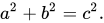
In mathematics, the Pythagorean theorem or Pythagoras's theorem is a fundamental relation in Euclidean geometry between the three sides of a right triangle. It states that the area of the square whose side is the hypotenuse (the side opposite the right angle) is equal to the sum of the areas of the squares on the other two sides.

The theorem can be written as an equation relating the lengths of the sides a, b and the hypotenuse c, sometimes called the Pythagorean equation:The theorem is named for the Greek philosopher Pythagoras, born around 570 BC. The theorem has been proved numerous times by many different methods – possibly the most for any mathematical theorem. The proofs are diverse, including both geometric proofs and algebraic proofs, with some dating back thousands of years.

View the full Wikipedia page for Pythagorean theorem
↑ Return to Menu

Geometry in the context of Pappus of Alexandria

Pappus of Alexandria (/ˈpæpəs/ ; Ancient Greek: Πάππος ὁ Ἀλεξανδρεύς; c. 290 – c.  350 AD) was a Greek mathematician of late antiquity known for his Synagoge (Συναγωγή) or Collection (c. 340), and for Pappus's hexagon theorem in projective geometry. Almost nothing is known about his life except for what can be found in his own writings, many of which are lost. Pappus apparently lived in Alexandria, where he worked as a mathematics teacher to higher level students, one of whom was named Hermodorus.

The Collection, his best-known work, is a compendium of mathematics in eight volumes, the bulk of which survives. It covers a wide range of topics that were part of the ancient mathematics curriculum, including geometry, astronomy, and mechanics.

View the full Wikipedia page for Pappus of Alexandria
↑ Return to Menu

Geometry in the context of Platonism

Platonism is the philosophy of Plato and philosophical systems closely derived from it, though later and contemporary Platonists do not necessarily accept all of Plato's own doctrines. Platonism has had a profound effect on Western thought. At the most fundamental level, Platonism affirms the existence of abstract objects, which are asserted to exist in a third realm distinct from both the sensible external world and from the internal world of consciousness, and is the opposite of nominalism. This can apply to properties, types, propositions, meanings, numbers, sets, truth values, and so on (see abstract object theory). Philosophers who affirm the existence of abstract objects are sometimes called Platonists; those who deny their existence are sometimes called nominalists. The terms "Platonism" and "nominalism" also have established senses in the history of philosophy. They denote positions that have little to do with the modern notion of an abstract object.

In a narrower sense, the term might indicate the doctrine of Platonic realism, a form of mysticism. The central concept of Platonism, a distinction essential to the Theory of Forms, is the distinction between the reality which is perceptible but unintelligible, associated with the flux of Heraclitus and studied by the likes of physical science, and the reality which is imperceptible but intelligible, associated with the unchanging being of Parmenides and studied by the likes of mathematics. Geometry was the main motivation of Plato, and this also shows the influence of Pythagoras. The Forms are typically described in dialogues such as the Phaedo, Symposium and Republic as perfect archetypes of which objects in the everyday world are imperfect copies. Aristotle's Third Man Argument is its most famous criticism in antiquity.

View the full Wikipedia page for Platonism
↑ Return to Menu

Geometry in the context of Three dimensions

In geometry, a three-dimensional space is a mathematical space in which three values (termed coordinates) are required to determine the position of a point. Alternatively, it can be referred to as 3D space, 3-space or, rarely, tri-dimensional space. Most commonly, it means the three-dimensional Euclidean space, that is, the Euclidean space of dimension three, which models physical space. More general three-dimensional spaces are called 3-manifolds. The term may refer colloquially to a subset of space, a three-dimensional region (or 3D domain), a solid figure.

Technically, a tuple of n numbers can be understood as the Cartesian coordinates of a location in a n-dimensional Euclidean space. The set of these n-tuples is commonly denoted and can be identified to the pair formed by a n-dimensional Euclidean space and a Cartesian coordinate system.When n = 3, this space is called the three-dimensional Euclidean space (or simply "Euclidean space" when the context is clear). In classical physics, it serves as a model of the physical universe, in which all known matter exists. When relativity theory is considered, it can be considered a local subspace of space-time. While this space remains the most compelling and useful way to model the world as it is experienced, it is only one example of a 3-manifold. In this classical example, when the three values refer to measurements in different directions (coordinates), any three directions can be chosen, provided that these directions do not lie in the same plane. Furthermore, if these directions are pairwise perpendicular, the three values are often labeled by the terms width/breadth, height/depth, and length.

View the full Wikipedia page for Three dimensions
↑ Return to Menu

Geometry in the context of Surface

A surface, as the term is most generally used, is the outermost or uppermost layer of a physical object. It is the portion or region of the object that can first be observed and with which other objects first interact.

The concept of surface has been abstracted and formalized in mathematics, specifically in geometry. Depending on the properties on which the emphasis is given, there are several inequivalent such formalizations that are all called surface, sometimes with a qualifier such as algebraic surface, smooth surface or fractal surface.

View the full Wikipedia page for Surface
↑ Return to Menu

Geometry in the context of Mathematical analysis

Analysis is the branch of mathematics dealing with continuous functions, limits, and related theories, such as differentiation, integration, measure, infinite sequences, series, and analytic functions.

These theories are usually studied in the context of real and complex numbers and functions. Analysis evolved from calculus, which involves the elementary concepts and techniques of analysis.Analysis may be distinguished from geometry; however, it can be applied to any space of mathematical objects that has a definition of nearness (a topological space) or specific distances between objects (a metric space).

View the full Wikipedia page for Mathematical analysis
↑ Return to Menu

Geometry in the context of Mathematical logic

Mathematical logic is the study of formal logic within mathematics. Major subareas include model theory, proof theory, set theory, and recursion theory (also known as computability theory). Research in mathematical logic commonly addresses the mathematical properties of formal systems of logic such as their expressive or deductive power. However, it can also include uses of logic to characterize correct mathematical reasoning or to establish foundations of mathematics.

Since its inception, mathematical logic has both contributed to and been motivated by the study of foundations of mathematics. This study began in the late 19th century with the development of axiomatic frameworks for geometry, arithmetic, and analysis. In the early 20th century it was shaped by David Hilbert's program to prove the consistency of foundational theories. Results of Kurt Gödel, Gerhard Gentzen, and others provided partial resolution to the program, and clarified the issues involved in proving consistency. Work in set theory showed that almost all ordinary mathematics can be formalized in terms of sets, although there are some theorems that cannot be proven in common axiom systems for set theory. Contemporary work in the foundations of mathematics often focuses on establishing which parts of mathematics can be formalized in particular formal systems (as in reverse mathematics) rather than trying to find theories in which all of mathematics can be developed.

View the full Wikipedia page for Mathematical logic
↑ Return to Menu

Geometry in the context of Renaissance humanism

"In his explicit turn back to an ancient model in search of knowledge and wisdom, Leonardo follows early humanist practice. What he finds in Vitruvius is a mathematical formula for the proportions of all parts of the human body, which results in its idealized representation as the true microcosmic measure of all things. [...]The perfection of this ideal human form corresponds visually to the early humanist belief in the unique central placement of human beings within the divine universal order and their consequent human grandeur and dignity, expressed in the philosopher Pico della Mirandola's Oration on the Dignity of Man (1486), known as the manifesto of the Renaissance."

— Anne Hudson Jones

Renaissance humanism is a worldview centered on the nature and importance of humanity that emerged from the study of Classical antiquity.

Renaissance humanists sought to create a citizenry able to speak and write with eloquence and clarity, and thus capable of engaging in the civic life of their communities and persuading others to virtuous and prudent actions. Humanism, while set up by a small elite who had access to books and education, was intended as a cultural movement to influence all of society. It was a program to revive the cultural heritage, literary legacy, and moral philosophy of the Greco-Roman civilization.

View the full Wikipedia page for Renaissance humanism
↑ Return to Menu

Geometry in the context of René Descartes

René Descartes (/dˈkɑːrt/ day-KART, also UK: /ˈdkɑːrt/ DAY-kart; 31 March 1596 – 11 February 1650) was a French philosopher, scientist, and mathematician, widely considered a seminal figure in the emergence of modern philosophy and science. Mathematics was paramount to his method of inquiry, and he connected the previously separate fields of geometry and algebra into analytic geometry.

Refusing to accept the authority of previous philosophers, Descartes frequently set his views apart from the philosophers who preceded him. In the opening section of the Passions of the Soul, an early modern treatise on emotions, Descartes goes so far as to assert that he will write on this topic "as if no one had written on these matters before." His best known philosophical statement is "cogito, ergo sum" ("I think, therefore I am," French: "Je pense, donc je suis").

View the full Wikipedia page for René Descartes
↑ Return to Menu

Geometry in the context of Octagon

In geometry, an octagon (from Ancient Greek ὀκτάγωνον (oktágōnon) 'eight angles') is an eight-sided polygon or 8-gon.

A regular octagon has Schläfli symbol {8} and can also be constructed as a quasiregular truncated square, t{4}, which alternates two types of edges. A truncated octagon, t{8} is a hexadecagon, {16}. A 3D analog of the octagon can be the rhombicuboctahedron with the triangular faces on it like the replaced edges, if one considers the octagon to be a truncated square.

View the full Wikipedia page for Octagon
↑ Return to Menu

Geometry in the context of Equator

The equator is the circle of latitude that divides Earth into the Northern and Southern hemispheres. It is an imaginary line located at 0 degrees latitude, about 40,075 km (24,901 mi) in circumference, halfway between the North and South poles. The term can also be used for any other celestial body that is roughly spherical.

In spatial (3D) geometry, as applied in astronomy, the equator of a rotating spheroid (such as a planet) is the parallel (circle of latitude) at which latitude is defined to be 0°. It is an imaginary line on the spheroid, equidistant from its poles, dividing it into northern and southern hemispheres. In other words, it is the intersection of the spheroid with the plane perpendicular to its axis of rotation and midway between its geographical poles.

View the full Wikipedia page for Equator
↑ Return to Menu

Geometry in the context of History of mathematics

The history of mathematics deals with the origin of discoveries in mathematics and the mathematical methods and notation of the past. Before the modern age and worldwide spread of knowledge, written examples of new mathematical developments have come to light only in a few locales. From 3000 BC the Mesopotamian states of Sumer, Akkad and Assyria, followed closely by Ancient Egypt and the Levantine state of Ebla began using arithmetic, algebra and geometry for taxation, commerce, trade, and in astronomy, to record time and formulate calendars.

The earliest mathematical texts available are from Mesopotamia and EgyptPlimpton 322 (Babylonian c. 2000 – 1900 BC), the Rhind Mathematical Papyrus (Egyptian c. 1800 BC) and the Moscow Mathematical Papyrus (Egyptian c. 1890 BC). All these texts mention the so-called Pythagorean triples, so, by inference, the Pythagorean theorem seems to be the most ancient and widespread mathematical development, after basic arithmetic and geometry.

View the full Wikipedia page for History of mathematics
↑ Return to Menu

Geometry in the context of Science in the medieval Islamic world

Science in the medieval Islamic world was the science developed and practised during the Islamic Golden Age under the Abbasid Caliphate of Baghdad, the Umayyads of Córdoba, the Abbadids of Seville, the Samanids, the Ziyarids and the Buyids in Persia and beyond, spanning the period roughly between 786 and 1258. Islamic scientific achievements encompassed a wide range of subject areas, especially astronomy, mathematics, and medicine. Other subjects of scientific inquiry included alchemy and chemistry, botany and agronomy, geography and cartography, ophthalmology, pharmacology, physics, and zoology.

Medieval Islamic science had practical purposes as well as the goal of understanding. For example, astronomy was useful for determining the Qibla, the direction in which to pray, botany had practical application in agriculture, as in the works of Ibn Bassal and Ibn al-'Awwam, and geography enabled Abu Zayd al-Balkhi to make accurate maps. Islamic mathematicians such as Al-Khwarizmi, Avicenna and Jamshīd al-Kāshī made advances in algebra, trigonometry, geometry and Arabic numerals. Islamic doctors described diseases like smallpox and measles, and challenged classical Greek medical theory. Al-Biruni, Avicenna and others described the preparation of hundreds of drugs made from medicinal plants and chemical compounds. Islamic physicists such as Ibn Al-Haytham, Al-Bīrūnī and others studied optics and mechanics as well as astronomy, and criticised Aristotle's view of motion.

View the full Wikipedia page for Science in the medieval Islamic world
↑ Return to Menu

Geometry in the context of Geometer

A geometer is a mathematician whose area of study is the historical aspects that define geometry, instead of the analytical geometric studies conducted by geometricians.

Some notable geometers and their main fields of work, chronologically listed, are:

View the full Wikipedia page for Geometer
↑ Return to Menu

Geometry in the context of Euclidean geometry

Euclidean geometry is a mathematical system attributed to Euclid, an ancient Greek mathematician, which he described in his textbook on geometry, Elements. Euclid's approach consists in assuming a small set of intuitively appealing axioms (postulates) and deducing many other propositions (theorems) from these. One of those is the parallel postulate which relates to parallel lines on a Euclidean plane. Although many of Euclid's results had been stated earlier, Euclid was the first to organize these propositions into a logical system in which each result is proved from axioms and previously proved theorems.

The Elements begins with plane geometry, still taught in secondary school (high school) as the first axiomatic system and the first examples of mathematical proofs. It goes on to the solid geometry of three dimensions. Much of the Elements states results of what are now called algebra and number theory, explained in geometrical language.

View the full Wikipedia page for Euclidean geometry
↑ Return to Menu