Flight feather in the context of "Owl"

Play Trivia Questions online!

or

Skip to study material about Flight feather in the context of "Owl"

Ad spacer

⭐ Core Definition: Flight feather

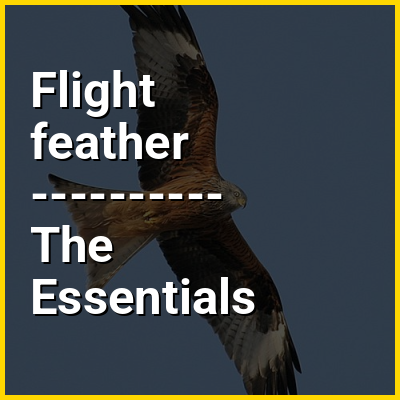
Flight feathers (Pennae volatus) are the long, stiff, asymmetrically shaped, but symmetrically paired pennaceous feathers on the wings or tail of a bird; those on the wings are called remiges (/ˈrɛmɪz/), singular remex (/ˈrmɛks/), while those on the tail are called rectrices (/ˈrɛktrɪsz/ or /rɛkˈtrsz/), singular rectrix (/ˈrɛktrɪks/). The primary function of the flight feathers is to aid in the generation of both thrust and lift, thereby enabling flight. The flight feathers of some birds perform additional functions, generally associated with territorial displays, courtship rituals or feeding methods. In some species, these feathers have developed into long showy plumes used in visual courtship displays, while in others they create a sound during display flights. Tiny serrations on the leading edge of their remiges help owls to fly silently (and therefore hunt more successfully), while the extra-stiff rectrices of woodpeckers help them to brace against tree trunks as they hammer on them. Even flightless birds still retain flight feathers, though sometimes in radically modified forms.

The remiges are divided into primary and secondary feathers based on their position along the wing. There are typically 11 primaries attached to the manus (six attached to the metacarpus and five to the phalanges), but the outermost primary, called the remicle, is often rudimentary or absent; certain birds, notably the flamingos, grebes, and storks, have seven primaries attached to the metacarpus and 12 in all. Secondary feathers are attached to the ulna. The fifth secondary remex (numbered inwards from the carpal joint) was formerly thought to be absent in some species, but the modern view of this diastataxy is that there is a gap between the fourth and fifth secondaries. Tertiary feathers growing upon the adjoining portion of the brachium are not considered true remiges.
↓ Menu

>>>PUT SHARE BUTTONS HERE<<<
In this Dossier

Flight feather in the context of Limb (anatomy)

A limb (from Old English lim, meaning "body part") is a jointed, muscled appendage of a tetrapod vertebrate animal used for weight-bearing, terrestrial locomotion and physical interaction with other objects. The distalmost portion of a limb is known as its extremity. The limbs' bony endoskeleton, known as the appendicular skeleton, is homologous among all tetrapods, who use their limbs for walking, running and jumping, swimming, climbing, grasping, touching and striking.

All tetrapods have four limbs that are organized into two bilaterally symmetrical pairs, with one pair at each end of the torso, which phylogenetically correspond to the four paired fins (pectoral and pelvic fins) of their fish (sarcopterygian) ancestors. The cranial pair (i.e. closer to the head) of limbs are known as the forelimbs or front legs, and the caudal pair (i.e. closer to the tail or coccyx) are the hindlimbs or back legs. In animals with a more erect bipedal posture (mainly hominid primates, particularly humans), the forelimbs and hindlimbs are often called upper and lower limbs, respectively. The fore-/upper limbs are connected to the thoracic cage via the pectoral/shoulder girdles, and the hind-/lower limbs are connected to the pelvis via the hip joints. Many animals, especially the arboreal species, have prehensile forelimbs adapted for grasping and climbing, while some (mostly primates) can also use hindlimbs for grasping. Some animals (birds and bats) have expanded forelimbs (and sometimes hindlimbs as well) with specialized feathers or membranes to achieve lift and fly. Aquatic and semiaquatic tetrapods usually have limb features (such as webbings) adapted to better provide propulsion in water, while marine mammals and sea turtles have convergently evolved flattened, paddle-like limbs known as flippers.

↑ Return to Menu

Flight feather in the context of Quill

A quill is a writing tool made from a moulted flight feather (preferably a primary wing-feather) of a large bird. Quills were used for writing with ink before the invention of the dip pen/metal-nibbed pen, the fountain pen, and, eventually, the ballpoint pen.

As with the earlier reed pen (and later dip pen), a quill has no internal ink reservoir and therefore needs to periodically be dipped into an inkwell during writing. The hand-cut goose quill is rarely used by modern calligraphers, however, it is still the tool of choice for a few scribes who claim the quills provide an unmatched sharp stroke as well as greater flexibility than a steel pen.

↑ Return to Menu

Flight feather in the context of Bird wing

Bird wings are paired forelimbs in birds, which evolved specialized feathers to generate lift and thrust and allow the birds to fly.

Terrestrial flightless birds have reduced wings or none at all (for example, moa). In aquatic flightless birds (penguins), wings can serve as flippers.

↑ Return to Menu

Flight feather in the context of Ligament

A ligament is a type of fibrous connective tissue in the body that connects bones to other bones. It also connects flight feathers to bones, in dinosaurs and birds. All 30,000 species of amniotes (land animals with internal bones) have ligaments.

It is also known as articular ligament, articular larua, fibrous ligament, or true ligament.

↑ Return to Menu

Flight feather in the context of Falcon

Falcons (/ˈfɒlkən, ˈfɔːl-, ˈfæl-/) are birds of prey in the genus Falco, which includes about 40 species. Some small species of falcons with long, narrow wings are called hobbies, and some that hover while hunting are called kestrels. Falcons are widely distributed on all continents of the world except Antarctica, though closely related raptors did occur there in the Eocene.

Adult falcons have thin, tapered wings, which enable them to fly at high speed and change direction rapidly. Fledgling falcons, in their first year of flying, have longer flight feathers, which make their configuration more like that of a general-purpose bird such as a broadwing. This makes flying easier while still learning the aerial skills required to be effective hunters like the adults.

↑ Return to Menu