Exotic hadron in the context of "Gluons"

Play Trivia Questions online!

or

Skip to study material about Exotic hadron in the context of "Gluons"

Ad spacer

⭐ Core Definition: Exotic hadron

Exotic hadrons are subatomic particles composed of quarks and gluons, but which – unlike "well-known" hadrons such as protons, neutrons and mesons – consist of more than three valence quarks. By contrast, "ordinary" hadrons contain just two or three quarks. Hadrons with explicit valence gluon content would also be considered exotic. In theory, there is no limit on the number of quarks in a hadron, as long as the hadron's color charge is white, or color-neutral.

Consistent with ordinary hadrons, exotic hadrons are classified as being either fermions, like ordinary baryons, or bosons, like ordinary mesons. According to this classification scheme, pentaquarks, containing five valence quarks, are exotic baryons, while tetraquarks (four valence quarks) and hexaquarks (six quarks, consisting of either a dibaryon or three quark-antiquark pairs) would be considered exotic mesons. Tetraquark and pentaquark particles are believed to have been observed and are being investigated; hexaquarks have not yet been confirmed as observed.

↓ Menu

>>>PUT SHARE BUTTONS HERE<<<
In this Dossier

Exotic hadron in the context of Exotic matter

There are several proposed types of exotic matter:

↑ Return to Menu

Exotic hadron in the context of Baryon number

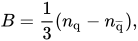
In particle physics, the baryon number (B) is an additive quantum number of a system. It is defined aswhere is the number of quarks, and is the number of antiquarks. Baryons (three quarks) have B = +1, mesons (one quark, one antiquark) have B = 0, and antibaryons (three antiquarks) have B = −1. Exotic hadrons like pentaquarks (four quarks, one antiquark) and tetraquarks (two quarks, two antiquarks) are also classified as baryons and mesons depending on their baryon number. In the Standard Model B conservation is an accidental symmetry which means that it appears in the Standard Model but is often violated when going beyond it. Physics beyond the Standard Model theories that contain baryon number violation are, for example, Standard Model with extra dimensions, Supersymmetry, Grand Unified Theory and String theory.

↑ Return to Menu

Exotic hadron in the context of Tetraquark

In particle physics, a tetraquark is an exotic meson composed of four valence quarks. A tetraquark state has long been suspected to be allowed by quantum chromodynamics, the modern theory of strong interactions. A tetraquark state is an example of an exotic hadron that lies outside the conventional quark model classification. A number of different types of tetraquark have been observed.

↑ Return to Menu

Exotic hadron in the context of Z(4430)

Z(4430) is a mesonic resonance discovered by the Belle experiment. It has a mass of 4430 MeV/c. The resonant nature of the peak has been confirmed by the LHCb experiment with a significance of at least 13.9 σ. The particle is charged and is thought to have a quark content of ccdu, making it a tetraquark candidate. It has the spin-parity quantum numbers J = 1.

The particle joins the X(3872), Zc(3900) and Y(4140) as exotic hadron candidates observed by multiple experiments, although it is the first to be confirmed as a resonance.

↑ Return to Menu

Exotic hadron in the context of LHCb

46°14′28″N 06°05′49″E / 46.24111°N 6.09694°E / 46.24111; 6.09694

The LHCb (Large Hadron Collider beauty) experiment is a particle physics detector collecting data at the Large Hadron Collider at CERN. LHCb specializes in the measurements of the parameters of CP violation in the interactions of b- and c-hadrons (heavy particles containing a bottom and charm quarks). Such studies can help to explain the matter-antimatter asymmetry of the Universe. The detector is also able to perform measurements of production cross sections, exotic hadron spectroscopy, and electroweak physics in the forward region. The LHCb collaborators, who built, operate and analyse data from the experiment, are composed of approximately 1650 people from 98 scientific institutes, representing 22 countries. Vincenzo Vagnoni succeeded on July 1, 2023 as spokesperson for the collaboration from Chris Parkes (spokesperson 2020–2023). The experiment is located at point 8 on the LHC tunnel close to Ferney-Voltaire, France just over the border from Geneva. The (small) MoEDAL experiment shares the same cavern.

↑ Return to Menu