Esparto in the context of "Stipa"

Play Trivia Questions online!

or

Skip to study material about Esparto in the context of "Stipa"

Ad spacer

⭐ Core Definition: Esparto

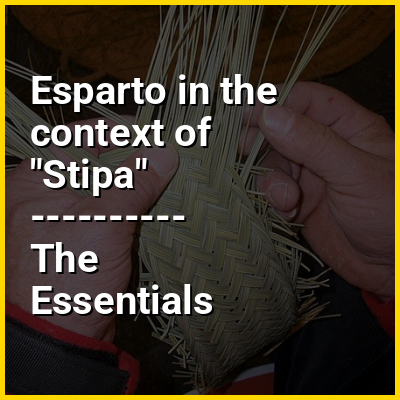
Esparto, halfah grass, or esparto grass is a fiber produced from two species of perennial grasses of north Africa, Spain and Portugal. It is used for crafts, such as cords, basketry, and espadrilles. Macrochloa tenacissima and Lygeum spartum are the species used to produce esparto.

Macrochloa tenacissima produces the better and stronger esparto. It is endemic to the Mediterranean region (growing in Portugal, Spain, Morocco, Algeria, Tunisia, Libya and Egypt). Another name in Spanish for the plant is "atocha," a pre-Roman word. "Esparto" or σπάρτο in Greek may refer to any woven products of sedge or broom, including cords and ropes. This species grows forming a steppic landscape – esparto grasslands – which covers large parts of Spain and Algeria.
↓ Menu

>>>PUT SHARE BUTTONS HERE<<<

👉 Esparto in the context of Stipa

Stipa is a genus of about 140 species of large perennial hermaphroditic grasses collectively known as feather grass, needle grass, and spear grass. They are placed in the subfamily Pooideae and the tribe Stipeae, which also contains many species formerly assigned to Stipa, which have since been reclassified into new genera.

Many species are important forage crops. Several species such as Stipa brachytricha, S. arundinacea, S. splendens, S. gigantea and S. pulchra are used as ornamental plants. One former species, esparto grass (Macrochloa tenacissima), is used for crafts and extensively in paper making.

↓ Explore More Topics
In this Dossier

Esparto in the context of Tazirbu

Tazerbu (Arabic: تازربو) is an oasis located in the Libyan Desert in the Kufra District of Libya, about 250 km to the northwest of Kufra. The name means "main seat" in the Toubou language, because this was the seat of the Toubou Sultanate before the Arab conquest. The oasis is 25–30 km long and 10 km wide. In the middle of the oasis and parallel to it runs a shallow valley with salt ponds and salines. In Tazerbu there are about ten villages: the most important is called El-Jezeera. In the oasis grow groups of palms, tamarisks, acacias, esparto and Juncus. Several kilometers to the north of this village lie the ruins of an old castle, named Gasr Giránghedi, which was the seat of the Sultan.The first European to visit the oasis was the German geographer and explorer Gerhard Rohlfs in August 1879.

↑ Return to Menu