Elliptic partial differential equation in the context of Hyperbolic partial differential equation


Elliptic partial differential equation in the context of Hyperbolic partial differential equation

Elliptic partial differential equation Study page number 1 of 1

Play TriviaQuestions Online!

or

Skip to study material about Elliptic partial differential equation in the context of "Hyperbolic partial differential equation"


HINT:

👉 Elliptic partial differential equation in the context of Hyperbolic partial differential equation

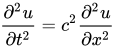
In mathematics, a hyperbolic partial differential equation of order is a partial differential equation (PDE) that, roughly speaking, has a well-posed initial value problem for the first derivatives. More precisely, the Cauchy problem can be locally solved for arbitrary initial data along any non-characteristic hypersurface. Many of the equations of mechanics are hyperbolic, and so the study of hyperbolic equations is of substantial contemporary interest. The model hyperbolic equation is the wave equation. In one spatial dimension, this isThe equation has the property that, if u and its first time derivative are arbitrarily specified initial data on the line t = 0 (with sufficient smoothness properties), then there exists a solution for all time t.

The solutions of hyperbolic equations are "wave-like". If a disturbance is made in the initial data of a hyperbolic differential equation, then not every point of space feels the disturbance at once. Relative to a fixed time coordinate, disturbances have a finite propagation speed. They travel along the characteristics of the equation. This feature qualitatively distinguishes hyperbolic equations from elliptic partial differential equations and parabolic partial differential equations. A perturbation of the initial (or boundary) data of an elliptic or parabolic equation is felt at once by essentially all points in the domain.

↓ Explore More Topics
In this Dossier

Elliptic partial differential equation in the context of Geometric analysis

Geometric analysis is a mathematical discipline where tools from differential equations, especially elliptic partial differential equations (PDEs), are used to establish new results in differential geometry and differential topology. The use of linear elliptic PDEs dates at least as far back as Hodge theory. More recently, it refers largelyto the use of nonlinear partial differential equations to study geometric and topological properties of spaces, such as submanifolds of Euclidean space, Riemannian manifolds, and symplectic manifolds. This approach dates back to the work by Tibor Radó and Jesse Douglas on minimal surfaces, John Forbes Nash Jr. on isometric embeddings of Riemannian manifolds into Euclidean space, work by Louis Nirenberg on the Minkowski problem and the Weyl problem, and work by Aleksandr Danilovich Aleksandrov and Aleksei Pogorelov on convex hypersurfaces. In the 1980s fundamental contributions by Karen Uhlenbeck, Clifford Taubes, Shing-Tung Yau, Richard Schoen, and Richard Hamilton launched a particularly exciting and productive era of geometric analysis that continues to this day. A celebrated achievement was the solution to the Poincaré conjecture by Grigori Perelman, completing a program initiated and largely carried out by Richard Hamilton.

View the full Wikipedia page for Geometric analysis
↑ Return to Menu

Elliptic partial differential equation in the context of Navier–Stokes equations

The Navier–Stokes equations (/nævˈjeɪ ˈstoʊks/ nav-YAY STOHKS) are partial differential equations which describe the motion of viscous fluid substances. They were named after French engineer and physicist Claude-Louis Navier and the Irish physicist and mathematician Sir George Gabriel Stokes, Bt. They were developed over several decades of progressively building the theories, from 1822 (Navier) to 1842–1850 (Stokes).

The Navier–Stokes equations mathematically express momentum balance for Newtonian fluids and make use of conservation of mass. They are sometimes accompanied by an equation of state relating pressure, temperature and density. They arise from applying Isaac Newton's second law to fluid motion, together with the assumption that the stress in the fluid is the sum of a diffusing viscous term (proportional to the gradient of velocity) and a pressure term—hence describing viscous flow. The difference between them and the closely related Euler equations is that Navier–Stokes equations take viscosity into account while the Euler equations model only inviscid flow. As a result, the Navier–Stokes are an elliptic equation and therefore have better analytic properties, at the expense of having less mathematical structure (e.g. they are never completely integrable).

View the full Wikipedia page for Navier–Stokes equations
↑ Return to Menu

Elliptic partial differential equation in the context of John Forbes Nash Jr.

John Forbes Nash Jr. (June 13, 1928 – May 23, 2015), known and published as John Nash, was an American mathematician who made fundamental contributions to game theory, real algebraic geometry, differential geometry, and partial differential equations. Nash and fellow game theorists John Harsanyi and Reinhard Selten were awarded the 1994 Nobel Prize in Economics. In 2015, Louis Nirenberg and he were awarded the Abel Prize for their contributions to the field of partial differential equations.

As a graduate student in the Princeton University Department of Mathematics, Nash introduced a number of concepts (including the Nash equilibrium and the Nash bargaining solution), which are now considered central to game theory and its applications in various sciences. In the 1950s, Nash discovered and proved the Nash embedding theorems by solving a system of nonlinear partial differential equations arising in Riemannian geometry. This work, also introducing a preliminary form of the Nash–Moser theorem, was later recognized by the American Mathematical Society with the Leroy P. Steele Prize for Seminal Contribution to Research. Ennio De Giorgi and Nash found, with separate methods, a body of results paving the way for a systematic understanding of elliptic and parabolic partial differential equations. Their De Giorgi–Nash theorem on the smoothness of solutions of such equations resolved Hilbert's nineteenth problem on regularity in the calculus of variations, which had been a well-known open problem for almost 60 years.

View the full Wikipedia page for John Forbes Nash Jr.
↑ Return to Menu

Elliptic partial differential equation in the context of Numerical methods for partial differential equations

Numerical methods for partial differential equations is the branch of numerical analysis that studies the numerical solution of partial differential equations (PDEs).

In principle, specialized methods for hyperbolic, parabolic or elliptic partial differential equations exist.

View the full Wikipedia page for Numerical methods for partial differential equations
↑ Return to Menu

Elliptic partial differential equation in the context of Maximum principle

In the mathematical fields of differential equations and geometric analysis, the maximum principle is one of the most useful and best known tools of study. Solutions of a partial differential equation (or, more generally, of a differential inequality) in a domain D are said to satisfy the maximum principle if they achieve their maxima at the boundary of D. Harmonic functions and, more generally, solutions of elliptic partial differential equations satisfy the maximum principle.

The maximum principle enables one to obtain information about solutions of differential equations without any explicit knowledge of the solutions themselves. In particular, the maximum principle is a useful tool in the numerical approximation of solutions of ordinary and partial differential equations and in the determination of bounds for the errors in such approximations.

View the full Wikipedia page for Maximum principle
↑ Return to Menu