Edo people in the context of "Benin bronze"

Play Trivia Questions online!

or

Skip to study material about Edo people in the context of "Benin bronze"

Ad spacer

⭐ Core Definition: Edo people

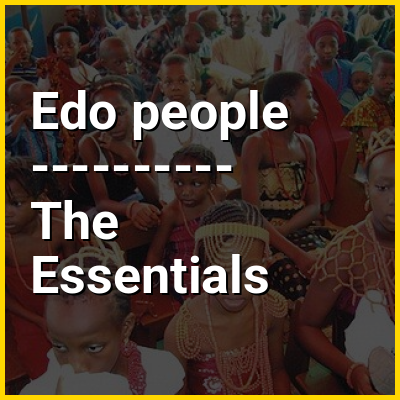
The Edo people, also referred to as the Benin people, are an Edoid-speaking ethnic group. They are prominently native to the Edo South senatorial district which make up seven local government areas of Edo State, Nigeria. They are speakers of the Edo language and are the descendants of the founders of the Benin Kingdom, the Ogiso. They are closely related to other Edoid ethnic groups, such as the Esan, the Etsakọ, the Isoko, the Owan and the Urhobo as well as other southern ethnic groups.

The names Benin and Bini are Portuguese corruptions, ultimately from the word Ubini, which came into use during the reign of Oba (ruler) Ewuare, c. 1440. Ubini is an Edo word meaning 'livable', used by Pa Idu, the progenitor of the Edo state people, to describe the area found as a livable locale during their sojourn from Egypt. Ubini was later corrupted to Bini by the mixed ethnicities living together at the centre; and further corrupted to Benin around 1485, when the Portuguese began trade relations with Oba Ewuare giving them coral beads, which the Edo people call 'Ivie'.
↓ Menu

>>>PUT SHARE BUTTONS HERE<<<

👉 Edo people in the context of Benin bronze

The Benin Bronzes are a group of several thousand metal plaques and sculptures that decorated the royal palace of the Kingdom of Benin, in what is now Edo State, Nigeria. The metal plaques were produced by the Guild of Benin Bronze Casters, now located in Igun Street, also known as Igun-Eronmwon Quarters. Collectively, the objects form the best examples of Benin art and were created from the fourteenth century by artists of the Edo people. The plaques, which in the Edo language are called Ama, depict scenes or represent themes in the history of the kingdom. Apart from the plaques, other sculptures in brass or bronze include portrait heads, jewellery, and smaller pieces.

Some of the dramatic sculptures date to the fourteenth century, but the bulk of the collection dates to the fifteenth and sixteenth centuries. It is believed that two "Golden Ages" in Benin metal workmanship occurred during the reigns of Esigie (fl. 1550) and of Eresoyen (1735–1750), when their workmanship achieved its highest quality.

↓ Explore More Topics
In this Dossier

Edo people in the context of Nigeria

Nigeria, officially the Federal Republic of Nigeria, is a country in West Africa. It is situated between the Sahel to the north and the Gulf of Guinea in the Atlantic Ocean to the south. It covers an area of 923,769 square kilometres (356,669 sq mi). With a population of more than 236 million, it is the most populous country in Africa, and the world's sixth-most populous country. Nigeria borders Niger in the north, Chad in the northeast, Cameroon in the east, and Benin in the west. Nigeria is a federal republic comprising 36 states and the Federal Capital Territory, where its capital, Abuja, is located. The largest city in Nigeria by population is Lagos, one of the largest metropolitan areas in the world and the largest in Africa.

Nigeria has been home to several indigenous material cultures, pre-colonial states and kingdoms since the second millennium BC. The Nok culture, c. 1500 BC, marks one of the earliest known civilisations in the region. The Hausa Kingdoms inhabited the north, with the Edo Kingdom of Benin in the south, Igbo Kingdom of Nri in the southeast and in the southwest, the Oyo Empire. The present day territory of Nigeria was home to a vast array of city-states. In the early 19th century the Fula jihads culminated in the Sokoto Caliphate. The modern state originated with British colonialization in the 19th century, taking its present territorial shape with the merging of the Southern Nigeria Protectorate and the Northern Nigeria Protectorate in 1914. The British set up administrative and legal structures and incorporated traditional monarchs as a form of indirect rule. Nigeria became a formally independent federation on 1 October 1960. It experienced a civil war from 1967 to 1970, followed by a succession of military dictatorships and democratically elected civilian governments until achieving a stable government in the 1999 Nigerian presidential election.

↑ Return to Menu

Edo people in the context of Demographics of Nigeria

Nigeria is the most populous country in Africa and the sixth most populous in the world. Nigeria is also one of the most densely populated countries in Africa, with approximately 218.5 million people in an area of 923,768 km (356,669 sq mi).

54.3% of Nigerians are urban dwellers, with the annual rate of urbanisation being estimated at 3.92%. Nigeria is home to 371 ethnic groups speaking over 500 languages and the variety of customs and traditions among them gives the country great cultural diversity. The three largest ethnic groups, namely the Hausas, Yorubas, and Igbos constitute more than 60% of the population. The Ijaw, Efik, Ibibio, Annang, Ogoni, Tiv, Urhobo-Isoko, Edo and Itsekiri are some of the other sizeable ethnic groups. Over 1.2 million people living in Nigeria (0.5% of its total population, or 1 in every 200 people living in Nigeria) are from a continent other than Africa. There are 100,000 people from the United States, 75,000 are from Lebanon, 60,000 are from China and 16,000 are from the United Kingdom.

↑ Return to Menu

Edo people in the context of Kingdom of Benin

The Kingdom of Benin or Empire of Benin, also known as Great Benin, is a traditional kingdom in southern Nigeria. It has no historical relation to the modern republic of Benin, which was known as Dahomey from the 17th century until 1975. The Kingdom of Benin's capital was Edo, now known as Benin City in Edo State, Nigeria. The Benin Kingdom was one of the oldest and most developed states in the coastal hinterland of West Africa. It grew out of the previous Edo Kingdom of Igodomigodo around the 11th century AD; it was annexed by the British Empire in 1897, but endured as a non-sovereign monarchy.

In the 15th and 16th centuries, the empire reached the height of its prosperity, expanding its territory, trading with European powers, and creating a remarkable artistic legacy in cast bronze, iron, brass, carved ivory, and other materials.

↑ Return to Menu

Edo people in the context of Yoruba religion


The Yorùbá religion (Yoruba: Ìṣẹ̀ṣe [ìʃɛ̀ʃē]), West African Orisa (Òrìṣà [òɾìʃà]), or Isese (Ìṣẹ̀ṣe), comprises the traditional religious and spiritual concepts and practice of the Yoruba people. Its homeland is in present-day Southwestern Nigeria and Southern Benin, which comprises the majority of the states of; Oyo, Ogun, Osun, Ondo, Ekiti, Kwara, Lagos and parts of Kogi in Nigeria, the Departments of; Collines, Oueme, Plateau in Benin, and the adjoining parts of central Togo, commonly known as Yorubaland (Yoruba: Ilẹ̀ Káàárọ̀-Oòjíire). It has become the largest indigenous African tradition / belief system in the world with several million adherents worldwide.

It shares some parallels with the Vodun practised by the neighbouring Fon and Ewe peoples to its west and with the religion of the Edo people to its east. Yorùbá religion is the basis for several religions in the New World, notably Santería, Umbanda, Trinidad Orisha, and Candomblé. Yorùbá religious beliefs are part of Ìtàn (history), the total complex of songs, histories, stories, and other cultural concepts which make up the Yorùbá society.

↑ Return to Menu

Edo people in the context of Edo language

Edo (Ẹ̀dó [ɛ̀.dó]; English: /ˈɛd/, locally: /ˈedo/), also known as Bini, is the language spoken by the Edo people in Edo State, Nigeria. It was the primary language of the Benin Empire and its predecessor, Igodomigodo. It is the majority language spoken in Edo State, particularly in Benin City, and the surrounding local governments and senatorial districts in the Southern parts of the State.

↑ Return to Menu

Edo people in the context of Ikenga

Ikenga (Igbo literal meaning "strength of majesty") is a horned god found among the Igbo people in southeastern Nigeria. It is one of the most powerful symbols of the Igbo people and one of the most common cultural artifacts. Ikenga is mostly maintained, kept or owned by men and occasionally by women of high reputation and integrity in the society. It comprises someone's Chi (personal god), his Ndichie (ancestors), aka Ikenga (right hand), ike (power) as well as spiritual activation through prayer and sacrifice.

Ikenga is exclusively an Igbo symbol. Nevertheless, various peoples of Southern Nigeria have slightly different notions of the components of an individual personality, but all agree that these various aspects can only be affected through ritual and personal effort. Some variants of it are found in Ijaw, Ishan, Isoko, Urhobo and Edo areas. Among the Isoko people, there are three types of personal shrine images: Oma, which represents the "spirit double" that resides in the other world; Obo which symbolizes the right hand and personal endeavor and the lvri which stands for personal determination. In the Urhobo areas it is also regarded as Ivri and in the Edo areas it's called Ikegobo.

↑ Return to Menu