DIY ethic in the context of "Zine"

Play Trivia Questions online!

or

Skip to study material about DIY ethic in the context of "Zine"

Ad spacer

⭐ Core Definition: DIY ethic

"Do it yourself" ("DIY") is the method of building, modifying, or repairing things by oneself without the direct aid of professionals or certified experts. Academic research has described DIY as behaviors where "individuals use raw and semi-raw materials and parts to produce, transform, or reconstruct material possessions, including those drawn from the natural environment (e.g., landscaping)". DIY behavior can be triggered by various motivations previously categorized as marketplace motivations (economic benefits, lack of product availability, lack of product quality, need for customization), and identity enhancement (craftsmanship, empowerment, community seeking, uniqueness).

The term "do-it-yourself" has been associated with consumers since at least 1912 primarily in the domain of home improvement and maintenance activities. The phrase "do it yourself" had come into common usage (in standard English) by the 1950s, in reference to the emergence of a trend of people undertaking home improvement and various other small craft and construction projects as both a creative-recreational and cost-saving activity.
↓ Menu

>>>PUT SHARE BUTTONS HERE<<<

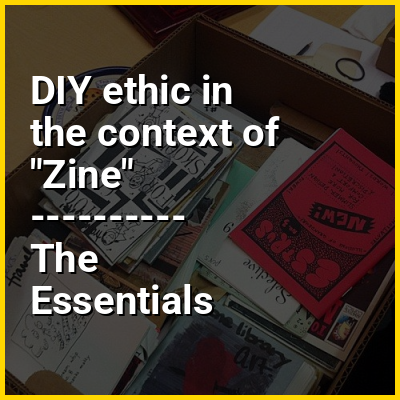
👉 DIY ethic in the context of Zine

A zine (/zn/ ZEEN; short for MAGA zine or FAN zine) is a magazine that is a "noncommercial often homemade or online publication usually devoted to specialized and often unconventional subject matter". Zines are the product of either a single person or of a very small group, and are popularly photocopied into physical prints for circulation. A fanzine (blend of fan and magazine) is a non-professional and non-official publication produced by enthusiasts of a particular cultural phenomenon (such as a literary or musical genre) for the pleasure of others who share their interest.

Zines are popularly defined within a circulation of 1,000 or fewer copies; in practice, however, many are produced in editions of fewer than 100. Among the various intentions for creation and publication are developing one's identity, sharing a niche skill or art, or developing a story, as opposed to seeking profit. Zines have served as a significant medium of communication in various subcultures, and frequently draw inspiration from a "do-it-yourself" philosophy that disregards the traditional conventions of professional design and publishing houses, proposing an alternative, confident, and self-aware contribution.

↓ Explore More Topics
In this Dossier

DIY ethic in the context of Punk rock

Punk rock (or simply punk) is a subgenre of rock music that emerged in the mid-1970s. Rooted in 1950s rock and roll and 1960s garage rock, punk bands rejected the overproduction and corporate nature of mainstream rock music. Typically producing short, fast-paced songs with rough stripped-down vocals and instrumentation and an anti-establishment theme, artists embrace a DIY ethic with many bands self-producing and distributing recordings through independent labels.

During the early 1970s, the term "punk rock" was originally used by some American rock critics to describe mid-1960s garage bands. Subsequent developments such as glam and pub rock in the UK, alongside the Velvet Underground and the New York Dolls from New York have been cited as key influences. By the mid-1970s, the term "punk rock" had become associated with several regional underground music scenes, including the MC5 and the Stooges in Detroit; Television, Patti Smith, Suicide, the Dictators, Richard Hell and the Voidoids, and the Ramones in New York City; Rocket from the Tombs, Electric Eels and Dead Boys in Ohio; the Saints and Radio Birdman in Australia; and the Sex Pistols, the Clash, the Damned and the Buzzcocks in England. By late 1976, punk had become a major cultural phenomenon in the UK, giving rise to a punk subculture that expressed youthful rebellion through distinctive styles of clothing, such as T-shirts with deliberately offensive graphics, leather jackets, studded or spiked bands, jewelry, bondage clothing and safety pins.

↑ Return to Menu

DIY ethic in the context of Punk subculture

The punk subculture includes a diverse and widely known array of music, ideologies, fashion, and other forms of expression, visual art, dance, literature, and film. Largely characterised by anti-establishment views, the promotion of individual freedom, and the DIY ethics, the culture originated from punk rock.

The punk ethos is primarily made up of beliefs such as non-conformity, anti-capitalism, anti-authoritarianism, anti-corporatism, a do-it-yourself ethic, anti-consumerist, anti-corporate greed, direct action, and not "selling out".

↑ Return to Menu

DIY ethic in the context of Alternative rock

Alternative rock (also known as alternative music, alt-rock or simply alternative) is a category of rock music that evolved from the independent music underground of the 1970s. Alternative rock acts achieved mainstream success in the 1990s with the likes of the grunge subgenre in the United States, and the Britpop and shoegaze subgenres in the United Kingdom and Ireland. During this period, many record labels were looking for "alternatives", as many corporate rock, hard rock, and glam metal acts from the 1980s were beginning to grow stale throughout the music industry. The emergence of Generation X as a cultural force in the 1990s also contributed greatly to the rise of alternative music.

"Alternative" refers to the genre's distinction from mainstream or commercial rock or pop. The term's original meaning was broader, referring to musicians influenced by the musical style or independent, DIY ethos of late-1970s punk rock. Traditionally, alternative rock varied in terms of its sound, social context, and regional roots. Throughout the 1980s, magazines and zines, college radio airplay, and word of mouth had increased the prominence and highlighted the diversity of alternative rock's distinct styles (and music scenes), such as noise pop, indie rock, grunge, and shoegaze. In September 1988, Billboard introduced "alternative" into their charting system to reflect the rise of the format across radio stations in the United States by stations like KROQ-FM in Los Angeles and WDRE-FM in New York, which were playing music from more underground, independent, and non-commercial rock artists.

↑ Return to Menu

DIY ethic in the context of New wave of British heavy metal

The new wave of British heavy metal (often abbreviated as NWOBHM) was a nationwide musical movement that began in England in the mid-1970s and achieved international attention by the early 1980s. Editor Alan Lewis coined the term for an article by Geoff Barton in a May 1979 issue of the British music newspaper Sounds to describe the emergence of heavy metal bands in the mid-to-late 1970s, as punk rock declined amid the dominance of new wave music.

Although encompassing diverse styles inherited from rock music, the music of the NWOBHM is best remembered for infusing earlier heavy metal with the intensity of punk rock to produce fast and aggressive songs. The DIY attitude of the NWOBHM bands led to raw-sounding, self-produced recordings and a proliferation of independent record labels. Song lyrics were usually about escapist themes, such as mythology, fantasy, horror, and the rock 'n' roll lifestyle.

↑ Return to Menu