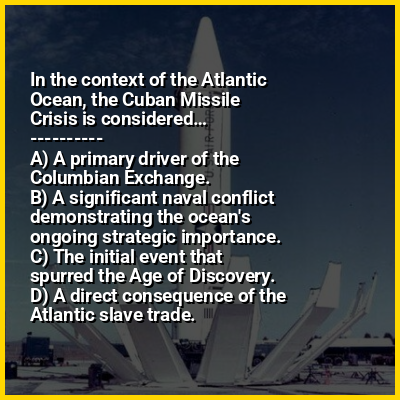
The Cuban Missile Crisis, also known as the October Crisis (Spanish: Crisis de Octubre) in Cuba, or the Caribbean Crisis (Russian: Карибский кризис, romanized: Karibskiy krizis), was a 13-day confrontation between the governments of the United States and the Soviet Union, when American deployments of nuclear missiles in the United Kingdom, Italy and Turkey were matched by Soviet deployments of nuclear missiles in Cuba. The crisis lasted from 16 to 28 October 1962. The confrontation is widely considered the closest the Cold War came to escalating into full-scale nuclear war.
From 1959, the US government based Thor nuclear missiles in England, known as Project Emily. In 1961, the US put Jupiter nuclear missiles in Italy and Turkey. All were within range of Moscow. The US had trained a paramilitary force of Cuban expatriates, which the CIA led in an attempt to invade Cuba and overthrow its government. Starting in November of that year, the US government engaged in a violent campaign of terrorism and sabotage in Cuba, referred to as the Cuban Project, which continued throughout the first half of the 1960s. The Soviet administration was concerned about a Cuban drift towards China, with which the Soviets had an increasingly fractious relationship. In response to these factors the Soviet and Cuban governments agreed, at a meeting between leaders Nikita Khrushchev and Fidel Castro in July 1962, to place nuclear missiles on Cuba to deter a future US invasion. Construction of launch facilities started shortly thereafter.