Croix de Guerre in the context of "Croix de guerre des théâtres d'opérations extérieures"

Play Trivia Questions online!

or

Skip to study material about Croix de Guerre in the context of "Croix de guerre des théâtres d'opérations extérieures"


⭐ Core Definition: Croix de Guerre

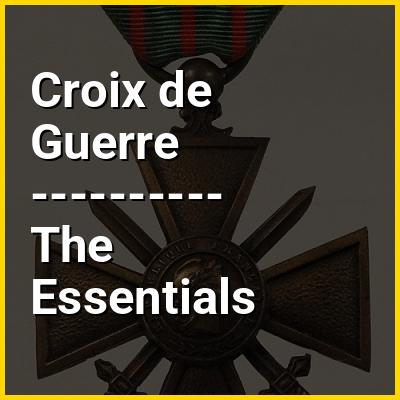
The Croix de Guerre (French: [kʁwa ɡɛʁ], Cross of War) is a military decoration of France. It was first created in 1915 and consists of a square-cross medal on two crossed swords, hanging from a ribbon with various degree pins. The decoration was first awarded during World War I, again in World War II, and in other conflicts; the croix de guerre des théâtres d'opérations extérieures ("cross of war for external theatres of operations") was established in 1921 for these. The Croix de Guerre was also commonly bestowed on foreign military forces allied to France.

The Croix de Guerre may be awarded either as an individual award or as a unit award to those soldiers who distinguish themselves by acts of heroism involving combat with the enemy. The medal is awarded to those who have been "mentioned in dispatches", meaning a heroic deed or deeds were performed meriting a citation from an individual's headquarters unit. The unit award of the Croix de Guerre with palm was issued to military units whose members performed heroic deeds in combat and were subsequently recognized by headquarters.
↓ Menu

👉 Croix de Guerre in the context of Croix de guerre des théâtres d'opérations extérieures

The Croix de guerre des théâtres d'opérations extérieurs (French pronunciation: [kʁwa d(ə) ɡɛʁ de teɑtʁ dɔpeʁɑsjɔ̃ ɛksteʁjœʁ]; "War Cross for Foreign Operational Theatres"), also called the Croix de Guerre TOE for short, is a French military award denoting citations earned in combat in foreign countries. The Armistice of November 11, 1918 ended the war between France and Germany, but French soldiers continued fighting in theatres outside metropolitan France. Combat operations continued in Syria, Palestine, Constantinople, Morocco, French West Africa and French Equatorial Africa.

The Croix de Guerre TOE is the second of three versions of the Croix de Guerre created since the award's inception, (the others being distinct versions for World War I and World War II), and the only one considered active for new awards.

↓ Explore More Topics
In this Dossier

Croix de Guerre in the context of Samuel Beckett

Samuel Barclay Beckett (/ˈbɛkɪt/ ; 13 April 1906 – 22 December 1989) was an Irish playwright, poet, novelist, and literary critic. Writing in both English and French, his literary and theatrical works feature bleak, impersonal, and tragicomic episodes of life, coupled with black comedy and literary nonsense. Beckett is widely regarded as one of the most influential and important writers of the 20th century, credited with transforming modern theatre. As a major figure of Irish literature, he is best known for his tragicomedy play Waiting for Godot (1953). For his foundational contribution to both literature and theatre, Beckett received the 1969 Nobel Prize in Literature, "for his writing, which—in new forms for the novel and drama—in the destitution of modern man acquires its elevation."

During his early career, Beckett worked as a literary critic and commentator, and in 1930 he took up a role as a lecturer in Dublin. He wrote his first novel Dream of Fair to Middling Women in 1932, which influenced many of his later works, but it was not published until after his death. Around this time, Beckett also began studying artistic expressions and art history, particularly of paintings displayed at the National Gallery of Ireland. He maintained a close friendship with Irish writer James Joyce throughout his life, and cited him as a major inspiration for his works. As a resident of Paris for most of his adult life, Beckett wrote in both French and English, sometimes under the pseudonym Andrew Belis. His later literary works, especially his plays, became increasingly austere and minimalistic as his career progressed, involving more aesthetic and linguistic experimentation, with techniques of stream of consciousness repetition and self-reference. During the Second World War, Beckett became a member of the French Resistance group Gloria SMH (Réseau Gloria) and was awarded the Croix de Guerre in 1949.

↑ Return to Menu

Croix de Guerre in the context of Robert Gauthiot

Robert Edmond Gauthiot (13 June 1876, Paris – 11 September 1916, Paris) was a French Orientalist, linguist and explorer. Born in Paris, he became, in 1909, a member of the Société Asiatique and met Paul Pelliot. Together, they translated the Sogdian manuscript Vessantara Jataka, found by Pelliot among the Dunhuang manuscripts in Mogao Cave 17.

Gauthiot interrupted his exploration of the Pamir Mountains in July 1914 to return home to serve as a captain in the infantry during World War I. Gauthiot received the Croix de Guerre before he was wounded at the Second Battle of Artois in spring 1915. He died from injuries at Val de Grâce Hospital.

↑ Return to Menu

Croix de Guerre in the context of Croix de Guerre 1914–1918 (France)

The Croix de guerre 1914–1918 (English: War Cross) was a French military decoration, the first version of the Croix de Guerre. It was created to recognize French and allied soldiers who were cited for valorous service during World War I, similar to the British mentioned in dispatches but with multiple degrees equivalent to other nations' decorations for courage.

Soon after the outbreak of World War I, French military officials felt that a new military award had to be created. At that time, the Citation du jour ("Daily Citation") already existed to acknowledge soldiers, but it was just a sheet of paper. Only the Médaille Militaire and Legion of Honour were bestowed for courage in the field, due to the numbers now involved, a new decoration was required in earnest. At the end of 1914, General Boëlle, Commandant in Chief of the French 4th Army Corps, tried to convince the French administration to create a formal military award. Maurice Barrès, the noted writer and parliamentarian for Paris, gave Boëlle support in his efforts.

↑ Return to Menu

Croix de Guerre in the context of War pigeon

Homing pigeons have long played an important role in war. Due to their homing ability, speed, and altitude, they were often used as military messengers because they were less likely to be intercepted by enemy forces. Carrier pigeons of the Racing Homer breed were used to carry messages in World War I and World War II, and 32 such pigeons were presented with the Dickin Medal. Medals such as the Croix de Guerre, awarded to Cher Ami, and the Dickin Medal awarded to the pigeons G.I. Joe and Paddy, amongst 32 others, have been awarded to pigeons for their services in saving human lives. Pigeons had a 95% success rate in delivering their messages.

During World War I and World War II, carrier pigeons were used by the Australian, French, German, American, and UK forces, to transport messages back to their home coop behind the lines. When they landed, wires in the coop would sound a bell or buzzer and a soldier of the Signal Corps would know a message had arrived. The soldier would go to the coop, remove the message from the canister, and send it to its destination by telegraph, field phone, or personal messenger.

↑ Return to Menu

Croix de Guerre in the context of Croix de Guerre 1939–1945

The Croix de Guerre 1939–1945 (English: War Cross 1939–1945) is a French military decoration, a version of the Croix de Guerre created on 26 September 1939 to honour people who fought with the Allies against the Axis forces at any time during World War II. After Germany invaded and overran mainland France in the Battle of France in May and June 1940, this Croix de Guerre was replaced by the pro-Axis Vichy French government with another Croix with a black-and-green ribbon, while the original was upheld by Free France. Since the triumph of the Free French side in World War II, this version is the only one officially recognized by the French government.

↑ Return to Menu