Conservation law (physics) in the context of "Conservation of electric charge"

Play Trivia Questions online!

or

Skip to study material about Conservation law (physics) in the context of "Conservation of electric charge"

Ad spacer

⭐ Core Definition: Conservation law (physics)

In physics, a conservation law states that a particular measurable property of an isolated physical system does not change as the system evolves over time. Exact conservation laws include conservation of mass-energy, conservation of linear momentum, conservation of angular momentum, and conservation of electric charge. There are also many approximate conservation laws, which apply to such quantities as mass, parity, lepton number, baryon number, strangeness, hypercharge, etc. These quantities are conserved in certain classes of physics processes, but not in all.

A local conservation law is usually expressed mathematically as a continuity equation, a partial differential equation which gives a relation between the amount of the quantity and the "transport" of that quantity. It states that the amount of the conserved quantity at a point or within a volume can only change by the amount of the quantity which flows in or out of the volume.

↓ Menu

>>>PUT SHARE BUTTONS HERE<<<

👉 Conservation law (physics) in the context of Conservation of electric charge

In physics, charge conservation is the principle, of experimental nature, that the total electric charge in an isolated system never changes. The net quantity of electric charge, the amount of positive charge minus the amount of negative charge in the universe, is always conserved. Charge conservation, considered as a physical conservation law, implies that the change in the amount of electric charge in any volume of space is exactly equal to the amount of charge flowing into the volume minus the amount of charge flowing out of the volume. In essence, charge conservation is an accounting relationship between the amount of charge in a region and the flow of charge into and out of that region, given by a continuity equation between charge density and current density .

This does not mean that individual positive and negative charges cannot be created or destroyed. Electric charge is carried by subatomic particles such as electrons and protons. Charged particles can be created and destroyed in elementary particle reactions. In particle physics, charge conservation means that in reactions that create charged particles, equal numbers of positive and negative particles are always created, keeping the net amount of charge unchanged. Similarly, when particles are destroyed, equal numbers of positive and negative charges are destroyed. This property is supported without exception by all empirical observations so far.

↓ Explore More Topics
In this Dossier

Conservation law (physics) in the context of Flow tracer

A flow tracer is any fluid property used to track the flow velocity (i.e., flow magnitude and direction) and circulation patterns. Tracers can be chemical properties, such as radioactive material, or chemical compounds, physical properties, such as density, temperature, salinity, or dyes, and can be natural or artificially induced. Flow tracers are used in many fields, such as physics, hydrology, limnology, oceanography, environmental studies and atmospheric studies.

Conservative tracers remain constant following fluid parcels, whereas reactive tracers (such as compounds undergoing a mutual chemical reaction) grow or decay with time. Active tracers dynamically alter the flow of the fluid by changing fluid properties which appear in the equation of motion such as density or viscosity, while passive tracers have no influence on flow.

↑ Return to Menu

Conservation law (physics) in the context of Relativistic mechanics

In physics, relativistic mechanics refers to mechanics compatible with special relativity (SR) and general relativity (GR). It provides a non-quantum mechanical description of a system of particles, or of a fluid, in cases where the velocities of moving objects are comparable to the speed of light c. As a result, classical mechanics is extended correctly to particles traveling at high velocities and energies, and provides a consistent inclusion of electromagnetism with the mechanics of particles. This was not possible in Galilean relativity, where it would be permitted for particles and light to travel at any speed, including faster than light. The foundations of relativistic mechanics are the postulates of special relativity and general relativity. The unification of SR with quantum mechanics is relativistic quantum mechanics, while attempts for that of GR is quantum gravity, an unsolved problem in physics.

As with classical mechanics, the subject can be divided into "kinematics"; the description of motion by specifying positions, velocities and accelerations, and "dynamics"; a full description by considering energies, momenta, and angular momenta and their conservation laws, and forces acting on particles or exerted by particles. There is however a subtlety; what appears to be "moving" and what is "at rest"—which is termed by "statics" in classical mechanics—depends on the relative motion of observers who measure in frames of reference.

↑ Return to Menu

Conservation law (physics) in the context of Continuity equation

A continuity equation or transport equation is an equation that describes the transport of some quantity. It is particularly simple and powerful when applied to a conserved quantity, but it can be generalized to apply to any extensive quantity. Since mass, energy, momentum, electric charge and other natural quantities are conserved under their respective appropriate conditions, a variety of physical phenomena may be described using continuity equations.

Continuity equations are a stronger, local form of conservation laws. For example, a weak version of the law of conservation of energy states that energy can neither be created nor destroyed—i.e., the total amount of energy in the universe is fixed. This statement does not rule out the possibility that a quantity of energy could disappear from one point while simultaneously appearing at another point. A stronger statement is that energy is locally conserved: energy can neither be created nor destroyed, nor can it "teleport" from one place to another—it can only move by a continuous flow. A continuity equation is the mathematical way to express this kind of statement. For example, the continuity equation for electric charge states that the amount of electric charge in any volume of space can only change by the amount of electric current flowing into or out of that volume through its boundaries.

↑ Return to Menu

Conservation law (physics) in the context of Electron-positron annihilation

Electron–positron annihilation occurs when an electron (e
) and a positron (e
, the electron's antiparticle) collide. At low energies, the result of the collision is the annihilation of the electron and positron, and the creation of energetic photons:

At high energies, other particles, such as B mesons or the W and Z bosons, can be created. All processes must satisfy a number of conservation laws, including:

↑ Return to Menu

Conservation law (physics) in the context of Weak hypercharge

In the Standard Model of electroweak interactions of particle physics, the weak hypercharge is a quantum number relating the electric charge and the third component of weak isospin. It is frequently denoted and corresponds to the gauge symmetry U(1).

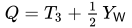
It is conserved (only terms that are overall weak-hypercharge neutral are allowed in the Lagrangian). However, one of the interactions is with the Higgs field. Since the Higgs field vacuum expectation value is nonzero, particles interact with this field all the time even in vacuum. This changes their weak hypercharge (and weak isospin T3). Only a specific combination of them, (electric charge), is conserved.

↑ Return to Menu

Conservation law (physics) in the context of Symmetry in quantum mechanics

Symmetries in quantum mechanics describe features of spacetime and particles which are unchanged under some transformation, in the context of quantum mechanics, relativistic quantum mechanics and quantum field theory, and with applications in the mathematical formulation of the standard model and condensed matter physics. In general, symmetry in physics, invariance, and conservation laws, are fundamentally important constraints for formulating physical theories and models. In practice, they are powerful methods for solving problems and predicting what can happen. While conservation laws do not always give the answer to the problem directly, they form the correct constraints and the first steps to solving a multitude of problems. In application, understanding symmetries can also provide insights on the eigenstates that can be expected. For example, the existence of degenerate states can be inferred by the presence of non-commuting symmetry operators or that the non-degenerate states are also eigenvectors of symmetry operators.

This article outlines the connection between the classical form of continuous symmetries as well as their quantum operators, and relates them to the Lie groups, and relativistic transformations in the Lorentz group and Poincaré group.

↑ Return to Menu