Chest in the context of "Pulmonology"

Play Trivia Questions online!

or

Skip to study material about Chest in the context of "Pulmonology"

Ad spacer

⭐ Core Definition: Chest

The thorax (pl.: thoraces or thoraxes) or chest is a part of the anatomy of mammals and other tetrapod animals located between the neck and the abdomen.

In insects, crustaceans, and the extinct trilobites, the thorax is one of the three main divisions of the body, each in turn composed of multiple segments.

↓ Menu

>>>PUT SHARE BUTTONS HERE<<<
In this Dossier

Chest in the context of Lungs

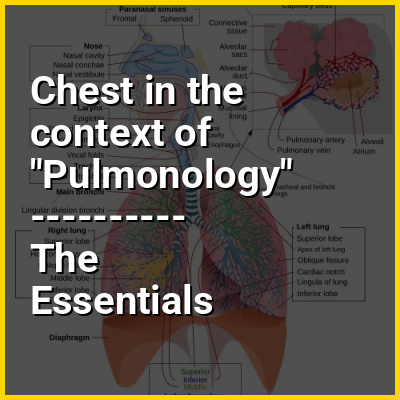
The lungs are the primary organs of the respiratory system in many animals, including humans. In mammals and most other tetrapods, two lungs are located near the backbone on either side of the heart. Their function in the respiratory system is to extract oxygen from the atmosphere and transfer it into the bloodstream, and to release carbon dioxide from the bloodstream into the atmosphere, in a process of gas exchange. Respiration is driven by different muscular systems in different species. Mammals, reptiles and birds use their musculoskeletal systems to support and foster breathing. In early tetrapods, air was driven into the lungs by the pharyngeal muscles via buccal pumping, a mechanism still seen in amphibians. In humans, the primary muscle that drives breathing is the diaphragm. The lungs also provide airflow that makes vocalisation including speech possible.

Humans have two lungs, a right lung and a left lung. They are situated within the thoracic cavity of the chest. The right lung is bigger than the left, and the left lung shares space in the chest with the heart. The lungs together weigh approximately 1.3 kilograms (2.9 lb), and the right is heavier. The lungs are part of the lower respiratory tract that begins at the trachea and branches into the bronchi and bronchioles, which receive air breathed in via the conducting zone. These divide until air reaches microscopic alveoli, where gas exchange takes place. Together, the lungs contain approximately 2,400 kilometers (1,500 mi) of airways and 300 to 500 million alveoli. Each lung is enclosed within a pleural sac of two pleurae which allows the inner and outer walls to slide over each other whilst breathing takes place, without much friction. The inner visceral pleura divides each lung as fissures into sections called lobes. The right lung has three lobes and the left has two. The lobes are further divided into bronchopulmonary segments and lobules. The lungs have a unique blood supply, receiving deoxygenated blood sent from the heart to receive oxygen (the pulmonary circulation) and a separate supply of oxygenated blood (the bronchial circulation).
↑ Return to Menu

Chest in the context of Bust (sculpture)

A bust is a sculpted or cast representation of the upper part of the human body, depicting a person's head and neck, and a variable portion of the chest and shoulders. The piece is normally supported by a plinth. The bust is generally a portrait intended to record the appearance of an individual, but may sometimes represent a type. They may be of any medium used for sculpture, such as marble, bronze, terracotta, plaster, wax or wood.

As a format that allows the most distinctive characteristics of an individual to be depicted with much less work, and therefore expense, and occupying far less space than a full-length statue, the bust has been since ancient times a popular style of life-size portrait sculpture.

↑ Return to Menu

Chest in the context of Breaststroke

Breaststroke is a swimming style in which the swimmer is on their chest and the torso does not rotate. It is the most popular recreational style due to the swimmer's head being out of the water a large portion of the time, and that it can be swum comfortably at slow speeds. In most swimming classes, beginners learn either the breaststroke or the freestyle (front crawl) first. However, at the competitive level, swimming breaststroke at speed requires endurance and strength comparable to other strokes. Some people refer to breaststroke as the "frog" stroke because the arms and legs move somewhat like a frog swimming in the water. The stroke itself is the slowest of any competitive strokes and is thought to be the oldest of all swimming strokes.

↑ Return to Menu

Chest in the context of Chest pain

Chest pain is pain or discomfort in the chest, typically the front of the chest. It may be described as sharp, dull, pressure, heaviness or squeezing. Associated symptoms may include pain in the shoulder, arm, upper abdomen, or jaw, along with nausea, sweating, or shortness of breath. It can be divided into heart-related and non-heart-related pain. Pain due to insufficient blood flow to the heart is also called angina pectoris. Those with diabetes or the elderly may have less clear symptoms.

Serious and relatively common causes include acute coronary syndrome such as a heart attack (31%), pulmonary embolism (2%), pneumothorax, pericarditis (4%), aortic dissection (1%) and esophageal rupture. Other common causes include gastroesophageal reflux disease (30%), muscle or skeletal pain (28%), pneumonia (2%), shingles (0.5%), pleuritis, traumatic and anxiety disorders. Determining the cause of chest pain is based on a person's medical history, a physical exam and other medical tests. About 3% of heart attacks, however, are initially missed.

↑ Return to Menu

Chest in the context of Blunt weapon

A blunt instrument is any solid object that can be used as a hand tool, weapon or thrown projectile for striking a target, exerts impact via direct transfer of force and momentum, and has no sharp point or edge on the contact surface with the target. A blunt weapon may be contrasted with edged weapons in that the former causes mostly closed trauma instead of open incisions or puncture wounds, and are also different to kinetic projectiles such as bullets or arrows, whose speed and kinetic energy are so significant that they cause penetrating trauma often with cavitations even if the projectile is of a blunt shape.

Blunt instruments typically inflict blunt force trauma, causing contusions, fractures and internal bleeding while leaving the skin intact, although they occasionally can produce irregular lacerations by shearing. Depending on the parts of the body struck, organs may be ruptured or otherwise damaged, and attacks with a blunt instrument may be fatal, especially when striking vital areas such as the head, neck and chest.

↑ Return to Menu

Chest in the context of Human sternum

The sternum (pl.: sternums or sterna) or breastbone is a long flat bone located in the central part of the chest. It connects to the ribs via cartilage and forms the front of the rib cage, thus helping to protect the heart, lungs, and major blood vessels from injury. Shaped roughly like a necktie, it is one of the largest and longest flat bones of the body. Its three regions are the manubrium, the body, and the xiphoid process. The word sternum originates from Ancient Greek στέρνον (stérnon) 'chest'.

↑ Return to Menu

Chest in the context of Human back

The human back, also called the dorsum (pl.: dorsa), is the large posterior area of the human body, rising from the top of the buttocks to the back of the neck. It is the surface of the body opposite from the chest and the abdomen. The vertebral column runs the length of the back and creates a central area of recession. The breadth of the back is created by the shoulders at the top and the pelvis at the bottom.

Back pain is a common medical condition, generally benign in origin.

↑ Return to Menu