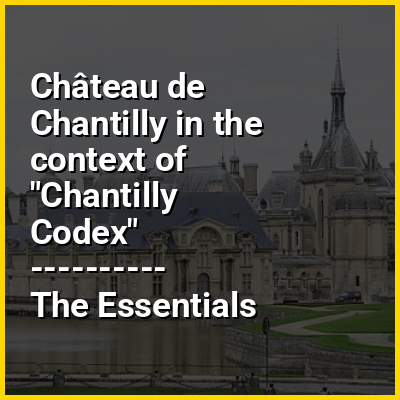
Château de Chantilly in the context of "Chantilly Codex"

Play Trivia Questions online!

or

Skip to study material about Château de Chantilly in the context of "Chantilly Codex"


👉 Château de Chantilly in the context of Chantilly Codex

The Chantilly Codex (Chantilly, Musée Condé MS 564) is a manuscript of medieval music containing pieces from the style known as the Ars subtilior. It is held in the museum at the Château de Chantilly in Chantilly, Oise.

Most of the compositions in the Chantilly Codex date from c. 1350–1400. There are 112 pieces total, mostly by French composers, and all of them polyphonic. The codex contains examples of many of the most popular courtly dance styles of its time, such as ballades, rondeaus, virelais, and isorhythmic motets. Some of the motets are rhythmically extremely complex, and are written in intricately exact musical notation. Two pieces by Baude Cordier were added at a slightly later date at the front of the manuscript, and use unusual shapes to reflect their musical contents. The piece "Belle, Bonne, Sage, Plaisant" (image right) was written to a special lady for the New Year, and reflects the shape of the notation with the text (Lovely, good, wise, and pleasant). The graphic layout of the notation is a play on words on the "Cor" ("heart") in "Cordier".

↓ Explore More Topics
In this Dossier

Château de Chantilly in the context of Musée Condé

The Musée Condé – in English, the Condé Museum – is a French museum located inside the Château de Chantilly in Chantilly, Oise, 40 km north of Paris. In 1897, Henri d'Orléans, Duke of Aumale, son of Louis Philippe I, bequeathed the château and its collections to the Institut de France. It included rooms remodeled as museum spaces and those left as residential quarters in the styles of the 18th and 19th centuries.

↑ Return to Menu

Château de Chantilly in the context of Chantilly, Oise

Chantilly (/ʃænˈtɪli/ shan-TIL-ee, French: [ʃɑ̃tiji] ; Picard: Cantily) is a commune in the Oise department in the Valley of the Nonette in the Hauts-de-France region of Northern France. Surrounded by Chantilly Forest, the town of 10,863 inhabitants (2017) falls within the metropolitan area of Paris. It lies 38.4 km (23.9 mi) north-northeast of the centre of Paris and together with six neighbouring communes forms an urban area of 37,254 inhabitants (2018).

Intimately tied to the House of Montmorency in the 15th to 17th centuries, the Château de Chantilly was home to the Princes of Condé, cousins of the Kings of France, from the 17th to the 19th centuries. It now houses the Musée Condé. Chantilly is also known for its horse racing track, Chantilly Racecourse, where prestigious races are held for the Prix du Jockey Club and Prix de Diane. Chantilly and the surrounding communities are home to the largest racehorse-training community in France.

↑ Return to Menu

Château de Chantilly in the context of La Vengeance Raguidel

La Vengeance Raguidel is a 13th-century poem written in Old French. It is widely, although not universally, attributed to Raoul de Houdenc. It consists of 6182 octosyllabic verses. The title comes from line 6173 of the Chantilly manuscript.

↑ Return to Menu

Château de Chantilly in the context of André Le Nôtre

André Le Nôtre (French pronunciation: [ɑ̃dʁe notʁ]; 12 March 1613 – 15 September 1700), originally rendered as André Le Nostre, was a French landscape architect and the principal gardener of King Louis XIV of France. He was the landscape architect who designed the gardens of the Palace of Versailles; his work represents the height of the French formal garden style, or jardin à la française.

Prior to working on Versailles, Le Nôtre collaborated with Louis Le Vau and Charles Le Brun on the park at Vaux-le-Vicomte. His other works include the design of gardens and parks at Bicton Park Botanical Gardens, Chantilly, Fontainebleau, Saint-Cloud and Saint-Germain. His contribution to planning was also significant: at the Tuileries in Paris he extended the westward vista, which later became the Avenue des Champs-Élysées within the Axe historique.

↑ Return to Menu