Catholic Monarchs of Spain in the context of "Sephardic Jews"

Play Trivia Questions online!

or

Skip to study material about Catholic Monarchs of Spain in the context of "Sephardic Jews"

Ad spacer

⭐ Core Definition: Catholic Monarchs of Spain

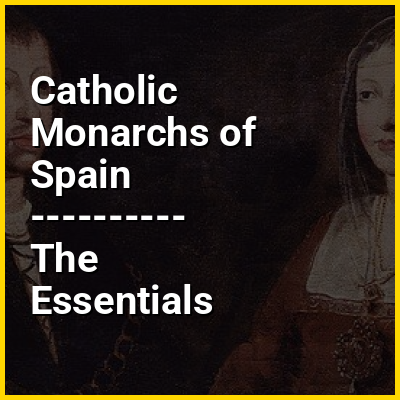
The Catholic Monarchs were Queen Isabella I of Castile (r. 1474–1504) and King Ferdinand II of Aragon (r. 1479–1516), whose marriage and joint rule marked the de facto unification of Spain. They were both from the House of Trastámara and were second cousins, as they were both descended from John I of Castile. To remove the obstacle that this consanguinity would otherwise have posed to their marriage under canon law, they were given a papal dispensation by Sixtus IV. They married on October 19, 1469, in the city of Valladolid; Isabella was 18 years old and Ferdinand a year younger. Most scholars generally accept that the unification of Spain can essentially be traced back to the marriage of Ferdinand and Isabella. Their reign was called by W.H. Prescott "the most glorious epoch in the annals of Spain."

Spain was formed as a dynastic union of two crowns rather than a unitary state, as Castile and Aragon remained separate kingdoms until the Nueva Planta decrees of 1707–1716. The court of Ferdinand and Isabella was constantly on the move in order to bolster local support for the crown from local feudal lords. The title of "Catholic King and Queen" was officially bestowed on Ferdinand and Isabella by Pope Alexander VI in 1494, in recognition of their defence of the Catholic faith within their realms.
↓ Menu

>>>PUT SHARE BUTTONS HERE<<<
In this Dossier

Catholic Monarchs of Spain in the context of Charles V, Holy Roman Emperor

Charles V (24 February 1500 – 21 September 1558) was Holy Roman Emperor and Archduke of Austria from 1519 to 1556, King of Spain (as Charles I) from 1516 to 1556, King of Sicily and Naples from 1516 to 1554, and also Lord of the Netherlands and titular Duke of Burgundy (as Charles II) from 1506 to 1555. He was heir to and then head of the rising House of Habsburg. His dominions in Europe included the Holy Roman Empire, extending from Germany to northern Italy with rule over the Austrian hereditary lands and Burgundian Low Countries, and Spain with its possessions of the southern Italian kingdoms of Sicily, Naples, and Sardinia. In the Americas, he oversaw the continuation of Spanish colonization and a short-lived German colonization. The personal union of the European and American territories he ruled was the first collection of realms labelled "the empire on which the sun never sets".

Charles was born in Flanders to Habsburg Archduke Philip the Handsome, son of Maximilian I, Holy Roman Emperor and Mary of Burgundy, and Joanna of Castile, younger child of Isabella I of Castile and Ferdinand II of Aragon, the Catholic Monarchs of Spain. Heir of his grandparents, Charles inherited his family dominions at a young age. After his father's death in 1506, he inherited the Habsburg Netherlands in the Low Countries. In 1516 he became King of Spain as co-monarch of Castile and Aragon with his mother. Spain's possessions included the Castilian colonies of the West Indies and the Spanish Main, as well as Naples, Sicily, and Sardinia. At the death of his grandfather Maximilian in 1519, he inherited the Austrian hereditary lands and was elected as Holy Roman Emperor. He adopted the Imperial name of Charles V as his main title, and styled himself as a new Charlemagne.

↑ Return to Menu

Catholic Monarchs of Spain in the context of Voyages of Christopher Columbus

Between 1492 and 1504, the Italian explorer and navigator Christopher Columbus led four transatlantic maritime expeditions in the name of the Catholic Monarchs of Spain to the Caribbean and to Central and South America. These voyages led to Europeans learning about the New World the Americas. This was an early breakthrough in the period known in Europe as the Age of Exploration, which saw the colonization of the Americas, a related biological exchange, and trans-Atlantic trade. These events, the effects and consequences of which persist to the present, are often cited as the beginning of the modern era.

Born in the Republic of Genoa, Columbus was a navigator who sailed in search of a westward route to India, China, Japan and the Spice Islands thought to be the East Asian source of spices and other precious oriental goods obtainable only through arduous overland routes. Columbus was partly inspired by 13th-century Italian explorer Marco Polo in his ambition to explore Asia. His initial belief that he had reached "the Indies" has resulted in the name "West Indies" being attached to the Bahamas and the other islands of the Caribbean.

↑ Return to Menu

Catholic Monarchs of Spain in the context of Sephardic

Sephardic Jews, also known as Sephardi Jews or Sephardim, and rarely as Iberian Peninsular Jews, are a Jewish diaspora population associated with the historic Jewish communities of the Iberian Peninsula (Spain and Portugal) and their descendants. The term "Sephardic" comes from Sepharad, the Hebrew word for Iberia. These communities flourished for centuries in Iberia until they were expelled in the late 15th century. Over time, "Sephardic" has also come to refer more broadly to Jews, particularly in the Middle East and North Africa, who adopted Sephardic religious customs and legal traditions, often due to the influence of exiles. In some cases, Ashkenazi Jews who settled in Sephardic communities and adopted their liturgy are also included under this term. Today, Sephardic Jews form a major component of the global Jewish population, with the largest population living in Israel.

The earliest documented Jewish presence in the Iberian Peninsula dates to the Roman period, beginning in the first centuries CE. After facing persecution under the Pagan and later Christian Visigothic Kingdom, Jewish communities flourished for centuries under Muslim rule in Al-Andalus following the Umayyad conquest (711–720s), a period often seen as a golden age. Their status declined under the radical Almoravid and Almohad dynasties and during the Christian Reconquista. In 1391, anti-Jewish riots in Castile and Aragon led to massacres and mass forced conversions. In 1492, the Alhambra Decree by the Catholic Monarchs expelled Jews from Spain, and in 1496, King Manuel I of Portugal issued a similar edict. These events led to migrations, forced conversions, and executions. Sephardic Jews dispersed widely: many found refuge in the Ottoman Empire, settling in cities such as Istanbul, Salonica, and İzmir; others relocated to North African centers like Fez, Algiers, and Tunis; Italian ports including Venice and Livorno; and parts of the Balkans, the Levant (notably Safed), and the Netherlands (notably Amsterdam). Smaller communities also emerged in France, England, and the Americas, where Sephardim often played key roles in commerce and diplomacy.

↑ Return to Menu

Catholic Monarchs of Spain in the context of Spanish Golden Age

The Spanish Golden Age (Spanish: Siglo de Oro Spanish pronunciation: [ˈsiɣlo ðe ˈoɾo], "Golden Century") was a period that coincided with the political rise of the Catholic Monarchs of Spain and the Spanish Habsburgs, during which arts and literature flourished in Spain. It is associated with the reigns of Isabella I, Ferdinand II, Charles V, Philip II, Philip III, and Philip IV. The Golden Age is generally considered to begin in 1492, marked by the end of the Reconquista, Christopher Columbus’s voyages, and the publication of Antonio de Nebrija's Grammar of the Castilian Language. It ended around 1659 with the Treaty of the Pyrenees, though some extend it to 1681, after the death of Pedro Calderón de la Barca.

The period of cultural flourishing saw major patrons, with El Escorial attracting leading artists including El Greco, contributing to a distinct Spanish style, and also includes the Plateresque/Renaissance and early Spanish Baroque styles, with major figures like Miguel de Cervantes, Lope de Vega, Luis de Góngora, Diego Velázquez, and composers such as Tomás Luis de Victoria and Francisco Guerrero.

↑ Return to Menu

Catholic Monarchs of Spain in the context of Reconquista

The Reconquista (Spanish and Portuguese for 'reconquest') or the fall of al-Andalus was a series of military and cultural campaigns by Northern Christian polities against Muslim-ruled al-Andalus, which had previously been part of the Visigothic Kingdom before the Muslim Conquest of 711. The Reconquista concluded in 1492 with the capture of Granada by the Catholic Monarchs of Spain, thereby ending the presence of any Muslim rule on the Iberian Peninsula.

The beginning of the Reconquista is traditionally dated to the Battle of Covadonga (c. 718 or 722), approximately a decade after the Muslim conquest of the Iberian Peninsula began, in which the army of the Kingdom of Asturias achieved the first Christian victory over the forces of the Umayyad Caliphate since the beginning of the military invasion. By the early 11th century, the Caliphate of Córdoba endured state collapse into a series of petty successor states known as taifas. The northern kingdoms advanced further against these fiefdoms and often made them subject to a protection racket system.

↑ Return to Menu

Catholic Monarchs of Spain in the context of Isabella I of Castile

Isabella I (Spanish: Isabel I; 22 April 1451 – 26 November 1504), also called Isabella the Catholic (Spanish: Isabel la Católica), was Queen of Castile and León from 1474 until her death in 1504. She was also Queen of Aragon from 1479 until her death as the wife of King Ferdinand II. Reigning together over a dynastically unified Spain, Isabella and Ferdinand are known as the Catholic Monarchs. Her reign marked the end of Reconquista and also the start of Spanish Empire and dominance of Spain over European politics for the next century.

Isabella's marriage to Ferdinand of Aragon in 1469 created the basis of the de facto unification of Spain. With Ferdinand's help, she won the War of the Castilian Succession, securing her position as Queen of Castille. Isabella reorganized the governmental system, brought the crime rate down, and unburdened the kingdom of the debt which her half-brother King Henry IV had left behind. Her reforms and those she made with her husband had an influence that extended well beyond the borders of their united kingdoms.

↑ Return to Menu

Catholic Monarchs of Spain in the context of Way of St James

The Camino de Santiago (Latin: Peregrinatio Compostellana, lit.'Pilgrimage of Compostela'; Galician: O Camiño de Santiago), or the Way of St. James in English, is a network of pilgrims' ways or pilgrimages leading to the shrine of the apostle James in the cathedral of Santiago de Compostela in Galicia in northwestern Spain, where tradition holds that the remains of the apostle are buried. Pilgrims follow its routes as a form of spiritual path or retreat for their spiritual growth. It is also popular with hikers, cyclists, and organized tour groups.

Created and established in the beginning of the 9th century following the discovery of the relics of Saint James the Great, the Way of St. James became a major pilgrimage route of medieval Christianity from the 10th century onwards. Following the end of the Granada War in 1492, under the reign of the Catholic Monarchs Ferdinand II of Aragon and Isabella I of Castile, Pope Alexander VI officially declared the Camino de Santiago to be one of the "three great pilgrimages of Christendom", along with Jerusalem and the Via Francigena to Rome.

↑ Return to Menu