CODATA in the context of Open science


CODATA in the context of Open science

CODATA Study page number 1 of 1

Play TriviaQuestions Online!

or

Skip to study material about CODATA in the context of "Open science"


⭐ Core Definition: CODATA

The Committee on Data of the International Science Council (CODATA) was established in 1966 as the Committee on Data for Science and Technology, originally part of the International Council of Scientific Unions, now part of the International Science Council (ISC). Since November 2023 its president is the Catalan researcher Mercè Crosas.

CODATA exists to promote global collaboration, to advance open science, and to improve the availability and usability of data for all areas of research. CODATA supports the principle that data produced by research and susceptible to being used for research should be as open as possible and as closed as necessary. CODATA works also to advance the interoperability and the usability of such data; research data should be FAIR (findable, accessible, interoperable and reusable). By promoting this policy, technological, and cultural changes that are essential to promote open science, CODATA helps advance the ISC's vision and mission of advancing science as a global public good.

↓ Menu
HINT:

In this Dossier

CODATA in the context of Electric constant

Vacuum permittivity, commonly denoted ε0 (pronounced "epsilon nought" or "epsilon zero"), is the value of the absolute dielectric permittivity of classical vacuum. It may also be referred to as the permittivity of free space, the electric constant, or the distributed capacitance of the vacuum. It is an ideal (baseline) physical constant. Its CODATA value is:

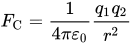
It is a measure of how dense of an electric field is "permitted" to form in response to electric charges and relates the units for electric charge to mechanical quantities such as length and force. For example, the force between two separated electric charges with spherical symmetry (in the vacuum of classical electromagnetism) is given by Coulomb's law:Here, q1 and q2 are the charges, r is the distance between their centres, and the value of the constant fraction 1/(4πε0) is approximately 9×10 N⋅m⋅C. Likewise, ε0 appears in Maxwell's equations, which describe the properties of electric and magnetic fields and electromagnetic radiation, and relate them to their sources. In electrical engineering, ε0 itself is used as a unit to quantify the permittivity of various dielectric materials.

View the full Wikipedia page for Electric constant
↑ Return to Menu

CODATA in the context of Dalton (unit)

The dalton or unified atomic mass unit (symbols: Da or u, respectively) is a unit of mass defined as 1/12 of the mass of an unbound neutral atom of carbon-12 in its nuclear and electronic ground state and at rest. It is a non-SI unit accepted for use with SI. The word "unified" emphasizes that the definition was accepted by both IUPAP and IUPAC. The atomic mass constant, denoted mu, is an atomic-scale reference mass, defined identically, but it is not a unit of mass. Expressed in terms of ma(C), the atomic mass of carbon-12: mu = ma(C)/12 = 1 Da. The dalton's numerical value in terms of the fixed-h kilogram is an experimentally determined quantity that, along with its inherent uncertainty, is updated periodically. As listed in the 9th edition, version 3.02, of the SI Brochure, the 2022 CODATA recommended value of the atomic mass constant expressed in the SI base unit kilogram is:

The previous value given for the dalton (1 Da = 1 u = mu) was the 2018 CODATA recommended value:

View the full Wikipedia page for Dalton (unit)
↑ Return to Menu

CODATA in the context of Vacuum permeability

The vacuum magnetic permeability (variously vacuum permeability, permeability of free space, permeability of vacuum, magnetic constant) is the magnetic permeability in a classical vacuum. It is a physical constant, conventionally written as μ0 (pronounced "mu nought" or "mu zero"), approximately equal to 4π × 10 H/m (by the former definition of the ampere). It quantifies the strength of the magnetic field induced by an electric current. Expressed in terms of SI base units, it has the unit kgms⋅A. It can be also expressed in terms of SI derived units, N⋅A, H·m, or T·m·A, which are all equivalent.

Since the revision of the SI in 2019 (when the values of e and h were fixed as defined quantities), μ0 is an experimentally determined constant, its value being proportional to the dimensionless fine-structure constant, which is known to a relative uncertainty of 1.6×10, with no other dependencies with experimental uncertainty. Its value in SI units as recommended by CODATA is:

View the full Wikipedia page for Vacuum permeability
↑ Return to Menu

CODATA in the context of Magnetic constant

The vacuum magnetic permeability (variously vacuum permeability, permeability of free space, permeability of vacuum, magnetic constant) is the magnetic permeability in a classical vacuum. It is a physical constant, conventionally written as μ0 (pronounced "mu nought" or "mu zero"), approximately equal to 4π × 10 H/m (by the former definition of the ampere). It quantifies the strength of the magnetic field induced by an electric current. Expressed in terms of SI base units, it has the unit kgms⋅A. It can be also expressed in terms of SI derived units, N⋅A, H·m, or T·m·A, which are all equivalent.

Since the revision of the SI in 2019 (when the values of e and h were fixed as defined quantities), μ0 is an experimentally determined constant with its value proportional to the dimensionless fine-structure constant, which is known to a relative uncertainty of 1.6×10, with no other dependencies with experimental uncertainty. Its value in SI units as recommended by CODATA is:

View the full Wikipedia page for Magnetic constant
↑ Return to Menu

CODATA in the context of KDa

The dalton (symbol: Da), or unified atomic mass unit (symbol: u), is a unit of mass defined as 1/12 of the mass of an unbound neutral atom of carbon-12 in its nuclear and electronic ground state and at rest. It is a non-SI unit accepted for use with SI. The word "unified" emphasizes that the definition was accepted by both IUPAP and IUPAC. The atomic mass constant, denoted mu, is an atomic-scale reference mass, defined identically, but it is not a unit of mass. Expressed in terms of ma(C), the atomic mass of carbon-12: mu = ma(C)/12 = 1 Da. The dalton's numerical value in terms of the fixed-h kilogram is an experimentally determined quantity that, along with its inherent uncertainty, is updated periodically. As listed in the 9th edition, version 3.02, of the SI Brochure, the 2022 CODATA recommended value of the atomic mass constant expressed in the SI base unit kilogram is:

The previous value given for the dalton (1 Da = 1 u = mu) was the 2018 CODATA recommended value:

View the full Wikipedia page for KDa
↑ Return to Menu

CODATA in the context of Hartree

The hartree (symbol: Eh), also known as the Hartree energy, is the unit of energy in the atomic units system, named after the British physicist Douglas Hartree. Its CODATA recommended value is Eh = 4.3597447222060(48)×10 J = 27.211386245981(30) eV. The name "hartree" was suggested for this unit of energy.

The hartree is approximately the negative electric potential energy of the electron in a hydrogen atom in its ground state and, by the virial theorem, approximately twice its ionization energy; the relationships are not exact because of the finite mass of the nucleus of the hydrogen atom and relativistic corrections.

View the full Wikipedia page for Hartree
↑ Return to Menu