Electric constant in the context of CODATA


Electric constant in the context of CODATA

Electric constant Study page number 1 of 1

Play TriviaQuestions Online!

or

Skip to study material about Electric constant in the context of "CODATA"


⭐ Core Definition: Electric constant

Vacuum permittivity, commonly denoted ε0 (pronounced "epsilon nought" or "epsilon zero"), is the value of the absolute dielectric permittivity of classical vacuum. It may also be referred to as the permittivity of free space, the electric constant, or the distributed capacitance of the vacuum. It is an ideal (baseline) physical constant. Its CODATA value is:

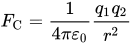
It is a measure of how dense of an electric field is "permitted" to form in response to electric charges and relates the units for electric charge to mechanical quantities such as length and force. For example, the force between two separated electric charges with spherical symmetry (in the vacuum of classical electromagnetism) is given by Coulomb's law:Here, q1 and q2 are the charges, r is the distance between their centres, and the value of the constant fraction 1/(4πε0) is approximately 9×10 N⋅m⋅C. Likewise, ε0 appears in Maxwell's equations, which describe the properties of electric and magnetic fields and electromagnetic radiation, and relate them to their sources. In electrical engineering, ε0 itself is used as a unit to quantify the permittivity of various dielectric materials.
↓ Menu
HINT:

In this Dossier

Electric constant in the context of Physical constant

A physical constant, sometimes called a fundamental physical constant or universal constant, is a physical quantity that cannot be explained by a theory and therefore must be measured experimentally. It is distinct from a mathematical constant, which has a fixed numerical value, but does not directly involve any physical measurement.

There are many physical constants in science, some of the most widely recognized being the speed of light in vacuum c, the gravitational constant G, the Planck constant h, the electric constant ε0, and the elementary charge e. Physical constants can take many dimensional forms: the speed of light has dimension of length divided by time (TL), while the proton-to-electron mass ratio is dimensionless.

View the full Wikipedia page for Physical constant
↑ Return to Menu