Buddhas of Bamiyan in the context of "Zuhak, Bamyan"

Play Trivia Questions online!

or

Skip to study material about Buddhas of Bamiyan in the context of "Zuhak, Bamyan"

Ad spacer

⭐ Core Definition: Buddhas of Bamiyan

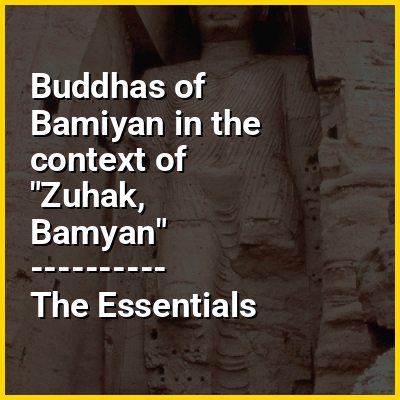
The Buddhas of Bamiyan (Pashto: د باميانو بودايي پژۍ, Dari: تندیس‌های بودا در بامیان) were two monumental Buddhist Reliefs in the Bamiyan Valley of Afghanistan, carved possibly around the 6th-century. Located 130 kilometres (81 mi) to the northwest of Kabul, at an elevation of 2,500 metres (8,200 ft), carbon dating of the structural components of the Buddhas has determined that the smaller 38 m (125 ft) "Eastern Buddha" was built around 570 CE, and the larger 55 m (180 ft) "Western Buddha" was built around 618 CE, which would date both to the time when the Hephthalites ruled the region.

In March 2001, both structures were destroyed by the Taliban following an order given on February 26, 2001, by Taliban leader Mullah Muhammad Omar, to destroy all the statues in Afghanistan "so that no one can worship or respect them in the future". International and local opinion condemned the destruction of the Buddhas.

↓ Menu

>>>PUT SHARE BUTTONS HERE<<<

👉 Buddhas of Bamiyan in the context of Zuhak, Bamyan


Shahr-e Zuhak or City of Zuhak (Dari: شهر ضحاک), also known as The Red City, is a historic city ruins in Bamyan, Afghanistan which was once home to 3,000 people. The fortress is believed to have been founded between 500 and 600 AD by the Hephthalites, around the same time as the Buddhas of Bamyan were carved into rock in the Bamiyan valley. The city lies at the easternmost point of the Bamyan valley, above the confluence of the Kunduz and Kalu Ganga rivers. The valley used to be a part of a route connecting Europe to India and China.

Zuhak was fortified during the Islamic period (10th - 13th century), under the rule of the Ghaznavid and Ghorid dynasties. The fortress was later ransacked by Genghis Khan and his army during the Siege of Bamyan, as a part of the greater invasion of the Khwarazmian Empire.

↓ Explore More Topics
In this Dossier

Buddhas of Bamiyan in the context of Cultural genocide

Cultural genocide or culturicide is a concept first described by Polish lawyer Raphael Lemkin in 1944, in the same book that coined the term genocide. The destruction of culture was a central component in Lemkin's formulation of genocide. The precise definition of cultural genocide remains contested, and the United Nations does not include it in the definition of genocide used in the 1948 Genocide Convention. The Armenian genocide Museum defines culturicide as "acts and measures undertaken to destroy nations' or ethnic groups' culture through spiritual, national, and cultural destruction", which appears to be essentially the same as ethnocide. Some ethnologists, such as Robert Jaulin, use the term ethnocide as a substitute for cultural genocide, although this usage has been criticized as risking the confusion between ethnicity and culture. Cultural genocide and ethnocide have in the past been used in distinct contexts. Cultural genocide without ethnocide is conceivable when a distinct ethnic identity is kept, but distinct cultural elements are eliminated.

Culturicide involves the eradication and destruction of cultural artifacts, such as books, artworks, and structures. The issue is addressed in multiple international treaties, including the Geneva Conventions and the Rome Statute, which define war crimes associated with the destruction of culture. Cultural genocide may also involve forced assimilation, as well as the suppression of a language or cultural activities that do not conform to the destroyer's notion of what is appropriate. Among many other potential reasons, cultural genocide may be committed for religious motives (e.g., iconoclasm which is based on aniconism); as part of a campaign of ethnic cleansing in an attempt to remove the evidence of a people from a specific locale or history; as part of an effort to implement a Year zero, in which the past and its associated culture is deleted and history is "reset". The drafters of the 1948 Genocide Convention initially considered using the term, but later dropped it from inclusion. The term "cultural genocide" has been considered in various draft United Nations declarations, but it is not used by the UN Genocide Convention.
↑ Return to Menu

Buddhas of Bamiyan in the context of Buddhism in Afghanistan

Buddhism, a religion founded by Gautama Buddha, first arrived in modern-day Afghanistan through the conquests of Ashoka (r. 268–232 BCE), the third emperor of the Maurya Empire. Among the earliest notable sites of Buddhist influence in the country is a bilingual mountainside inscription in Greek and Aramaic that dates back to 260 BCE and was found on the rocky outcrop of Chil Zena near Kandahar.

Many prominent Buddhist monks were based in Afghanistan during this period: Menander I (r. 165–130 BCE), a Greco-Bactrian king, was a renowned patron of Buddhism and is immortalized in the Milinda Panha, a Pali-language Buddhist text; Mahadharmaraksita, a 2nd-century BCE Indo-Greek monk, is said to have led 30,000 Buddhist monks from "Alasandra, the city of the Yonas" (a colony of Alexander the Great, located approximately 150 kilometres or 93 miles to the north of modern-day Kabul) to Sri Lanka for the dedication of the Mahathupa in Anuradhapura, according to the Mahavamsa (Chap. XXIX); Lokaksema, a 2nd-century Kushan monk, travelled to the Chinese capital city of Luoyang during the reign of the Han dynasty, and was the first translator of Mahayana Buddhist scriptures into the Chinese language.

↑ Return to Menu

Buddhas of Bamiyan in the context of Gandharan Buddhism

Gandhāran Buddhism was the Buddhist culture of ancient Gandhāra, which was a major center of Buddhism in the northwestern Indian subcontinent from the 3rd century BCE to approximately 1200 CE. Ancient Gandhāra corresponds to modern day north Pakistan, mainly the Peshawar Valley and Potohar Plateau as well as Afghanistan's Jalalabad. The region has yielded the Gandhāran Buddhist texts written in Gāndhārī Prakrit the oldest Buddhist manuscripts yet discovered (1st century CE). Gandhāra was also home to a unique Buddhist artistic and architectural culture which blended elements from Indian, Hellenistic, Roman and Parthian art. Buddhist Gandhāra was also influential as the gateway through which Buddhism spread to Central Asia and China.

↑ Return to Menu

Buddhas of Bamiyan in the context of Afghan Post

Afghan Post is the national mail and courier organization of Afghanistan with its headquarters in Kabul. It has offices in all 34 provinces and 420 or so districts of Afghanistan.

Most homes in Afghanistan, particularly in older neighborhoods and in the rural areas, do not have street addresses. Names and other descriptions may be used in place of street addresses.

↑ Return to Menu