Binary operation in the context of Matrix multiplication


Binary operation in the context of Matrix multiplication

Binary operation Study page number 1 of 3

Play TriviaQuestions Online!

or

Skip to study material about Binary operation in the context of "Matrix multiplication"


⭐ Core Definition: Binary operation

In mathematics, a binary operation or dyadic operation is a rule for combining two elements (called operands) to produce another element. More formally, a binary operation is an operation of arity two.

More specifically, a binary operation on a set is a binary function that maps every pair of elements of the set to an element of the set. Examples include the familiar arithmetic operations like addition, subtraction, multiplication, set operations like union, complement, intersection. Other examples are readily found in different areas of mathematics, such as vector addition, matrix multiplication, and conjugation in groups.

↓ Menu
HINT:

👉 Binary operation in the context of Matrix multiplication

In mathematics, specifically in linear algebra, matrix multiplication is a binary operation that produces a matrix from two matrices. For matrix multiplication, the number of columns in the first matrix must be equal to the number of rows in the second matrix. The resulting matrix, known as the matrix product, has the number of rows of the first and the number of columns of the second matrix. The product of matrices A and B is denoted as AB.

Matrix multiplication was first described by the French mathematician Jacques Philippe Marie Binet in 1812, to represent the composition of linear maps that are represented by matrices. Matrix multiplication is thus a basic tool of linear algebra, and as such has numerous applications in many areas of mathematics, as well as in applied mathematics, statistics, physics, economics, and engineering.Computing matrix products is a central operation in all computational applications of linear algebra.

↓ Explore More Topics
In this Dossier

Binary operation in the context of Material conditional

The material conditional (also known as material implication) is a binary operation commonly used in logic. When the conditional symbol is interpreted as material implication, a formula is true unless is true and is false.

Material implication is used in all the basic systems of classical logic as well as some nonclassical logics. It is assumed as a model of correct conditional reasoning within mathematics and serves as the basis for commands in many programming languages. However, many logics replace material implication with other operators such as the strict conditional and the variably strict conditional. Due to the paradoxes of material implication and related problems, material implication is not generally considered a viable analysis of conditional sentences in natural language.

View the full Wikipedia page for Material conditional
↑ Return to Menu

Binary operation in the context of Exponentiation

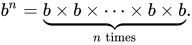
In mathematics, exponentiation, denoted b, is an operation involving two numbers: the base, b, and the exponent or power, n. When n is a positive integer, exponentiation corresponds to repeated multiplication of the base: that is, b is the product of multiplying n bases:In particular, .

The exponent is usually shown as a superscript to the right of the base as b or in computer code as b^n. This binary operation is often read as "b to the power n"; it may also be referred to as "b raised to the nth power", "the nth power of b", or, most briefly, "b to the n".

View the full Wikipedia page for Exponentiation
↑ Return to Menu

Binary operation in the context of Algebraic structures

In mathematics, an algebraic structure or algebraic system consists of a nonempty set A (called the underlying set, carrier set or domain), a collection of operations on A (typically binary operations such as addition and multiplication), and a finite set of identities (known as axioms) that these operations must satisfy.

An algebraic structure may be based on other algebraic structures with operations and axioms involving several structures. For instance, a vector space involves a second structure called a field, and an operation called scalar multiplication between elements of the field (called scalars), and elements of the vector space (called vectors).

View the full Wikipedia page for Algebraic structures
↑ Return to Menu

Binary operation in the context of Algebraic operation

In mathematics, a basic algebraic operation is a mathematical operation similar to any one of the common operations of elementary algebra, which include addition, subtraction, multiplication, division, raising to a whole number power, and taking roots (fractional power). The operations of elementary algebra may be performed on numbers, in which case they are often called arithmetic operations. They may also be performed, in a similar way, on variables, algebraic expressions, and more generally, on elements of algebraic structures, such as groups and fields.

An algebraic operation on a set may be defined more formally as a function that maps to the tuples of a given length of elements of . The length of the tuples is called the arity of the operation, and each member of the tuple is called an operand. The most common case is the case of arity two, where the operation is called a binary operation and the operands form an ordered pair. A unary operation is an operation of arity one that has only one operand; for example, the square root. An example of a ternary operation (arity three) is the triple product.

View the full Wikipedia page for Algebraic operation
↑ Return to Menu

Binary operation in the context of Unary operation

In mathematics, a unary operation is an operation with only one operand, i.e. a single input. This is in contrast to binary operations, which use two operands. An example is any function , where A is a set; the function is a unary operation on A.

Common notations are prefix notation (e.g. ¬, ), postfix notation (e.g. factorial n!), functional notation (e.g. sinx or sin(x)), and superscripts (e.g. transpose A). Other notations exist as well, for example, in the case of the square root, a horizontal bar extending the square root sign over the argument can indicate the extent of the argument.

View the full Wikipedia page for Unary operation
↑ Return to Menu

Binary operation in the context of Operation (mathematics)

In mathematics, an operation is a function from a set to itself. For example, an operation on real numbers will take in real numbers and return a real number. An operation can take zero or more input values (also called "operands" or "arguments") to a well-defined output value. The number of operands is the arity of the operation.

The most commonly studied operations are binary operations (i.e., operations of arity 2), such as addition and multiplication, and unary operations (i.e., operations of arity 1), such as additive inverse and multiplicative inverse. An operation of arity zero, or nullary operation, is a constant. The mixed product is an example of an operation of arity 3, also called ternary operation.

View the full Wikipedia page for Operation (mathematics)
↑ Return to Menu

Binary operation in the context of Subring

In mathematics, a subring of a ring R is a subset of R that is itself a ring when binary operations of addition and multiplication on R are restricted to the subset, and that shares the same multiplicative identity as R.
Cite error: There are <ref group=lower-alpha> tags or {{efn}} templates on this page, but the references will not show without a {{reflist|group=lower-alpha}} template or {{notelist}} template (see the help page).

View the full Wikipedia page for Subring
↑ Return to Menu

Binary operation in the context of Group (mathematics)

In mathematics, a group is a set with an operation that combines any two elements of the set to produce a third element within the same set and the following conditions must hold: the operation is associative, it has an identity element, and every element of the set has an inverse element. For example, the integers with the addition operation form a group.

The concept of a group was elaborated for handling, in a unified way, many mathematical structures such as numbers, geometric shapes and polynomial roots. Because the concept of groups is ubiquitous in numerous areas both within and outside mathematics, some authors consider it as a central organizing principle of contemporary mathematics.

View the full Wikipedia page for Group (mathematics)
↑ Return to Menu

Binary operation in the context of Subgroup

In group theory, a branch of mathematics, a subset of a group G is a subgroup of G if the members of that subset form a group with respect to the group operation in G.

Formally, given a group G under a binary operation ∗, a subset H of G is called a subgroup of G if H also forms a group under the operation ∗. More precisely, H is a subgroup of G if the restriction of ∗ to H × H is a group operation on H. This is often denoted HG, read as "H is a subgroup of G".

View the full Wikipedia page for Subgroup
↑ Return to Menu

Binary operation in the context of Semilattice

In mathematics, a join-semilattice (or upper semilattice) is a partially ordered set that has a join (a least upper bound) for any nonempty finite subset. Dually, a meet-semilattice (or lower semilattice) is a partially ordered set which has a meet (or greatest lower bound) for any nonempty finite subset. Every join-semilattice is a meet-semilattice in the inverse order and vice versa.

Semilattices can also be defined algebraically: join and meet are associative, commutative, idempotent binary operations, and any such operation induces a partial order (and the respective inverse order) such that the result of the operation for any two elements is the least upper bound (or greatest lower bound) of the elements with respect to this partial order.

View the full Wikipedia page for Semilattice
↑ Return to Menu

Binary operation in the context of Ring (mathematics)

In mathematics, a ring is an algebraic structure consisting of a set with two binary operations typically called addition and multiplication and denoted like addition and multiplication of integers. They work similarly to integer addition and multiplication, except that multiplication in a ring does not need to be commutative. Ring elements may be numbers such as integers or complex numbers, but they may also be non-numerical objects such as polynomials, square matrices, functions, and power series.

More formally, a ring is a set that is endowed with two binary operations (addition and multiplication) such that the ring is an abelian group with respect to addition. The multiplication is associative, is distributive over the addition operation, and has a multiplicative identity element. Some authors apply the term ring to a further generalization, often called a rng, that omits the requirement for a multiplicative identity, and instead call the structure defined above a ring with identity.

View the full Wikipedia page for Ring (mathematics)
↑ Return to Menu

Binary operation in the context of Commutative property

In mathematics, a binary operation is commutative if changing the order of the operands does not change the result. It is a fundamental property of many binary operations, and many mathematical proofs depend on it. Perhaps most familiar as a property of arithmetic, e.g. "3 + 4 = 4 + 3" or "2 × 5 = 5 × 2", the property can also be used in more advanced settings. The name is needed because there are operations, such as division and subtraction, that do not have it (for example, "3 − 5 ≠ 5 − 3"); such operations are not commutative, and so are referred to as noncommutative operations.

The idea that simple operations, such as the multiplication and addition of numbers, are commutative was for many centuries implicitly assumed. Thus, this property was not named until the 19th century, when new algebraic structures started to be studied.

View the full Wikipedia page for Commutative property
↑ Return to Menu

Binary operation in the context of Associative property

In mathematics, the associative property is a property of some binary operations that rearranging the parentheses in an expression will not change the result. In propositional logic, associativity is a valid rule of replacement for expressions in logical proofs.

Within an expression containing two or more occurrences in a row of the same associative operator, the order in which the operations are performed does not matter as long as the sequence of the operands is not changed. That is (after rewriting the expression with parentheses and in infix notation if necessary), rearranging the parentheses in such an expression will not change its value. Consider the following equations:

View the full Wikipedia page for Associative property
↑ Return to Menu

Binary operation in the context of Distribution (logic)

In mathematics, the distributive property of binary operations is a generalization of the distributive law, which asserts that the equalityis always true in elementary algebra.For example, in elementary arithmetic, one hasTherefore, one would say that multiplication distributes over addition.

This basic property of numbers is part of the definition of most algebraic structures that have two operations called addition and multiplication, such as complex numbers, polynomials, matrices, rings, and fields. It is also encountered in Boolean algebra and mathematical logic, where each of the logical and (denoted ) and the logical or (denoted ) distributes over the other.

View the full Wikipedia page for Distribution (logic)
↑ Return to Menu