Belvedere, Vienna in the context of "Austrian State Treaty"

Play Trivia Questions online!

or

Skip to study material about Belvedere, Vienna in the context of "Austrian State Treaty"

Ad spacer

⭐ Core Definition: Belvedere, Vienna

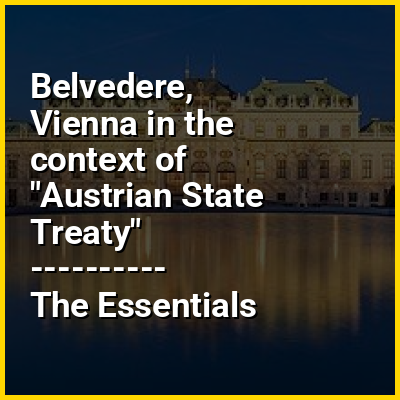
The Belvedere is a historic building complex in Vienna, Austria consisting of two Baroque palaces (the Upper and Lower Belvedere), the Orangery, and the Palace Stables. The buildings are set in a Baroque park landscape in the third district of the city, on the south-eastern edge of its centre. It currently houses the Belvedere museum known in German as the Österreichische Galerie Belvedere (in English, referred to both as the Belvedere Museum and Austrian Gallery). The grounds are set on a gentle gradient and include decorative tiered fountains and cascades, Baroque sculptures, and majestic wrought iron gates. The Baroque palace complex was built as a summer residence for Prince Eugene of Savoy.

The Belvedere was built during a period of extensive construction in Vienna, which at the time was both the imperial capital and home to the ruling Habsburg dynasty. This period of prosperity followed on from the commander-in-chief Prince Eugene of Savoy's successful conclusion of a series of wars against the Ottoman Empire.
↓ Menu

>>>PUT SHARE BUTTONS HERE<<<

👉 Belvedere, Vienna in the context of Austrian State Treaty

The Austrian State Treaty (German: Österreichischer Staatsvertrag [ˈøːstɐraɪçɪʃɐ ˈʃtaːtsfɐˌtraːɡ] ) or Austrian Independence Treaty established Austria as a sovereign state. It was signed on 15 May 1955 in Vienna, at the Schloss Belvedere among the Allied occupying powers (France, the United Kingdom, the United States, and the Soviet Union) and the Austrian government. The neighbouring Federal People's Republic of Yugoslavia acceded to the treaty subsequently. It officially came into force on 27 July 1955.

Its full title is "Treaty for the re-establishment of an independent and democratic Austria, signed in Vienna on 15 May 1955" (German: Staatsvertrag betreffend die Wiederherstellung eines unabhängigen und demokratischen Österreich, unterzeichnet in Wien am 15. Mai).

↓ Explore More Topics
In this Dossier

Belvedere, Vienna in the context of Yugoslav accession to the Tripartite Pact

On 25 March 1941, Yugoslavia signed the Tripartite Pact with the Axis powers. The agreement was reached after months of negotiations between Germany and Yugoslavia and was signed at the Belvedere in Vienna by Joachim von Ribbentrop, German foreign minister, and Dragiša Cvetković, Yugoslav Prime Minister. Pursuant to the alliance, the parties agreed that the Axis powers would respect Yugoslav sovereignty and territorial integrity, including the Axis refraining from seeking permission to transport troops through Yugoslavia or requesting any military assistance.

Yugoslav accession to the Tripartite Pact (Serbo-Croatian: Тројни пакт / Trojni pakt) was short-lived, however. On 27 March 1941, two days after the agreement had been signed, the Yugoslav government was overthrown when the regency led by Prince Paul was ended and King Peter II fully assumed power. On 6 April 1941, less than two weeks after Yugoslavia had signed onto the Tripartite Pact, the Axis invaded Yugoslavia. By 18 April, the country was conquered and occupied by the Axis powers.

↑ Return to Menu

Belvedere, Vienna in the context of Madonna del Prato (Raphael)

The Madonna del Prato (Madonna of the Meadow), formally Madonna with the Christ Child and Saint John the Baptist, is an oil on board painting by Raphael, created in 1506, now held in the Kunsthistorisches Museum in Vienna. It is also known as the Madonna del Belvedere after its long residence in the imperial collection in the Vienna Belvedere.

↑ Return to Menu

Belvedere, Vienna in the context of Belvedere (structure)

A belvedere (/ˈbɛlvəˌdɪər/ BEL-və-deer; Italian for 'beautiful view') or belvidere is an architectural structure sited to take advantage of a fine or scenic view. The term has been used both for rooms in the upper part of a building or structures on the roof, or a separate pavilion in a garden or park. The actual structure can be of any form or style, including a turret, a cupola or an open gallery. The term may be also used for a paved terrace or just a place with a good viewpoint, but no actual building.

It has also been used as a name for a whole building, as in the Belvedere, Vienna, a huge palace, or Belvedere Castle, a folly in Central Park in New York.

↑ Return to Menu

Belvedere, Vienna in the context of The Kiss (Klimt)

The Kiss (German: Der Kuss) is an oil-on-canvas painting with added gold leaf, silver and platinum by the Austrian Symbolist painter Gustav Klimt. It was painted at some point in 1907 and 1908, during the height of what scholars call his "Golden Period". It was exhibited in 1908 under the title Liebespaar (the lovers) as stated in the catalogue of the exhibition. The painting depicts a couple embracing each other, their bodies entwined in elaborate robes decorated in a style influenced by the contemporary Art Nouveau style and the organic forms of the earlier Arts and Crafts movement.

The painting now hangs in the Österreichische Galerie Belvedere museum in the Upper Belvedere Palace in Vienna, and is considered a masterpiece of Vienna Secession – the local variation of Art Nouveau – and probably Klimt's most important work.

↑ Return to Menu