Banksia in the context of "Lignotuber"

Play Trivia Questions online!

or

Skip to study material about Banksia in the context of "Lignotuber"

Ad spacer

⭐ Core Definition: Banksia

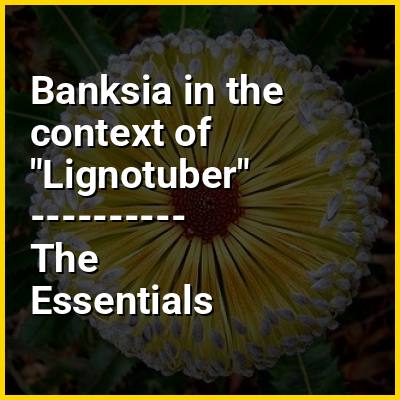
Banksia is a genus of around 170 species of flowering plants in the family Proteaceae. These Australian wildflowers and popular garden plants are easily recognised by their characteristic flower spikes, and woody fruiting "cones" and heads. Banksias range in size from prostrate woody shrubs to trees up to 30 metres (100 ft) tall. They are found in a wide variety of landscapes: sclerophyll forest, (occasionally) rainforest, shrubland, and some more arid landscapes, though not in Australia's deserts.

Heavy producers of nectar, banksias are a vital part of the food chain in the Australian bush. They are an important food source for nectarivorous animals, including birds, bats, rats, possums, stingless bees and a host of invertebrates. Further, they are of economic importance to Australia's nursery and cut flower industries. However, these plants are threatened by a number of processes including land clearing, frequent burning and disease, and a number of species are rare and endangered.
↓ Menu

>>>PUT SHARE BUTTONS HERE<<<

👉 Banksia in the context of Lignotuber

A lignotuber is a woody swelling of the root crown possessed by some plants as a protection against destruction of the plant stem, such as by fire. Other woody plants may develop basal burls as a similar survival strategy, often as a response to coppicing or other environmental stressors. However, lignotubers are specifically part of the normal course of development of the plants that possess them, and often develop early on in growth. The crown contains buds from which new stems may sprout, as well as stores of starch that can support a period of growth in the absence of photosynthesis. The term "lignotuber" was coined in 1924 by Australian botanist Leslie R. Kerr.

Plants possessing lignotubers include many species in Australia; Eucalyptus marginata (jarrah), Eucalyptus brevifolia (snappy gum) and Eucalyptus ficifolia (scarlet gum) all of which can have lignotubers 3 m (10 ft) wide and 1 m (3 ft) deep, as well as most mallees (where it is also known as a mallee root) and many Banksia species.

↓ Explore More Topics
In this Dossier

Banksia in the context of Anthesis

Anthesis is the period during which a flower is fully open and functional. It may also refer to the onset of that period.

The onset of anthesis is spectacular in some species. In Banksia species, for example, anthesis involves the extension of the style far beyond the upper perianth parts. Anthesis of flowers is sequential within an inflorescence, so when the style and perianth are different colours, the result is a striking colour change that gradually sweeps along the inflorescence.

↑ Return to Menu

Banksia in the context of Whorl (botany)

In botany, a whorl or verticil is a whorled arrangement of leaves, sepals, petals, stamens, or carpels that radiate from a single point and surround or wrap around the stem or stalk. A leaf whorl consists of at least three elements; a pair of opposite leaves is not called a whorl.

For leaves to grow in whorls is fairly rare except in plant species with very short internodes. Genera with species having whorled leaves include Galium, Nerium, Elodea, and Lilium. Leaf-like bracts may also be whorled (as in Trillium, e.g.). Leaf whorls occur in some trees such as Brabejum stellatifolium and other species in the family Proteaceae (e.g., in the genus Banksia). In plants such as these, crowded internodes within the leaf whorls alternate with long internodes between the whorls.

↑ Return to Menu

Banksia in the context of Logging in Australia

Land clearing in Australia describes the removal of native vegetation and deforestation in Australia. Land clearing involves the removal of native vegetation and habitats, including the bulldozing of native bushlands, forests, savannah, woodlands and native grasslands and the draining of natural wetlands for replacement with agriculture, urbanization and other land uses. Much of today's clearing occurs in northern Australia.

As of 2011, of the vegetation which existed in Australia at the time of European settlement, approximately 87% remains. One estimate places the rate of rainforest of all types has been reduced by three quarters since the time of European settlement from eight million hectares to two million. Land clearing threatens native species including ground orchids and eucalyptus. Extensive unlawful deforestation continues across the country.

↑ Return to Menu

Banksia in the context of Australian Kingdom

The flora of Australia comprises a vast assemblage of plant species estimated to over 21,000 vascular and 14,000 non-vascular plants, 250,000 species of fungi and over 3,000 lichens. The flora has strong affinities with the flora of Gondwana, and below the family level has a highly endemic angiosperm flora whose diversity was shaped by the effects of continental drift and climate change since the Cretaceous. Prominent features of the Australian flora are adaptations to aridity and fire which include scleromorphy and serotiny. These adaptations are common in species from the large and well-known families Proteaceae (Banksia), Myrtaceae (Eucalyptus - gum trees), and Fabaceae (Acacia - wattle).

The arrival of humans around 50,000 years ago and the settlement by Europeans from 1788, has had a significant impact on the flora. The use of fire-stick farming by Aboriginal people led to significant changes in the distribution of plant species over time, and the large-scale modification or destruction of vegetation for agriculture and urban development since 1788 has altered the composition of most terrestrial ecosystems, leading to the extinction of 61 plant species by 2006, and endangering over 1000 more.

↑ Return to Menu

Banksia in the context of Evergreen forest

An evergreen forest is a forest made up of evergreen trees. They occur across a wide range of climatic zones, and include trees such as conifers and holly in cold climates, eucalyptus, live oak, acacias, magnolia, and banksia in more temperate zones, and rainforest trees in tropical zones.

↑ Return to Menu

Banksia in the context of Banksia serrata

Banksia serrata, commonly known as the saw banksia, the old man banksia, the saw-tooth banksia or the red honeysuckle and as wiriyagan by the Cadigal people, is a species of woody shrub or tree of the genus Banksia, in the family Proteaceae. Native to the east coast of Australia, it is found from Queensland to Victoria with outlying populations on Tasmania and Flinders Island. Commonly growing as a gnarled tree up to 16 m (50 ft) in height, it can be much smaller in more exposed areas. This Banksia species has wrinkled grey bark, shiny dark green serrated leaves and large yellow or greyish-yellow flower spikes appearing over summer. The flower spikes, or inflorescences, turn grey as they age and pollinated flowers develop into large, grey, woody seed pods called follicles.

B. serrata is one of the four original Banksia species collected by Sir Joseph Banks in 1770, and one of four species published in 1782 as part of Carolus Linnaeus the Younger's original description of the genus. There are no recognised varieties, although it is closely related to Banksia aemula. Throughout its range, it grows exclusively in sandy soil, and is usually the dominant plant in scrubland or low woodland. B. serrata is pollinated by and provides food for a wide array of vertebrate and invertebrate animals in the autumn and winter months, and is an important source of food for honeyeaters. It is a common plant of parks and gardens.

↑ Return to Menu

Banksia in the context of Proteaceae

The Proteaceae /ˌprtiˈs/ form a family of flowering plants predominantly distributed in the Southern Hemisphere. The family comprises 83 genera with about 1,660 known species. Australia and South Africa have the greatest concentrations of diversity. Together with the Platanaceae (plane trees), Nelumbonaceae (the sacred lotus) and in the recent APG IV system the Sabiaceae, they make up the order Proteales. Well-known Proteaceae genera include Protea, Banksia, Embothrium, Grevillea, Hakea, and Macadamia. Species such as the New South Wales waratah (Telopea speciosissima), king protea (Protea cynaroides), and various species of Banksia, Grevillea, and Leucadendron are popular cut flowers. The nuts of Macadamia integrifolia are widely grown commercially and consumed, as are those of Gevuina avellana on a smaller scale.

↑ Return to Menu