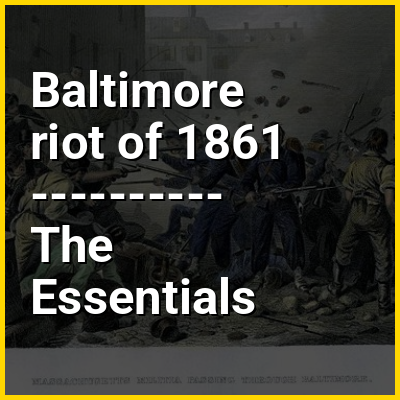
The Baltimore riot of 1861 (also called the "Pratt Street Riots" and the "Pratt Street Massacre") was a civil conflict on Friday, April 19, 1861, on Pratt Street, Baltimore, Maryland. It occurred between antiwar "Copperhead" Democrats and other Confederate sympathizers on one side, and on the other, members of Massachusetts and Pennsylvania state militia regiments en route to the national capital at Washington who had been called up for federal service. The fighting began at the President Street Station, spreading throughout President Street and subsequently to Howard Street, where it ended at the Camden Street Station. The riot produced the first deaths of Union volunteers by hostile action, although caused by civilians, in the American Civil War. Civilians among the attackers also were killed.
👉 Baltimore riot of 1861 in the context of President Street Station
The President Street Station in Baltimore, Maryland, is a former train station and railroad terminal. Built in 1849 and opened in February 1850, the station saw some of the earliest bloodshed of the American Civil War (1861-1865), and was an important rail link during the conflict. It is the oldest surviving big-city railroad terminal in the United States.
In 1997, a preservation campaign and renovation project was completed, enabling the station to be operated as Baltimore Civil War Museum.
- ⭐ Core Definition: Baltimore riot of 1861
- 👉 Baltimore riot of 1861 in the context of President Street Station
- Baltimore riot of 1861 in the context of Baltimore
- Baltimore riot of 1861 in the context of Camden Station
- Baltimore riot of 1861 in the context of Baltimore, Maryland
Baltimore riot of 1861 in the context of Baltimore
Baltimore is the most populous city in the U.S. state of Maryland. It is the 30th-most populous U.S. city with a population of 585,708 at the 2020 census and estimated at 568,271 in 2024, while the Baltimore metropolitan area at 2.86 million residents is the 22nd-largest metropolitan area in the nation. The city is also part of the Washington–Baltimore combined statistical area, which had a population of 9.97 million in 2020. Baltimore was designated as an independent city by the Constitution of Maryland in 1851. Though not located under the jurisdiction of any county in the state, it forms part of the Central Maryland region together with the surrounding county that shares its name.
The land that is present-day Baltimore was once used as hunting ground by Paleo-Indians. In the early 1600s, the Susquehannock began to hunt there. People from the Province of Maryland established the Port of Baltimore in 1706 to support the tobacco trade with Europe and established the Town of Baltimore in 1729. During the American Revolutionary War, the Second Continental Congress briefly moved its deliberations to the Henry Fite House from December 1776 to February 1777 prior to the capture of Philadelphia to British troops, which permitted Baltimore to serve briefly as the nation's capital before it returned to Philadelphia. The Battle of Baltimore was pivotal during the War of 1812, culminating in the British bombardment of Fort McHenry, during which Francis Scott Key wrote a poem that became "The Star-Spangled Banner", which was designated as the national anthem in 1931. During the Pratt Street Riot of 1861, the city was the site of some of the earliest violence associated with the American Civil War.
View the full Wikipedia page for BaltimoreBaltimore riot of 1861 in the context of Camden Station
Camden Station, now also referred to as Camden Street Station, Camden Yards, and formally as the Transportation Center at Camden Yards, is a train station at the intersection of South Howard and West Camden Streets in Baltimore, Maryland, adjacent to Oriole Park at Camden Yards, behind the B&O Warehouse. It is served by MARC commuter rail service and local Light Rail trains.
Camden Street Station was originally built beginning in 1856, continuing until 1865, by the Baltimore and Ohio Railroad as its main passenger terminal and early offices/ headquarters (until 1881) in Baltimore and is one of the longest continuously operated terminals in the United States. Its upstairs offices were the workplace of famous Civil War era B&O President John Work Garrett (1820–1884). The station and its environs were also the site of several infamous civil strife actions of the 19th century with the Baltimore riot of 1861, on April 18–19, also known as the Pratt Street Riots and later labor strife in the Great Railroad Strike of 1877.
View the full Wikipedia page for Camden StationBaltimore riot of 1861 in the context of Baltimore, Maryland
Baltimore, also known as Baltimore City, is the most populous city in the U.S. state of Maryland. It is the 30th-most populous U.S. city with a population of 585,708 at the 2020 census and estimated at 568,271 in 2024, while the Baltimore metropolitan area at 2.86 million residents is the 22nd-largest metropolitan area in the nation. The city is also part of the Washington–Baltimore combined statistical area, which had a population of 9.97 million in 2020. Baltimore was designated as an independent city by the Constitution of Maryland in 1851. Though not located under the jurisdiction of any county in the state, it forms part of the Central Maryland region together with the surrounding county that shares its name.
The land that is present-day Baltimore was once used as hunting ground by Paleo-Indians. In the early 1600s, the Susquehannock began to hunt there. People from the Province of Maryland established the Port of Baltimore in 1706 to support the tobacco trade with Europe and established the Town of Baltimore in 1729. During the American Revolutionary War, the Second Continental Congress briefly moved its deliberations to the Henry Fite House from December 1776 to February 1777 prior to the capture of Philadelphia to British troops, which permitted Baltimore to serve briefly as the nation's capital before it returned to Philadelphia. The Battle of Baltimore was pivotal during the War of 1812, culminating in the British bombardment of Fort McHenry, during which Francis Scott Key wrote a poem that became "The Star-Spangled Banner", which was designated as the national anthem in 1931. During the Pratt Street Riot of 1861, the city was the site of some of the earliest violence associated with the American Civil War.
View the full Wikipedia page for Baltimore, Maryland