Balasagun in the context of "Mongol conquest of the Qara Khitai"

Play Trivia Questions online!

or

Skip to study material about Balasagun in the context of "Mongol conquest of the Qara Khitai"

Ad spacer

⭐ Core Definition: Balasagun

Balasagun (Kyrgyz: Баласагун or Баласагын Balasagyn; simplified Chinese: 八剌沙衮; traditional Chinese: 八剌沙袞; pinyin: Bā là shā gǔn) was an ancient Sogdian city in modern-day Kyrgyzstan, located in the Chüy Valley between Bishkek and the Issyk-Kul lake. Located along the Silk Road, the ruins of the city were inscribed in 2014 on the UNESCO World Heritage List as part of the Silk Roads: the Routes Network of Chang'an-Tianshan Corridor World Heritage Site.

Balasagun was founded by the Sogdians, a people of Iranian origin and the Sogdian language was still in use in this town until the 11th century.
↓ Menu

>>>PUT SHARE BUTTONS HERE<<<

👉 Balasagun in the context of Mongol conquest of the Qara Khitai

The Mongol Empire conquered the Qara Khitai (Western Liao Empire) in the year 1218 AD. Prior to the invasion, war with the Khwarazmian Empire and the usurpation of power by the Naiman prince Kuchlug had weakened the Qara Khitai. When Kuchlug besieged Almaliq, a city belonging to the Karluks, vassals of the Mongol Empire, and killed their ruler Ozar, who was a grandson-in-law to Genghis Khan, Genghis Khan dispatched a force under command of Jebe and Barchuk to pursue Kuchlug. After his force of over 30,000 was defeated by Jebe at the Khitan capital Balasagun, Kuchlug faced rebellions over his unpopular rule, forcing him to flee to modern Afghanistan, where he was captured by hunters in 1218. The hunters turned Kuchlug over to the Mongols who beheaded him. Upon defeating the Qara Khitai, the Mongols now had a direct border with the Khwarazmian Empire, which they would soon invade in 1219.

↓ Explore More Topics
In this Dossier

Balasagun in the context of History of Kyrgyzstan

The history of the Kyrgyz people and the land now called Kyrgyzstan goes back more than 3,000 years. Although geographically isolated by its mountainous location, it had an important role as part of the historical Silk Road trade route. Turkic nomads, who trace their ancestry to many Turkic states such as the First and Second Turkic Khaganates, have inhabited the country throughout its history. In the 13th century, Kyrgyzstan was conquered by the Mongols; subsequently it regained independence but was invaded by Kalmyks, Manchus, and Uzbeks. In 1876, it became part of the Russian Empire, remaining in the USSR as the Kirghiz Soviet Socialist Republic after the Russian Revolution. Following Mikhail Gorbachev's democratic reforms in the USSR, in 1990 pro-independence candidate Askar Akayev was elected president of the SSR. On 31 August 1991, Kyrgyzstan declared independence from Moscow, and a democratic government was subsequently established.

↑ Return to Menu

Balasagun in the context of Burana Tower

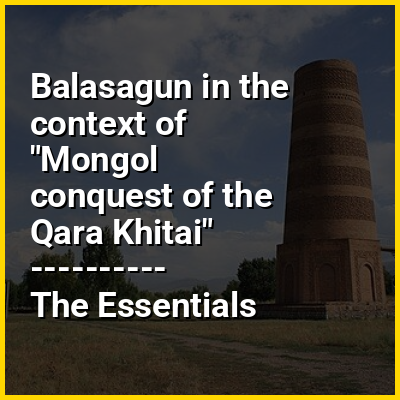
The Burana Tower (Kyrgyz: Бурана мунарасы) is a large minaret in the Chüy Valley in northern Kyrgyzstan. It is located about 80 km east of the country's capital Bishkek, near the town of Tokmok. The tower, along with grave markers, some earthworks and the remnants of a castle and three mausoleums, is all that remains of the ancient city of Balasagun, which was established by the Karakhanids at the end of the 9th century. The tower was built in the 11th century and was used as a template for other minarets. An external staircase and steep, winding stairway inside the tower enables visitors to climb to the top. It is one of the oldest architectural constructions in Central Asia.

The tower was originally 45 m (148 ft) high. However, over the centuries a number of earthquakes caused significant damage to the structure. The last major earthquake in the 15th century destroyed the top half of the tower, reducing it to its current height of 25 m (82 ft). A renovation project was carried out in the 1970s to restore its foundation and repair the west-facing side of the tower, which was in danger of collapse.

↑ Return to Menu

Balasagun in the context of Yūsuf Balasaguni

Yusuf Khass Hajib was an 11th-century Central Asian Turkic poet, statesman, vizier, Maturidi theologian and philosopher from the city of Balasaghun, the capital of the Kara-Khanid Khanate in modern-day Kyrgyzstan. He wrote the Kutadgu Bilig and most of what is known about him, comes from his own writings in this work. He is mostly referred to as Yūsuf Balasaguni, derived from his city of origin.

↑ Return to Menu