Articulated bus in the context of "Tandem"

Play Trivia Questions online!

or

Skip to study material about Articulated bus in the context of "Tandem"


⭐ Core Definition: Articulated bus

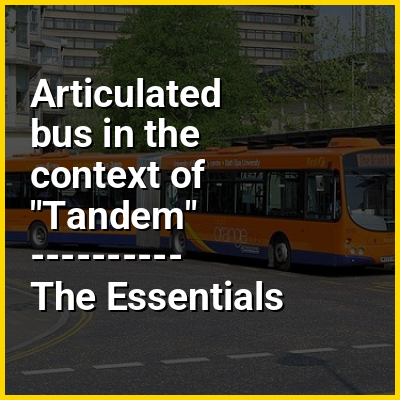
An articulated bus, also referred to as a slinky bus, bendy bus, tandem bus, vestibule bus, stretch bus, or an accordion bus, is an articulated vehicle, typically a motor bus or trolleybus, used in public transportation. It is usually a single-decker, and comprises two or more rigid sections linked by a pivoting joint (articulation) enclosed by protective bellows inside and outside, and a cover plate on the floor. This allows a longer legal length than rigid-bodied buses, and hence a higher passenger capacity (94–120), while still allowing the bus to maneuver adequately.

Due to their high passenger capacity, articulated buses are often used as part of bus rapid transit schemes, and can include a mechanical guidance system and electric bus or trolleybus.Articulated buses are typically 18 m (59 ft) long, in contrast to standard rigid buses at 11 to 14 m (36 to 46 ft) long. The common arrangement of an articulated bus is to have a forward section with two axles leading a rear section with a single axle, with the driving axle mounted on either the front or the rear section. Some articulated buses have a steering arrangement on the rearmost axle that turns slightly in opposition to the front steering axle, allowing the vehicle to negotiate tighter turns, similar to hook-and-ladder fire trucks operating in city environments. A less common variant of the articulated bus is the bi-articulated bus, where the vehicle has two trailer sections rather than one. Such vehicles have a capacity of around 200 people, and a length of about 25 m (82 ft); as such, they are used almost exclusively on high-capacity, high-frequency arterial routes and on bus rapid transit services.
↓ Menu

In this Dossier

Articulated bus in the context of Bus

A bus (contracted from omnibus, with variants multibus, motorbus, autobus, etc.) is a motor vehicle that carries significantly more passengers than an average car or van, but fewer than the average rail transport. It is most commonly used in public transport, but is also in use for charter purposes, or through private ownership. Although the average bus carries between 30 and 100 passengers, some buses have a capacity of up to 300 passengers. The most common type is the single-deck rigid bus, with double-decker and articulated buses carrying larger loads, and midibuses and minibuses carrying smaller loads. Coaches are used for longer-distance services. Many types of buses, such as city transit buses and inter-city coaches, charge a fare. Other types, such as elementary or secondary school buses or shuttle buses within a post-secondary education campus, are free. In many jurisdictions, bus drivers require a special large vehicle licence above and beyond a regular driving license.

Buses may be used for scheduled bus transport, scheduled coach transport, school transport, private hire, or tourism; promotional buses may be used for political campaigns and others are privately operated for a wide range of purposes, including rock and pop band tour vehicles.

↑ Return to Menu

Articulated bus in the context of City bus

A transit bus (also big bus, commuter bus, city bus, town bus, urban bus, stage bus, public bus, public transit bus, or simply bus) is a type of bus used in public transport bus services. Several configurations are used, including low-floor buses, high-floor buses, double-decker buses, articulated buses and midibuses.

These are distinct from all-seated coaches used for intercity travel and smaller minibuses, for more flexible services.

↑ Return to Menu

Articulated bus in the context of Volvo B5LH

The Volvo B5LH (initially known as the Volvo B5L Hybrid, also known as the Volvo BRLH) is a low-floor hybrid electric bus chassis for both single-decker buses and double-decker buses manufactured by Volvo since 2008. It is the basis for Volvo's integral 7700 Hybrid full low floor city bus and its successor, the 7900 Hybrid from 2011. In 2008, pre-production batches of both types of chassis were manufactured. Serial production started in June 2010. From 2013 it is also available as an articulated bus chassis.

An updated version, the Volvo B5LHC, was launched in 2016, designed for high-capacity inner-city work. The chassis was available with Wright SRM bodywork. The B5LHC was discontinued in 2018 after only two examples built, with Volvo instead focusing on developing the Volvo BZL battery electric bus chassis.

↑ Return to Menu

Articulated bus in the context of Public transport bus service

Public transport bus services are generally based on regular operation of transit buses along a route calling at agreed bus stops according to a published public transport timetable.

↑ Return to Menu

Articulated bus in the context of Hybrid electric vehicle

A hybrid electric vehicle (HEV) is a type of hybrid vehicle that couples a conventional internal combustion engine (ICE) with one or more electric engines into a combined propulsion system. The presence of the electric powertrain, which has inherently better energy conversion efficiency, is intended to achieve either better fuel economy or better acceleration performance than a conventional vehicle. There is a variety of HEV types and the degree to which each functions as an electric vehicle (EV) also varies. The most common form of HEV is hybrid electric passenger cars, although hybrid electric trucks (pickups, tow trucks and tractors), buses, motorboats, and aircraft also exist.

Modern HEVs use energy recovery technologies such as motor–generator units and regenerative braking to recycle the vehicle's kinetic energy to electric energy via an alternator, which is stored in a battery pack or a supercapacitor. Some varieties of HEV use an internal combustion engine to directly drive an electrical generator, which either recharges the vehicle's batteries or directly powers the electric traction motors; this combination is known as a range extender. Many HEVs reduce idle emissions by temporarily shutting down the combustion engine at idle (such as when waiting at the traffic light) and restarting it when needed; this is known as a start-stop system. A hybrid-electric system produces less tailpipe emissions than a comparably sized petrol engine vehicle since the hybrid's petrol engine usually has smaller displacement and thus lower fuel consumption than that of a conventional petrol-powered vehicle. If the engine is not used to drive the car directly, it can be geared to run at maximum efficiency, further improving fuel economy.

↑ Return to Menu

Articulated bus in the context of Nova Bus LF Series

The Low Floor Series (LFS) is a series of transit buses manufactured by Nova Bus for North American customers since 1996. It is produced in 40' rigid and 62' articulated (nominal) lengths with a variety of powertrains, including conventionally-fueled (diesel and natural gas), hybrid diesel-electric, and battery-electric. The LFS is the first transit bus designed by Nova Bus.

↑ Return to Menu