Arthur Orton in the context of "Tichborne case"

Play Trivia Questions online!

or

Skip to study material about Arthur Orton in the context of "Tichborne case"


⭐ Core Definition: Arthur Orton

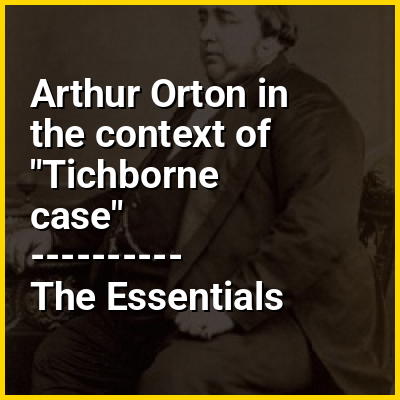
Arthur Orton (20 March 1834 – 1 April 1898) was an English man who has generally been identified by legal historians and commentators as the "Tichborne Claimant", who in two celebrated court cases both fascinated and shocked Victorian society in the 1860s and 1870s.

The son of a London butcher, Orton went to sea as a boy, spent a year in Chile, and worked as a butcher and stockman for squatters in Australia in the middle-to-late 1850s. In 1866 Thomas Castro, a butcher from Wagga Wagga in Australia, claimed to be Roger Tichborne, the heir to the Tichborne estates and baronetcy who had been declared lost at sea in 1854. During the protracted court proceedings that followed Castro's claim, evidence was produced that Castro might in fact be Arthur Orton, attempting to secure the Tichborne fortunes by imposture.
↓ Menu

👉 Arthur Orton in the context of Tichborne case

The Tichborne case was a legal cause célèbre that fascinated Victorian Britain in the 1860s and 1870s. It concerned the claims by a man sometimes referred to as Thomas Castro or as Arthur Orton, but usually termed "the Claimant", to be the missing heir to the Tichborne baronetcy. He failed to convince the courts, was convicted of perjury and served a 14-year prison sentence.

Roger Tichborne, heir to the family's title and fortunes, was presumed to have died in a shipwreck in 1854 at age 25. His mother, Lady Tichborne, clung to a belief that he might have survived, and after hearing rumours that he had made his way to Australia, she advertised extensively in Australian newspapers, offering a reward for information. In 1866, a Wagga Wagga butcher known as Thomas Castro came forward claiming to be Roger Tichborne. Although his manners and bearing were unrefined, he gathered support and travelled to England. He was instantly accepted by Lady Tichborne as her son, although other family members were dismissive and sought to expose him as an impostor.

↓ Explore More Topics
In this Dossier

Arthur Orton in the context of Little Tich

Harry Relph (21 July 1867 – 10 February 1928), professionally known as Little Tich, was a 4-foot-6-inch-tall (137 cm) English music hall comedian and dancer during the late 19th and early 20th centuries. He was best known for his acrobatic and comedic "Big-Boot Dance", which he performed in Europe and for which he wore boots with soles 28 inches (71 cm) long. Aside from his music hall appearances, he was also a popular performer in Christmas pantomimes and appeared in them annually at theatres throughout the English provinces. He repeated this success in London, where he appeared in three pantomimes at the Theatre Royal, Drury Lane, between 1891 and 1893 alongside Dan Leno and Marie Lloyd.

Born in Cudham, Kent, Little Tich began performing aged ten when he developed a dance and tin-whistle act which he showcased at public houses in Sevenoaks. In the early 1880s he formed a blackface act and gained popularity with performances at the nearby Rosherville Pleasure Gardens and Barnard's Music Hall in Chatham. He travelled to London and appeared at the Forester's Music Hall in 1884. Later that year, he adopted the stage name "Little Tich", which he based on his childhood nickname of "Tichborne", acquired through his portly stature and physical likeness to the suspected Tichborne Claimant Arthur Orton. The terms "titchy" or "titch" were later derived from "Little Tich" and are used to describe things that are small.

↑ Return to Menu