Apollo Lunar Module in the context of Apollo Program


Apollo Lunar Module in the context of Apollo Program

Apollo Lunar Module Study page number 1 of 2

Play TriviaQuestions Online!

or

Skip to study material about Apollo Lunar Module in the context of "Apollo Program"


⭐ Core Definition: Apollo Lunar Module

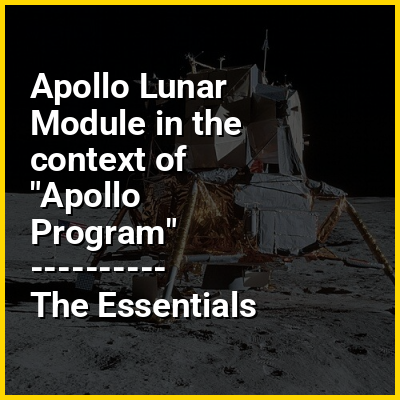
The Apollo Lunar Module (LM /ˈlɛm/), originally designated the Lunar Excursion Module (LEM), was the lunar lander spacecraft that was flown between lunar orbit and the Moon's surface during the United States' Apollo program. It was the first crewed spacecraft to operate exclusively in space, and remains the only crewed vehicle to land anywhere beyond Earth.

Structurally and aerodynamically incapable of flight through Earth's atmosphere, the two-stage Lunar Module was ferried to lunar orbit attached to the Apollo command and service module (CSM), about twice its mass. Its crew of two flew the Lunar Module from lunar orbit to the Moon's surface. During takeoff, the spent descent stage was used as a launch pad for the ascent stage which then flew back to the command module, after which it was also discarded.
↓ Menu
HINT:

In this Dossier

Apollo Lunar Module in the context of Apollo program

The Apollo program, also known as Project Apollo, was the United States human spaceflight program led by NASA, which landed the first humans on the Moon in 1969. Apollo was conceived during Project Mercury and executed after Project Gemini. It was conceived in 1960 as a three-person spacecraft during the presidency of Dwight D. Eisenhower. Apollo was later dedicated to President John F. Kennedy's national goal for the 1960s of "landing a man on the Moon and returning him safely to the Earth" in an address to the U.S. Congress on May 25, 1961.

Kennedy's goal was accomplished on the Apollo 11 mission, when astronauts Neil Armstrong and Buzz Aldrin landed their Apollo Lunar Module (LM) on July 20, 1969, and walked on the lunar surface, while Michael Collins remained in lunar orbit in the command and service module (CSM), and all three landed safely on Earth in the Pacific Ocean on July 24. Five subsequent Apollo missions also landed astronauts on the Moon, the last, Apollo 17, in December 1972. In these six spaceflights, twelve people walked on the Moon.

View the full Wikipedia page for Apollo program
↑ Return to Menu

Apollo Lunar Module in the context of Apollo 11

Apollo 11 was the first spaceflight to land humans on the Moon, conducted by NASA from July 16 to 24, 1969. Commander Neil Armstrong and Lunar Module Pilot Edwin "Buzz" Aldrin landed the Lunar Module Eagle on July 20 at 20:17 UTC, and Armstrong became the first person to step onto the surface about six hours later, at 02:56 UTC on July 21. Aldrin joined him 19 minutes afterward, and together they spent about two and a half hours exploring the site they had named Tranquility Base upon landing. They collected 47.5 pounds (21.5 kg) of lunar material to bring back to Earth before re-entering the Lunar Module. In total, they were on the Moon’s surface for 21 hours, 36 minutes before returning to the Command Module Columbia, which remained in lunar orbit, piloted by Michael Collins.

Apollo 11 was launched by a Saturn V rocket from Kennedy Space Center in Florida, on July 16 at 13:32 UTC (9:32 am EDT, local time). It was the fifth crewed mission of the Apollo program. The Apollo spacecraft consisted of three parts: the command module (CM), which housed the three astronauts and was the only part to return to Earth; the service module (SM), which provided propulsion, electrical power, oxygen, and water to the command module; and the Lunar Module (LM), which had two stages—a descent stage with a large engine and fuel tanks for landing on the Moon, and a lighter ascent stage containing a cabin for two astronauts and a small engine to return them to lunar orbit.

View the full Wikipedia page for Apollo 11
↑ Return to Menu

Apollo Lunar Module in the context of Apollo 9

Apollo 9 (March 3–13, 1969) was the third human spaceflight in NASA's Apollo program, which successfully tested systems and procedures critical to landing on the Moon. The three-man crew consisted of Commander James McDivitt, Command Module Pilot David Scott, and Lunar Module Pilot Rusty Schweickart. Flown in low Earth orbit, it was the second crewed Apollo mission that the United States launched via a Saturn V rocket, and was the first flight of the full Apollo spacecraft: the command and service module (CSM) with the Lunar Module (LM).

The mission was flown to qualify the LM for lunar orbit operations in preparation for the first Moon landing by demonstrating its descent and ascent propulsion systems, showing that its crew could fly it independently, then rendezvous and dock with the CSM again, as would be required for the first crewed lunar landing. Other objectives of the flight included firing the LM descent engine to propel the spacecraft stack as a backup mode (as was required on the Apollo 13 mission), and use of the portable life support system backpack outside the LM cabin.

View the full Wikipedia page for Apollo 9
↑ Return to Menu

Apollo Lunar Module in the context of Apollo 10

Apollo 10 (May 18–26, 1969) was the fourth human spaceflight in the United States' Apollo program and the second to orbit the Moon. NASA, the mission's operator, described it as a "dress rehearsal" for the first Moon landing (Apollo 11, two months later). It was designated an "F" mission, intended to test all spacecraft components and procedures short of actual descent and landing.

After the spacecraft reached lunar orbit, astronaut John Young remained in the Command and Service Module (CSM) while astronauts Thomas Stafford and Gene Cernan flew the Apollo Lunar Module (LM) to within 14.4 kilometers (7.8 nautical miles; 9 miles) of the lunar surface, the point at which powered descent for landing would begin on a landing mission. After four orbits they rejoined Young in the CSM and, after the CSM completed its 31st orbit of the Moon, they returned safely to Earth.

View the full Wikipedia page for Apollo 10
↑ Return to Menu

Apollo Lunar Module in the context of Harrison Schmitt

Harrison Hagan "Jack" Schmitt (born July 3, 1935) is an American geologist, former NASA astronaut, university professor, and former U.S. senator from New Mexico. He is the most recent living person—and only person without a background in military aviation—to have walked on the Moon.

In December 1972, as a crewmember of Apollo 17, Schmitt became the first member of NASA's first scientist-astronaut group to fly in space. As Apollo 17 was the last of the Apollo missions, he also became the twelfth and second-youngest person to set foot on the Moon and the second-to-last person to step off of the Moon (he boarded the Lunar Module shortly before commander Eugene Cernan). Schmitt also remains the only professional scientist to have flown beyond low Earth orbit and to have visited the Moon. Before training for Apollo 17, he was influential in the geology field for supporting the Apollo program and had helped train Apollo astronauts chosen to visit the lunar surface.

View the full Wikipedia page for Harrison Schmitt
↑ Return to Menu

Apollo Lunar Module in the context of Reaction control system

A reaction control system (RCS) is a spacecraft system that uses thrusters to provide attitude control and translation. Alternatively, reaction wheels can be used for attitude control, rather than RCS. Use of diverted engine thrust to provide stable attitude control of a short-or-vertical takeoff and landing aircraft below conventional winged flight speeds, such as with the Harrier "jump jet", may also be referred to as a reaction control system.

Reaction control systems are capable of providing small amounts of thrust in any desired direction or combination of directions. An RCS is also capable of providing torque to allow control of rotation (roll, pitch, and yaw).

View the full Wikipedia page for Reaction control system
↑ Return to Menu

Apollo Lunar Module in the context of Apollo 7

Apollo 7 (October 11–22, 1968) was the first crewed flight in NASA's Apollo program, and saw the resumption of human spaceflight by the agency after the fire that had killed the three Apollo 1 astronauts during a launch rehearsal test on January 27, 1967. The Apollo 7 crew was commanded by Walter M. Schirra, with Command Module Pilot Donn F. Eisele and Lunar Module pilot R. Walter Cunningham (so designated even though Apollo 7 did not carry a Lunar Module).

The three astronauts were originally designated for the second crewed Apollo flight, and then as backups for Apollo 1. After the Apollo 1 fire, crewed flights were suspended while the cause of the accident was investigated and improvements made to the spacecraft and safety procedures, and uncrewed test flights made. Determined to prevent a repetition of the fire, the crew spent long periods monitoring the construction of their Apollo command and service modules (CSM). Training continued over much of the 21-month pause that followed the Apollo 1 disaster.

View the full Wikipedia page for Apollo 7
↑ Return to Menu

Apollo Lunar Module in the context of Apollo 15

Apollo 15 (July 26 – August 7, 1971) was the ninth crewed mission in the Apollo program and the fourth Moon landing. It was the first J mission, with a longer stay on the Moon and a greater focus on science than earlier landings. Apollo 15 saw the first use of the Lunar Roving Vehicle.

The mission began on July 26 and ended on August 7, with the lunar surface exploration taking place between July 30 and August 2. Commander David Scott and Lunar Module Pilot James Irwin landed near Hadley Rille and explored the local area using the rover, allowing them to travel further from the Lunar Module than had been possible on previous missions. They spent 1812 hours on the Moon's surface on four extravehicular activities (EVA), and collected 170 pounds (77 kg) of surface material.

View the full Wikipedia page for Apollo 15
↑ Return to Menu

Apollo Lunar Module in the context of Apollo command and service module

The Apollo command and service module (CSM) was one of two principal components of the United States Apollo spacecraft, used for the Apollo program, which landed astronauts on the Moon between 1969 and 1972. The CSM functioned as a mother ship, which carried a crew of three astronauts and the second Apollo spacecraft, the Apollo Lunar Module, to lunar orbit, and brought the astronauts back to Earth. It consisted of two parts: the conical command module, a cabin that housed the crew and carried equipment needed for atmospheric reentry and splashdown; and the cylindrical service module which provided propulsion, electrical power and storage for various consumables required during a mission. An umbilical connection transferred power and consumables between the two modules. Just before reentry of the command module on the return home, the umbilical connection was severed and the service module was cast off and allowed to burn up in the atmosphere.

The CSM was developed and built for NASA by North American Aviation starting in November 1961. It was initially designed to land on the Moon atop a landing rocket stage and return all three astronauts on a direct-ascent mission, which would not use a separate lunar module, and thus had no provisions for docking with another spacecraft. This, plus other required design changes, led to the decision to design two versions of the CSM: Block I was to be used for uncrewed missions and a single crewed Earth orbit flight (Apollo 1), while the more advanced Block II was designed for use with the lunar module. The Apollo 1 flight was cancelled after a cabin fire killed the crew and destroyed their command module during a launch rehearsal test. Corrections of the problems which caused the fire were applied to the Block II spacecraft, which was used for all crewed spaceflights.

View the full Wikipedia page for Apollo command and service module
↑ Return to Menu

Apollo Lunar Module in the context of Apollo (spacecraft)

The Apollo spacecraft was composed of three parts designed to accomplish the American Apollo program's goal of landing astronauts on the Moon by the end of the 1960s and returning them safely to Earth. The expendable (single-use) spacecraft consisted of a combined command and service module (CSM) and an Apollo Lunar Module (LM). Two additional components complemented the spacecraft stack for space vehicle assembly: a spacecraft–LM adapter (SLA) designed to shield the LM from the aerodynamic stress of launch and to connect the CSM to the Saturn launch vehicle and a launch escape system (LES) to carry the crew in the command module safely away from the launch vehicle in the event of a launch emergency.

The design was based on the lunar orbit rendezvous approach: two docked spacecraft were sent to the Moon and went into lunar orbit. While the LM separated and landed, the CSM remained in orbit. After the lunar excursion, the two craft rendezvoused and docked in lunar orbit, and the CSM returned the crew to Earth. The command module was the only part of the space vehicle that returned with the crew to the Earth's surface.

View the full Wikipedia page for Apollo (spacecraft)
↑ Return to Menu

Apollo Lunar Module in the context of Saturn V

The Saturn V is a retired American super heavy-lift launch vehicle developed by NASA under the Apollo program for human exploration of the Moon. The rocket was human-rated, had three stages, and was powered by liquid fuel. Flown from 1967 to 1973, it was used for nine crewed flights to the Moon and to launch Skylab, the first American space station.

As of 2025, the Saturn V remains the only launch vehicle to have carried humans beyond low Earth orbit (LEO). The Saturn V holds the record for the largest payload capacity to low Earth orbit, 140,000 kg (310,000 lb), which included unburned propellant needed to send the Apollo command and service module and Lunar Module to the Moon.

View the full Wikipedia page for Saturn V
↑ Return to Menu

Apollo Lunar Module in the context of Spacecraft propulsion

Spacecraft propulsion is any method used to accelerate spacecraft and artificial satellites. In-space propulsion exclusively deals with propulsion systems used in the vacuum of space and should not be confused with space launch or atmospheric entry.

Several methods of pragmatic spacecraft propulsion have been developed, each having its own drawbacks and advantages. Most satellites have simple reliable chemical thrusters (often monopropellant rockets) or resistojet rockets for orbital station-keeping, while a few use momentum wheels for attitude control. Russian and antecedent Soviet bloc satellites have used electric propulsion for decades, and newer Western geo-orbiting spacecraft are starting to use them for north–south station-keeping and orbit raising. Interplanetary vehicles mostly use chemical rockets as well, although a few have used electric propulsion such as ion thrusters and Hall-effect thrusters. Various technologies need to support everything from small satellites and robotic deep space exploration to space stations and human missions to Mars.

View the full Wikipedia page for Spacecraft propulsion
↑ Return to Menu

Apollo Lunar Module in the context of Lunar Flag Assembly

The Lunar Flag Assembly (LFA) was a kit containing a flag of the United States designed to be erected on the Moon during the Apollo program. Six such flag assemblies were planted on the Moon. The nylon flags were hung on telescoping staffs and horizontal bars constructed of one-inch anodized aluminum tubes.

The flags were carried on the outside of the Apollo Lunar Module (LM), most of them on the descent ladder inside a thermally insulated tubular case to protect them from exhaust gas temperatures calculated to reach 2,000 °F (1,090 °C). The assembly was designed and supervised by Jack Kinzler, head of technical services at the Manned Spacecraft Center (MSC) in Houston, Texas. Six of the flags (including one for Apollo 13 which was not planted on the Moon) were ordered from a government supply catalog and measured 3 by 5 feet (0.91 by 1.52 m); the last one planted on the Moon was the slightly larger, 6-foot (1.8 m)-wide flag which had hung in the MSC Mission Operations Control Room for most of the Apollo program.

View the full Wikipedia page for Lunar Flag Assembly
↑ Return to Menu

Apollo Lunar Module in the context of Tranquility Base

Tranquility Base (Latin: Statio Tranquillitatis) is the site on the Moon where, in July 1969, humans landed and walked on a celestial body other than Earth for the first time. On July 20, 1969, Apollo 11 crewmembers Neil Armstrong and Buzz Aldrin landed their Apollo Lunar Module Eagle at approximately 20:17:40 UTC. Armstrong exited the spacecraft six hours and 39 minutes after touchdown, followed 19 minutes later by Aldrin. The astronauts spent two hours and 31 minutes examining and photographing the lunar surface, setting up several scientific experiment packages, and collecting 47.5 pounds (21.5 kg) of dirt and rock samples for return to Earth. They lifted off the surface on July 21 at 17:54 UTC. The two named the base, which Armstrong announced when the Lunar Module Eagle landed. It is located in the south-western corner of the dark lunar plain Mare Tranquillitatis ("Sea of Tranquility").

Due to involvement of facilities within the U.S. states of California and New Mexico with the Apollo program, the relevant government bodies in these states have registered Tranquility Base as a historic site associated with the heritage of the respective state: the California State Historical Resources Commission in the California Register of Historical Resources, and the New Mexico Historic Preservation Division of the New Mexico Department of Cultural Affairs in the New Mexico State Register of Cultural Properties site #1946. However, Texas, the U.S. National Park Service, and UNESCO have declined to do so, citing the procedural technicality that it is not located within their borders (which according to common convention don't extend thousands of miles beyond the Earth's surface).

View the full Wikipedia page for Tranquility Base
↑ Return to Menu

Apollo Lunar Module in the context of Vertical takeoff, vertical landing

Vertical takeoff, vertical landing (VTVL) is a form of takeoff and landing for rockets. Multiple VTVL craft have flown. A notable VTVL vehicle was the Apollo Lunar Module which delivered the first humans to the Moon. Building on the decades of development, SpaceX utilised the VTVL concept for its flagship Falcon 9 first stage, which has delivered over four hundred successful powered landings so far.

VTVL technologies were first seriously developed for the Apollo program. By the '90s, development on large reliable restartable rocket engines made it possible to use the already matured technology for rocket stages. The first pioneer was the McDonnell Douglas DC-X demonstrator. After the success of the DC-X prototype, the concept was developed substantially with small rockets after 2000, in part due to incentive prize competitions like the Lunar Lander Challenge.

View the full Wikipedia page for Vertical takeoff, vertical landing
↑ Return to Menu

Apollo Lunar Module in the context of SpaceX Merlin

Merlin is a family of rocket engines developed by SpaceX. They are currently a part of the Falcon 9 and Falcon Heavy launch vehicles, and were formerly used on the Falcon 1. Merlin engines use RP-1 and liquid oxygen as rocket propellants in a gas-generator power cycle. The Merlin engine was originally designed for sea recovery and reuse, but since 2016 the entire Falcon 9 booster is recovered for reuse by landing vertically on a landing pad using one of its nine Merlin engines.

The injector at the heart of Merlin is of the pintle type that was first used in the Apollo Lunar Module landing engine (LMDE). Propellants are fed by a single-shaft, dual-impeller turbopump. The turbopump also provides high-pressure fluid for the hydraulic actuators, which then recycles into the low-pressure inlet. This eliminates the need for a separate hydraulic drive system and means that thrust vectoring control failure by running out of hydraulic fluid is not possible. The engine is named after Merlin (a falcon).

View the full Wikipedia page for SpaceX Merlin
↑ Return to Menu

Apollo Lunar Module in the context of Deliberate crash landings on extraterrestrial bodies

This is a list of uncrewed spacecraft which have been intentionally destroyed at their objects of study, typically by hard landings or crash landings at the end of their respective missions and/or functionality. This list only includes spacecraft specifically instructed to crash into the surface of an astronomical body other than the Earth, and also does not include unintentionally crashed spacecraft, derelict spacecraft, or spacecraft designed as landers. Intentionally crashing spacecraft not only removes the possibility of orbital space debris and planetary contamination, but also provides the opportunity (in some cases) for terminal science given that the transient light released by the kinetic energy may be available for spectroscopy; the physical ejecta can be used for further study.

Even after soft landings had been mastered, NASA used crash landings to test whether Moon craters contained ice by crashing space probes into craters and testing the debris that got thrown out. Several rocket stages utilized during the Apollo space program were intentionally crashed on the Moon to aid seismic research, and four of the ascent stages of Apollo Lunar Modules were intentionally crashed onto the Moon after they had fulfilled their primary mission. In total at least 47 NASA rocket bodies have impacted the Moon.

View the full Wikipedia page for Deliberate crash landings on extraterrestrial bodies
↑ Return to Menu