Anzû in the context of "Ninurta"

Play Trivia Questions online!

or

Skip to study material about Anzû in the context of "Ninurta"

Ad spacer

⭐ Core Definition: Anzû

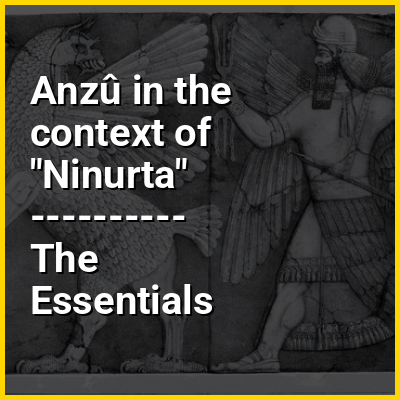
Anzû, also known as and Imdugud (Sumerian: 𒀭𒅎𒂂 im.dugud), is a demon in several Mesopotamian religions. He was conceived by the cosmic freshwater ocean Abzu and mother Earth Mami, or as son of Siris. In Babylonian myths Anzû was depicted as a massive bird - also as an eagle with lion head - who can breathe fire and water. This narrative seems to refer to much earlier Sumerian myths, in which he appears as a half-human storm bird who stole the tablet of destiny, challenging Enlil's power over his organisation of different gods that provided Mesopotamia with agriculture (cf. the Flood epic Athrahasis).

Stephanie Dalley, in Myths from Mesopotamia, writes that the Epic of Anzu itself "is principally known in two versions: an Old Babylonian version of the early second millennium [BC], giving the hero as Ningirsu; and 'The Standard Babylonian' version, dating to the first millennium BC, which appears to be the most quoted version, with the hero as Ninurta". However, the Anzu character does not appear as often in some other writings, as noted below.
↓ Menu

>>>PUT SHARE BUTTONS HERE<<<

👉 Anzû in the context of Ninurta

Ninurta (Sumerian: 𒀭𒊩𒌆𒅁: NIN.URTA, possible meaning "Lord [of] Barley"), also known as Ninĝirsu (Sumerian: 𒀭𒊩𒌆𒄈𒋢: NIN.ĜIR2.SU, meaning "Lord [of] Girsu"), is an ancient Mesopotamian god associated with farming, healing, hunting, law, scribes, and war who was first worshipped in early Sumer. In the earliest records, he is a god of agriculture and healing, who cures humans of sicknesses and releases them from the power of demons. In later times, as Mesopotamia grew more militarized, he became a warrior deity, though he retained many of his earlier agricultural attributes. He was regarded as the son of the chief god Enlil and his main cult center in Sumer was the Eshumesha temple in Nippur. Ninĝirsu was honored by King Gudea of Lagash (ruled 2144–2124 BC), who rebuilt Ninĝirsu's temple in Lagash. Later, Ninurta became beloved by the Assyrians as a formidable warrior. The Assyrian king Ashurnasirpal II (ruled 883–859 BC) built a massive temple for him at Kalhu, which became his most important cult center from then on.

In the epic poem Lugal-e, Ninurta slays the demon Asag using his talking mace Sharur and uses stones to build the Tigris and Euphrates rivers to make them useful for irrigation. In a poem sometimes referred to as the "Sumerian Georgica", Ninurta provides agricultural advice to farmers. In an Akkadian myth, he was the champion of the gods against the Anzû bird after it stole the Tablet of Destinies from his father Enlil and, in a myth that is alluded to in many works but never fully preserved, he killed a group of warriors known as the "Slain Heroes". His major symbols were a perched bird and a plow.

↓ Explore More Topics
In this Dossier

Anzû in the context of Assyriology

Assyriology (from Greek Ἀσσυρίᾱ, Assyriā; and -λογία, -logia), also known as Cuneiform studies or Ancient Near East studies, is the archaeological, anthropological, historical, and linguistic study of the cultures that used cuneiform writing. The field covers Pre Dynastic Mesopotamia, Sumer, the early Sumero-Akkadian city-states, the Akkadian Empire, Ebla, the Akkadian and Imperial Aramaic speaking states of Assyria, Babylonia and the Sealand Dynasty, the migrant foreign dynasties of southern Mesopotamia, including the Gutians, Amorites, Kassites, Arameans, Suteans and Chaldeans. Assyriology can be included to cover Neolithic pre-Dynastic cultures dating to as far back as 8000 BC, to the Islamic Conquest of the 7th century AD, so the topic is significantly wider than that implied by the root "Assyria".

The large number of cuneiform clay tablets preserved by these Sumero-Akkadian and Assyro-Babylonian cultures provide an extremely large resource for the study of the period. The region's—and the world's—first cities and city-states, like Ur, are archaeologically invaluable for studying the growth of urbanization.

↑ Return to Menu

Anzû in the context of Ninhursag

Ninḫursaĝ (Sumerian: 𒀭𒎏𒄯𒊕 Ninḫarsang; NIN-ḪAR.SAG̃), sometimes transcribed Ninursag, Ninḫarsag, or Ninḫursaĝa, also known as Damgalnuna or Ninmah, was the ancient Sumerian mother goddess of the mountains, and one of the seven great deities of Sumer. She is known earliest as a nurturing or fertility goddess. She is the tutelary deity to several Sumerian leaders.

Her best-known myths are Enki and Ninhursag describing her dealings with Enki resulting from his sexual exploits, and Enki and Ninmah a creation myth wherein the two deities compete to create humans. She is referenced or makes brief appearances in others as well, most notably as the mother of Ninurta in the Anzû Epic.

↑ Return to Menu

Anzû in the context of Enlil

Enlil, later known as Elil and Ellil, is an ancient Mesopotamian god associated with wind, air, earth, and storms. He is first attested as the chief deity of the Sumerian pantheon, but he was later worshipped by the Akkadians, Babylonians, Assyrians, and Hurrians. Enlil's primary center of worship was the Ekur temple in the city of Nippur, which was believed to have been built by Enlil himself and was regarded as the "mooring-rope" of heaven and earth. He is also sometimes referred to in Sumerian texts as Nunamnir. According to one Sumerian hymn, Enlil himself was so holy that not even the other gods could look upon him. Enlil rose to prominence during the twenty-fourth century BC with the rise of Nippur. His cult fell into decline after Nippur was sacked by the Elamites in 1230 BC and he was eventually supplanted as the chief god of the Mesopotamian pantheon by the Babylonian national god Marduk.

Enlil plays a vital role in the ancient near eastern cosmology; he separates An (heaven) from Ki (earth), thus making the world habitable for humans. In the Sumerian flood myth Eridu Genesis, Enlil rewards Ziusudra with immortality for having survived the flood and, in the Babylonian flood myth, Enlil is the cause of the flood himself, having sent the flood to exterminate the human race, who made too much noise and prevented him from sleeping; the cuneiform tablets of Atra-Hasis report on this connections in a comparatively well-preserved state. The myth of Enlil and Ninlil is about Enlil's serial seduction of the goddess Ninlil in various guises, resulting in the conception of the moon-god Nanna and the Underworld deities Nergal, Ninazu, and Enbilulu. Enlil was regarded as the inventor of the mattock and the patron of agriculture. Enlil also features prominently in several myths involving his son Ninurta, including Anzû and the Tablet of Destinies and Lugale.

↑ Return to Menu

Anzû in the context of Shara (god)

Shara (Sumerian: 𒀭𒁈, šara2) was a Mesopotamian god associated with the city of Umma and other nearby settlements. He was chiefly regarded as the tutelary deity of this area, responsible for agriculture, animal husbandry, and irrigation, but he could also be characterized as a divine warrior. In the third millennium BCE, his wife was Ninura, associated with the same area, but later, in the Old Babylonian period, her cult faded into obscurity, and Shara was instead associated with Usaḫara or Kumulmul. An association between him and Inanna is well attested. In Umma, he was regarded as the son of Inanna of Zabalam and an unknown father, while in the myth Inanna's Descent to the Underworld, he is one of the servants mourning her temporary death. He also appears in the myth of Anzû, in which he is one of the three gods who refuse to fight the eponymous monster.

↑ Return to Menu

Anzû in the context of Lamashtu

In Mesopotamian mythology, Lamashtu (𒀭𒈕𒈨; Akkadian La-maš-tu; Sumerian Dimme Dim3-me or Kamadme) is a demonic Mesopotamian deity with the "head of a lion, the teeth of a donkey, naked breasts, a hairy body, hands stained (with blood?), long fingers and fingernails, and the feet of Anzû". She was believed to feed on the blood of human infants and was widely blamed as the cause of miscarriages and cot deaths.

Although Lamashtu has traditionally been identified as a demoness, the fact that she could cause evil on her own without the permission of other deities strongly indicates that she was seen as a goddess in her own right. Mesopotamian peoples protected themselves against her using amulets and talismans. She was believed to ride in her boat on the river of the underworld and she was associated with donkeys. She was believed to be the daughter of An.

↑ Return to Menu

Anzû in the context of Ningirsu

Ninĝirsu was a Mesopotamian god regarded as the tutelary deity of the city of Ĝirsu, and as the chief god of the local pantheon of the state of Lagash. He shares many aspects with the god Ninurta. Ninĝirsu was identified as a local hypostasis of Ninurta in a syncretism that is documented at the latest by the time of Gudea in the late third millennium BC. Assyriologists are divided on the question of whether they were originally two manifestations of the same god, or two separate deities.

Ninĝirsu's two main aspects were that of a warlike god, and that of a god connected with agricultural fertility. In Lagash, he was particularly associated with a composite emblem depicting the Anzû bird over two lions. It could sometimes represent him in cultic contexts.

↑ Return to Menu