Adolfo de la Huerta in the context of "Sonora in the Mexican Revolution"

Play Trivia Questions online!

or

Skip to study material about Adolfo de la Huerta in the context of "Sonora in the Mexican Revolution"


⭐ Core Definition: Adolfo de la Huerta

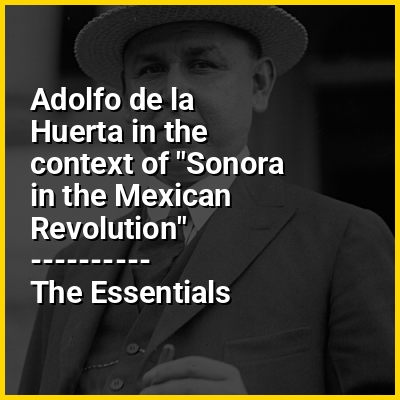
Felipe Adolfo de la Huerta Marcor (Spanish pronunciation: [aˈðolfo ðelaˈweɾta]; 26 May 1881 – 9 July 1955) was a Mexican politician, the 45th President of Mexico from 1 June to 30 November 1920, following the overthrow of Mexican president Venustiano Carranza, with Sonoran generals Álvaro Obregón and Plutarco Elías Calles under the Plan of Agua Prieta. He is considered "an important figure among Constitutionalists during the Mexican Revolution."

↓ Menu

👉 Adolfo de la Huerta in the context of Sonora in the Mexican Revolution

Sonora was a crucial region of the Mexican Revolution, with its main leaders called the Sonoran Dynasty or the Sonoran Triumvirate, that collectively ruled Mexico for fifteen years from 1920 to 1935. The northwestern state of Sonora was geographically and culturally distinct from other states of Mexico, including other parts of northern Mexico. Because of its geographical isolation from other parts of Mexico, its close ties with the United States, its large-scale export agriculture, its distinct indigenous populations, and its broad-based participation in the Revolution its leaders had a different worldview from central Mexico. Four Sonorans became Presidents of Mexico, Adolfo de la Huerta, Álvaro Obregón, Plutarco Elías Calles, and Abelardo L. Rodríguez. Seven other important figures of the revolution also come from Sonora or in nearby states, José María Maytorena and Benjamín G. Hill, both middle class; Manuel Diéguez, Salvador Alvarado, and Juan G. Cabral; and Francisco R. Serrano and Arnulfo R. Gómez. Although not formally a member of the Sonora Dynasty, Michoacan-born General Lázaro Cárdenas, later President of Mexico, was part of the revolutionary circle of Plutarco Elías Calles, right until the point that President Cárdenas forced former President Calles into exile in 1936. Only in recent years have historians begun focusing on the role of Sonora and the Sonoran Dynasty in Mexican Revolution, shifting from an emphasis on populist leaders like Francisco Villa of Chihuahua and Emiliano Zapata of Morelos. The Sonoran leaders sought greater material betterment for impoverished Mexicans, sought to centralize authority, and diminish the role of the Catholic Church. As with Díaz's Científicos, they believed in the importance of material progress, public education (as one way to counter the influence of the Catholic Church), and rationalism.

↓ Explore More Topics
In this Dossier

Adolfo de la Huerta in the context of Plutarco Elías Calles

Plutarco Elías Calles (born Francisco Plutarco Elías Campuzano; 25 September 1877 – 19 October 1945) was a Mexican politician and military officer who served as the 47th President of Mexico from 1924 to 1928. After the assassination of Álvaro Obregón, Calles founded the Institutional Revolutionary Party and held unofficial power as Mexico's de facto leader from 1929 to 1934, a period known as the Maximato. Previously, he served as a general in the Constitutional Army, as Governor of Sonora, Secretary of War, and Secretary of the Interior. During the Maximato, he served as Secretariat of Public Education, Secretary of War again, and Secretary of the Economy. During his presidency, he implemented many left-wing populist and secularist reforms, opposition to which sparked the Cristero War.

Born on 25 September 1877 in Sonora, Calles fought in Venustiano Carranza's Constitutional Army during the Mexican Revolution, which allowed him to rise in politics, joining the cabinets of Presidents Carranza, Adolfo de la Huerta, and Álvaro Obregón. Obregón selected him as the Laborist Party's candidate in the 1924 election. His campaign was the first populist presidential campaign in Mexico's history, as he called for land redistribution and promised equal justice, further labor rights, and democratic governance. He won the election and expanded education, implemented infrastructure projects, and improved public health. After this populist phase (1924–1926) he began to persecute the Catholic Church in Mexico (1926–1928), passing several anticlerical laws that resulted in the Cristero War. He allowed CROM's Luis N. Morones to consolidate unions under the Laborist Party, and launched a failed attempt to cancel the Bucareli Treaty. Obregón still held significant political sway and was Calles's main base of support.

↑ Return to Menu

Adolfo de la Huerta in the context of Álvaro Obregón

Álvaro Obregón Salido (Spanish pronunciation: [ˈalβaɾo oβɾeˈɣon]; 19 February 1880 – 17 July 1928) was a Mexican general, inventor and politician who served as the 46th President of Mexico from 1920 to 1924. Obregón was re-elected to the presidency in 1928 but was assassinated before he could take office.

Born in Navojoa, Sonora, Obregón joined the Revolution after the February 1913 coup d'état that brought General Victoriano Huerta to the presidency. Obregón supported Sonora's decision to follow Governor Venustiano Carranza as leader of the northern revolutionary coalition, the Constitutionalist Army, against the Huerta regime. Obregón quickly became the Constitutionalist Army's most prominent general, along with Pancho Villa. Carranza appointed Obregón commander of the revolutionary forces in northwestern Mexico. The Constitutionalists defeated Huerta in July 1914, and the Federal Army dissolved in August. In 1915, the revolution entered a new phase of civil war between the Conventionists led by Emiliano Zapata and Villa versus Obregón and Carranza. Obregón was made leader of the Constitutionalist army and defeated Villa, but lost his right arm. In 1917, the Constitution of Mexico went into effect and the Conventionists forces were quickly getting defeated by Obregón and the Constitutionalist Army. Carranza stepped down from the presidency and designated Ignacio Bonillas to succeed him. Obregón and other Sonoran generals Plutarco Elías Calles and Adolfo de la Huerta ousted Bonillas and Carranza under the Plan of Agua Prieta. Obregón was elected to the presidency in 1920 with overwhelming popular support.

↑ Return to Menu

Adolfo de la Huerta in the context of Governor of Sonora

↑ Return to Menu