Administrative divisions of Nazi Germany in the context of "Gauleiter"

Play Trivia Questions online!

or

Skip to study material about Administrative divisions of Nazi Germany in the context of "Gauleiter"

Ad spacer

⭐ Core Definition: Administrative divisions of Nazi Germany

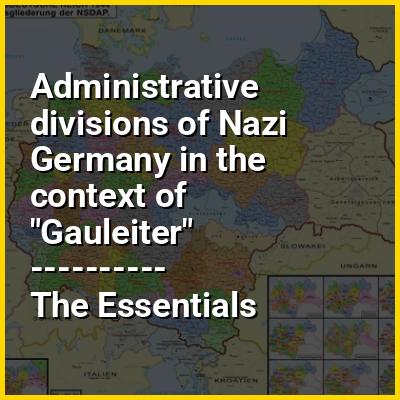
The Gaue (singular: Gau) were the main administrative divisions of Nazi Germany from 1934 to 1945.

The Gaue were formed in 1926 as Nazi Party regional districts in Weimar Germany based on the territorial changes after the First World War. The Gau system was established in 1934 as part of the Gleichschaltung process, replacing the de jure system of Länder (states) and Prussian provinces, which held no administrative purpose since the Enabling Act of 1933 and were reduced to rudimentary bodies. Each Gau was headed by an administrative leader, the Gauleiter, a high-ranking Nazi Party official with near-autocratic powers.
↓ Menu

>>>PUT SHARE BUTTONS HERE<<<

👉 Administrative divisions of Nazi Germany in the context of Gauleiter

A Gauleiter (German pronunciation: [ˈɡaʊlaɪtɐ] ) was a regional leader of the Nazi Party (NSDAP) who served as the head of a Gau or Reichsgau. Gauleiter was the third-highest rank in the Nazi political leadership, subordinate only to Reichsleiter and to the Führer himself. The position was effectively abolished with the fall of the Nazi regime on 8 May 1945.

↓ Explore More Topics
In this Dossier

Administrative divisions of Nazi Germany in the context of Reichsgau Sudetenland

The Reichsgau Sudetenland was an administrative division of Nazi Germany from 1939 to 1945. It comprised the northern part of the Sudetenland territory, which was annexed from Czechoslovakia according to the 30 September 1938 Munich Agreement. The Reichsgau was headed by the former Sudeten German Party leader, now Nazi Party functionary Konrad Henlein as Gauleiter and Reichsstatthalter. From October 1938 to May 1939, it was the regional subdivision of the Nazi Party in that area, also under Henlein's leadership. The administrative capital was Reichenberg (Liberec).

↑ Return to Menu

Administrative divisions of Nazi Germany in the context of Bezirk

The German term Bezirk (German pronunciation: [bəˈtsɪʁk] ; pl. Bezirke [bəˈtsɪʁkə] ; derived from Latin: circulus, "circle") translated as "district" can refer to the following types of administrative divisions:

↑ Return to Menu

Administrative divisions of Nazi Germany in the context of Wochenspruch der NSDAP

Wochenspruch der NSDAP (lit.'Weekly Quotation of the Nazi Party') was a wall newspaper published by the Nazi Party between 1937 and 1944, displaying quotations, mostly from Nazi leaders. About 1,100 issues were published. Some were issued by the Reichspropagandaleitung and others by local party organizations in each Gau. Along with Nazi leaders, the posters also quoted famous Germans from history, including Ludwig van Beethoven, Carl von Clausewitz, Otto von Bismarck, and Friedrich Schiller. The posters were displayed in many public locations including town halls, restaurants, doctor's offices, offices, schools or companies. Historian Jeffrey Herf estimates that 32.5 million copies were printed in total from September 1939 to when the periodical was discontinued.

The purpose of the publication was to educate Germans about Nazi ideals and values, especially those who did not take advantage of the party's indoctrination sessions. Initially, they were often printed in Fraktur type, but this changed in later editions. Anti-Nazi diarist Friedrich Kellner noted that it was printed on high-quality paper despite shortages which necessitated rationing.

↑ Return to Menu