Absorption line in the context of Solar transition region


Absorption line in the context of Solar transition region

Absorption line Study page number 1 of 1

Play TriviaQuestions Online!

or

Skip to study material about Absorption line in the context of "Solar transition region"


⭐ Core Definition: Absorption line

Absorption spectroscopy is spectroscopy that involves techniques that measure the absorption of electromagnetic radiation, as a function of frequency or wavelength, due to its interaction with a sample. The sample absorbs energy, i.e., photons, from the radiating field. The intensity of the absorption varies as a function of frequency, and this variation is the absorption spectrum. Absorption spectroscopy is performed across the electromagnetic spectrum.

Absorption spectroscopy is employed as an analytical chemistry tool to determine the presence of a particular substance in a sample and, in many cases, to quantify the amount of the substance present. Infrared and ultraviolet–visible spectroscopy are particularly common in analytical applications. Absorption spectroscopy is also employed in studies of molecular and atomic physics, astronomical spectroscopy and remote sensing.
↓ Menu
HINT:

👉 Absorption line in the context of Solar transition region

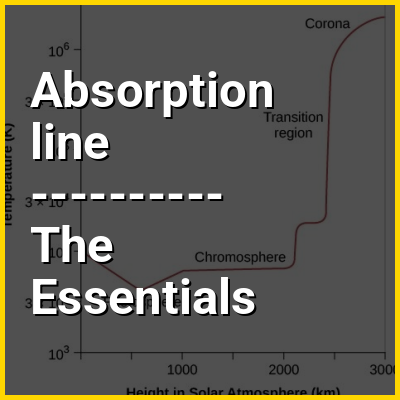
The solar transition region is a region of the Sun's atmosphere between the upper chromosphere and corona. It is important because it is the site of several unrelated but important transitions in the physics of the solar atmosphere:

  • Below, gravity tends to dominate the shape of most features, so that the Sun may often be described in terms of layers and horizontal features (like sunspots); above, dynamic forces dominate the shape of most features, so that the transition region itself is not a well-defined layer at a particular altitude.
  • Below, most of the helium is not fully ionized, so that it radiates energy very effectively; above, it becomes fully ionized. This has a profound effect on the equilibrium temperature (see below).
  • Below, the material is opaque to the particular colors associated with spectral lines, so that most spectral lines formed below the transition region are absorption lines in infrared, visible light, and near ultraviolet, while most lines formed at or above the transition region are emission lines in the far ultraviolet (FUV) and X-rays. This makes radiative transfer of energy within the transition region very complicated.
  • Below, gas pressure and fluid dynamics usually dominate the motion and shape of structures; above, magnetic forces dominate the motion and shape of structures, giving rise to different simplifications of magnetohydrodynamics. The transition region itself is not well studied in part because of the computational cost, uniqueness, and complexity of Navier–Stokes combined with electrodynamics.

Helium ionization is important because it is a critical part of the formation of the corona: when solar material is cool enough that the helium within it is only partially ionized (i.e. retains one of its two electrons), the material cools by radiation very effectively via both black-body radiation and direct coupling to the helium Lyman continuum. This condition holds at the top of the chromosphere, where the equilibrium temperature is a few tens of thousands of kelvins.

↓ Explore More Topics
In this Dossier

Absorption line in the context of Opacity (optics)

Opacity is the measure of impenetrability to electromagnetic or other kinds of radiation, especially visible light. In radiative transfer, it describes the absorption and scattering of radiation in a medium, such as a plasma, dielectric, shielding material, glass, etc. An opaque object is neither transparent (allowing all light to pass through) nor translucent (allowing some light to pass through). When light strikes an interface between two substances, in general, some may be reflected, some absorbed, some scattered, and the rest transmitted (also see refraction). Reflection can be diffuse, for example light reflecting off a white wall, or specular, for example light reflecting off a mirror. An opaque substance transmits no light, and therefore reflects, scatters, or absorbs all of it. Other categories of visual appearance, related to the perception of regular or diffuse reflection and transmission of light, have been organized under the concept of cesia in an order system with three variables, including opacity, transparency and translucency among the involved aspects. Both mirrors and carbon black are opaque. Opacity depends on the frequency of the light being considered. For instance, some kinds of glass, while transparent in the visual range, are largely opaque to ultraviolet light. More extreme frequency-dependence is visible in the absorption lines of cold gases. Opacity can be quantified in many ways (see: Mathematical descriptions of opacity).

Different processes can lead to opacity, including absorption, reflection, and scattering.

View the full Wikipedia page for Opacity (optics)
↑ Return to Menu

Absorption line in the context of Fraunhofer lines

The Fraunhofer lines are a set of spectral absorption lines. They are dark absorption lines, seen in the optical spectrum of the Sun, and are formed when atoms in the solar atmosphere absorb light being emitted by the solar photosphere. The lines are named after German physicist Joseph von Fraunhofer, who observed them in 1814.

View the full Wikipedia page for Fraunhofer lines
↑ Return to Menu

Absorption line in the context of S-type star

An S-type star (or just S star) is a cool giant star with approximately equal quantities of carbon and oxygen in its atmosphere. The class was originally defined in 1922 by Paul Merrill for stars with unusual absorption lines and molecular bands now known to be due to s-process elements. The bands of zirconium monoxide (ZrO) are a defining feature of the S stars.

The carbon stars have more carbon than oxygen in their atmospheres. In most stars, such as class M giants, the atmosphere is richer in oxygen than carbon and they are referred to as oxygen-rich stars. S-type stars are intermediate between carbon stars and normal giants. They can be grouped into two classes: intrinsic S stars, which owe their spectra to convection of fusion products and s-process elements to the surface; and extrinsic S stars, which are formed through mass transfer in a binary system.

View the full Wikipedia page for S-type star
↑ Return to Menu

Absorption line in the context of Eddington limit

The Eddington luminosity, also referred to as the Eddington limit, is the maximum luminosity a body (such as a star) can achieve when there is balance between the force of radiation acting outward and the gravitational force acting inward. The state of balance is called hydrostatic equilibrium. When a star exceeds the Eddington luminosity, it will initiate a very intense radiation-driven stellar wind from its outer layers. Since most massive stars have luminosities far below the Eddington luminosity, their winds are driven mostly by the less intense line absorption. The Eddington limit is invoked to explain the observed luminosities of accreting black holes such as quasars.

Originally, Sir Arthur Eddington took only the electron scattering into account when calculating this limit, something that now is called the classical Eddington limit. Nowadays, the modified Eddington limit also takes into account other radiation processes such as bound–free and free–free radiation interaction.

View the full Wikipedia page for Eddington limit
↑ Return to Menu

Absorption line in the context of B-type main-sequence star

A B-type main-sequence star is a main-sequence (core hydrogen-burning) star of spectral type B. The spectral luminosity class is typically V. These stars have from 2 to 18 times the mass of the Sun and surface temperatures between about 10,000 and 30,000 K.

B-type stars are luminous and blue-white. Their spectra have strong neutral helium absorption lines, which are most prominent at the B2 subclass, and moderately strong hydrogen lines. Examples include Regulus, Algol A and Acrux.

View the full Wikipedia page for B-type main-sequence star
↑ Return to Menu

Absorption line in the context of 2 Andromedae

2 Andromedae, abbreviated 2 And, is a binary star system in the northern constellation of Andromeda. 2 Andromedae is the Flamsteed designation. It is a faint star system but visible to the naked eye with a combined apparent visual magnitude of 5.09. Based upon an annual parallax shift of 7.7 mas, it is located 420 light years away. The binary nature of the star was discovered by American astronomer Sherburne Wesley Burnham at Lick Observatory in 1889. The pair orbit each other over a period of 74 years with a high eccentricity of 0.8.

The magnitude 5.26 primary, designated component A, is an A-type main-sequence star based on a stellar classification of A1V or A2V, although it may have already left the main sequence. It was identified as a candidate Lambda Boötis star, but this was ruled out by Paunzen et al. (2003) as it doesn't match the typical characteristics of these objects. Although 2 Andromedae does not display a significant infrared excess, it is a shell star that displays varying absorption features due to circumstellar dust grains. This may indicate it has an orbiting debris disk containing gas that is being viewed edge-on. The star is about 100 million years old and is spinning rapidly with a projected rotational velocity of 212 km/s.

View the full Wikipedia page for 2 Andromedae
↑ Return to Menu

Absorption line in the context of Type Ic supernova

Type Ib and Type Ic supernovae are categories of supernovae that are caused by the stellar core collapse of massive stars. These stars have shed or been stripped of their outer envelope of hydrogen, and, when compared to the spectrum of Type Ia supernovae, they lack the absorption line of silicon. Compared to Type Ib, Type Ic supernovae are hypothesized to have lost more of their initial envelope, including most of their helium.

View the full Wikipedia page for Type Ic supernova
↑ Return to Menu