Absolute value in the context of "Non-negative"

Play Trivia Questions online!

or

Skip to study material about Absolute value in the context of "Non-negative"

Ad spacer

⭐ Core Definition: Absolute value

In mathematics, the absolute value or modulus of a real number , denoted , is the non-negative value of without regard to its sign. Namely, if is a positive number, and if is negative (in which case negating makes positive), and . For example, the absolute value of 3 is 3, and the absolute value of −3 is also 3. The absolute value of a number may be thought of as its distance from zero.

Generalisations of the absolute value for real numbers occur in a wide variety of mathematical settings. For example, an absolute value is also defined for the complex numbers, the quaternions, ordered rings, fields and vector spaces. The absolute value is closely related to the notions of magnitude, distance, and norm in various mathematical and physical contexts.

↓ Menu

>>>PUT SHARE BUTTONS HERE<<<
In this Dossier

Absolute value in the context of Numerical digit

A numerical digit (often shortened to just digit) or numeral is a single symbol used alone (such as "1"), or in combinations (such as "15"), to represent numbers in positional notation, such as the common base 10. The name "digit" originates from the Latin digiti meaning fingers.

For any numeral system with an integer base, the number of different digits required is the absolute value of the base. For example, decimal (base 10) requires ten digits (0 to 9), and binary (base 2) requires only two digits (0 and 1). Bases greater than 10 require more than 10 digits, for instance hexadecimal (base 16) requires 16 digits (usually 0 to 9 and A to F).

↑ Return to Menu

Absolute value in the context of Complex plane

In mathematics, the complex plane is the plane formed by the complex numbers, with a Cartesian coordinate system such that the horizontal x-axis, called the real axis, is formed by the real numbers, and the vertical y-axis, called the imaginary axis, is formed by the imaginary numbers.

The complex plane allows for a geometric interpretation of complex numbers. Under addition, they add like vectors. The multiplication of two complex numbers can be expressed more easily in polar coordinates: the magnitude or modulus of the product is the product of the two absolute values, or moduli, and the angle or argument of the product is the sum of the two angles, or arguments. In particular, multiplication by a complex number of modulus 1 acts as a rotation.

↑ Return to Menu

Absolute value in the context of Velocity

↑ Return to Menu

Absolute value in the context of Slope

In mathematics, the slope or gradient of a line is a number that describes the direction of the line on a plane. Often denoted by the letter m, slope is calculated as the ratio of the vertical change to the horizontal change ("rise over run") between two distinct points on the line, giving the same A slope is the ratio of the vertical distance (rise) to the horizontal distance (run) between two points, not a direct distance or a direct angle for any choice of points. To explain, a slope is the ratio of the vertical distance (rise) to the horizontal distance (run) between two points, not a direct distance or a direct angleThe line may be physical – as set by a road surveyor, pictorial as in a diagram of a road or roof, or abstract.An application of the mathematical concept is found in the grade or gradient in geography and civil engineering.

The steepness, incline, or grade of a line is the absolute value of its slope: greater absolute value indicates a steeper line. The line trend is defined as follows:

↑ Return to Menu

Absolute value in the context of Magnitude (mathematics)

In mathematics, the magnitude or size of a mathematical object is a property which determines whether the object is larger or smaller than other objects of the same kind. More formally, an object's magnitude is the displayed result of an ordering (or ranking) of the class of objects to which it belongs. Magnitude as a concept dates to Ancient Greece and has been applied as a measure of distance from one object to another. For numbers, the absolute value of a number is commonly applied as the measure of units between a number and zero.

In vector spaces, the Euclidean norm is a measure of magnitude used to define a distance between two points in space. In physics, magnitude can be defined as quantity or distance. An order of magnitude is typically defined as a unit of distance between one number and another's numerical places on the decimal scale.

↑ Return to Menu

Absolute value in the context of Gradient

In vector calculus, the gradient of a scalar-valued differentiable function of several variables is the vector field (or vector-valued function) whose value at a point gives the direction and the rate of fastest increase. The gradient transforms like a vector under change of basis of the space of variables of . If the gradient of a function is non-zero at a point , the direction of the gradient is the direction in which the function increases most quickly from , and the magnitude of the gradient is the rate of increase in that direction, the greatest absolute directional derivative. Further, a point where the gradient is the zero vector is known as a stationary point. The gradient thus plays a fundamental role in optimization theory, where it is used to minimize a function by gradient descent. In coordinate-free terms, the gradient of a function may be defined by:

↑ Return to Menu

Absolute value in the context of Irreducible fraction

An irreducible fraction (or fraction in lowest terms, simplest form or reduced fraction) is a fraction in which the numerator and denominator are integers that have no other common divisors than 1 (and −1, when negative numbers are considered). In other words, a fraction a/b is irreducible if and only if a and b are coprime, that is, if a and b have a greatest common divisor of 1. In higher mathematics, "irreducible fraction" may also refer to rational fractions such that the numerator and the denominator are coprime polynomials. Every rational number can be represented as an irreducible fraction with positive denominator in exactly one way.

An equivalent definition is sometimes useful: if a and b are integers, then the fraction a/b is irreducible if and only if there is no other equal fraction c/d such that |c| < |a| or |d| < |b|, where |a| means the absolute value of a. (Two fractions a/b and c/d are equal or equivalent if and only if ad = bc.)

↑ Return to Menu

Absolute value in the context of Mandelbrot set

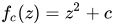
The Mandelbrot set (/ˈmændəlbrt, -brɒt/) is a two-dimensional set that is defined in the complex plane as the complex numbers for which the function does not diverge to infinity when iterated starting at , i.e., for which the sequence , , etc., remains bounded in absolute value.

This set was first defined and drawn by Robert W. Brooks and Peter Matelski in 1978, as part of a study of Kleinian groups. Afterwards, in 1980, Benoit Mandelbrot obtained high-quality visualizations of the set while working at IBM's Thomas J. Watson Research Center in Yorktown Heights, New York.

↑ Return to Menu