ATP synthase in the context of "Photophosphorylation"

Play Trivia Questions online!

or

Skip to study material about ATP synthase in the context of "Photophosphorylation"

Ad spacer

⭐ Core Definition: ATP synthase

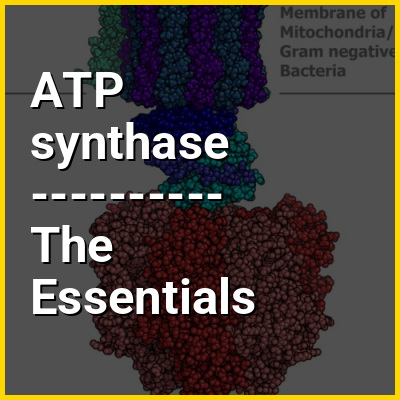
ATP synthase is an enzyme that catalyzes the formation of the energy storage molecule adenosine triphosphate (ATP) using adenosine diphosphate (ADP) and inorganic phosphate (Pi). ATP synthase is a molecular machine. The overall reaction catalyzed by ATP synthase is:

  • ADP + Pi + 2Hout ⇌ ATP + H2O + 2Hin

ATP synthase lies across a cellular membrane and forms an aperture that protons can cross from areas of high concentration to areas of low concentration, imparting energy for the synthesis of ATP. This electrochemical gradient is generated by the electron transport chain and allows cells to store energy in ATP for later use. In prokaryotic cells ATP synthase lies across the plasma membrane, while in eukaryotic cells it lies across the inner mitochondrial membrane. Organisms capable of photosynthesis also have ATP synthase across the thylakoid membrane, which in plants is located in the chloroplast and in cyanobacteria is located in the cytoplasm.
↓ Menu

>>>PUT SHARE BUTTONS HERE<<<
In this Dossier

ATP synthase in the context of Aerobe

An aerobic organism or aerobe is an organism that can survive and grow in an oxygenated environment. The ability to exhibit aerobic respiration may yield benefits to the aerobic organism, as aerobic respiration yields more energy than anaerobic respiration. Energy production of the cell involves the synthesis of ATP by an enzyme called ATP synthase. In aerobic respiration, ATP synthase is coupled with an electron transport chain in which oxygen acts as a terminal electron acceptor. In July 2020, marine biologists reported that aerobic microorganisms (mainly), in "quasi-suspended animation", were found in organically poor sediments, up to 101.5 million years old, 250 feet below the seafloor in the South Pacific Gyre (SPG) ("the deadest spot in the ocean"), and could be the longest-living life forms ever found.

↑ Return to Menu

ATP synthase in the context of Oxidative phosphorylation

Oxidative phosphorylation or electron transport-linked phosphorylation or terminal oxidation, is the metabolic pathway in which cells use enzymes to oxidize nutrients, thereby releasing chemical energy in order to produce adenosine triphosphate (ATP). In eukaryotes, this takes place inside mitochondria. Almost all aerobic organisms carry out oxidative phosphorylation. This pathway is so pervasive because it releases more energy than fermentation.

In aerobic respiration, the energy stored in the chemical bonds of glucose is released by the cell in glycolysis and subsequently the citric acid cycle, producing carbon dioxide and the energetic electron donors NADH and FADH₂. Oxidative phosphorylation uses these molecules and O2 to produce ATP, which is used throughout the cell whenever energy is needed. During oxidative phosphorylation, electrons are transferred from the electron donors to a series of electron acceptors in a series of redox reactions ending in oxygen, whose reaction releases half of the total energy.

↑ Return to Menu

ATP synthase in the context of Molecular machine

Molecular machines are a class of molecules typically described as an assembly of a discrete number of molecular components intended to produce mechanical movements in response to specific stimuli, mimicking macromolecular devices such as switches and motors. Naturally occurring or biological molecular machines are responsible for vital living processes such as DNA replication and ATP synthesis. Kinesins and ribosomes are examples of molecular machines, and they often take the form of multi-protein complexes. For the last several decades, scientists have attempted, with varying degrees of success, to miniaturize machines found in the macroscopic world.

The first example of an artificial molecular machine (AMM) was reported in 1994, featuring a rotaxane with a ring and two different possible binding sites. In 2016 the Nobel Prize in Chemistry was awarded to Jean-Pierre Sauvage, Sir J. Fraser Stoddart, and Bernard L. Feringa for the design and synthesis of molecular machines. A major point is to exploit existing motion in proteins, such as rotation about single bonds or cis-trans isomerization. Different AMMs are produced by introducing various functionalities, such as the introduction of bistability to create switches. A broad range of AMMs has been designed, featuring different properties and applications; some of these include molecular motors, switches, and logic gates. A wide range of applications have been demonstrated for AMMs, including those integrated into polymeric, liquid crystal, and crystalline systems for varied functions (such as materials research, homogenous catalysis and surface chemistry).

↑ Return to Menu

ATP synthase in the context of Halobacterium

Halobacterium (common abbreviation Hbt.), from Ancient Greek ἅλς (háls), meaning "salt", and "bacterium", is a genus in the family Halobacteriaceae.

The genus Halobacterium ("salt" or "ocean bacterium") consists of several species of Archaea with an aerobic metabolism which requires an environment with a high concentration of salt; many of their proteins will not function in low-salt environments. They grow on amino acids in their aerobic conditions. Their cell walls are also quite different from those of bacteria, as ordinary lipoprotein membranes fail in high salt concentrations. In shape, they may be either rods or cocci, and in color, either red or purple. They reproduce via binary fission (constriction), and are motile. Halobacterium grows best in a 42 °C environment. The genome of an unspecified Halobacterium species, sequenced by Shiladitya DasSarma, comprises 2,571,010 bp (base pairs) of DNA compiled into three circular strands: one large chromosome with 2,014,239 bp, and two smaller ones with 191,346 and 365,425 bp. This species, called Halobacterium sp. NRC-1, has been extensively used for postgenomic analysis. Halobacterium species can be found in the Great Salt Lake, the Dead Sea, Lake Magadi, and any other waters with high salt concentration. Purple Halobacterium species owe their color to bacteriorhodopsin, a light-sensitive membrane protein which acts as a proton pump, providing chemical energy with the proton gradient for the cell using light energy. The resulting proton gradient across the cell membrane is used to drive ATP synthase to generate adenosine triphosphate (ATP). Bacteriorhodopsin is very similar to rhodopsin, light-sensitive receptor proteins found in the retina of most animals.

↑ Return to Menu

ATP synthase in the context of Chemiosmosis

Chemiosmosis is the movement of ions across a semipermeable membrane through an integral membrane protein, down their electrochemical gradient. An important example is the formation of adenosine triphosphate (ATP) by the movement of hydrogen ions (H) through ATP synthase during cellular respiration or photophosphorylation.

Hydrogen ions, or protons, will diffuse from a region of high proton concentration to a region of lower proton concentration, and an electrochemical concentration gradient of protons across a membrane can be harnessed to make ATP. This process is related to osmosis, the movement of water across a selective membrane, which is why it is called "chemiosmosis".

↑ Return to Menu

ATP synthase in the context of Phototroph

Phototrophs (from Ancient Greek φῶς, φωτός (phôs, phōtós) 'light' and τροφή (trophḗ) 'nourishment') are organisms that carry out photon capture to acquire energy. They use the energy from light to carry out various cellular metabolic processes. It is a common misconception that phototrophs are obligatorily photosynthetic. Many, but not all, phototrophs photosynthesize: they anabolically convert carbon dioxide into biomolecules to be utilized structurally (e.g. cellulose and membrane lipids), functionally (e.g. vitamins, nucleotides, and amino acids), or as a source for later catabolic processes (e.g. starches, sugars and fats). All phototrophs either use electron transport chains or direct proton pumping to establish an electrochemical gradient, which is utilized by ATP synthase to provide adenosine triphosphate (ATP) for the cell. Phototrophs can be either autotrophs or heterotrophs. If their electron and hydrogen donors are inorganic compounds (e.g., Na
2
S
2
O
3
, as in some purple sulfur bacteria, or H
2
S
, as in some green sulfur bacteria) they can be also called lithotrophs, and so, some photoautotrophs are also called photolithoautotrophs. Examples of phototroph organisms are Rhodobacter capsulatus, Chromatium, and Chlorobium.

↑ Return to Menu