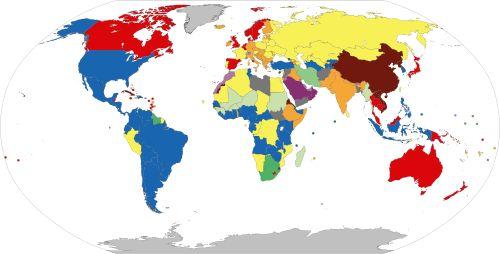
Materials covered in this trivia questions quiz
Study Hint 1
Question: In the context of the Government of Albania, the parliamentary system is characterized by a division of executive power between which two roles?
Trivia Question Study Fact: Albania operates as a parliamentary republic where the president serves as the head of state and the prime minister functions as the head of government. While the president represents national unity and commands the military, the prime minister holds the most political power, leading the government and requiring the confidence of Parliament to maintain office.
Trivia Question Explanation: Albania’s governmental structure distinctly separates executive authority between the president, who is head of state, and the prime minister, who is head of government and wields the most political influence.
Return to Question
Study Hint 2
Question: In the context of the Singaporean President, a parliamentary system is considered to function with a distinct division of roles, where does the primary executive authority reside?
Trivia Question Study Fact: Singapore's parliamentary system operates under a non-executive model, meaning the President, as head of state, does not hold the executive powers typically associated with a head of government. Instead, these powers are vested in the Cabinet, headed by the Prime Minister, demonstrating a clear separation of powers within the framework of the Westminster system.
Trivia Question Explanation: Singapore operates under a non-executive model of the Westminster parliamentary system, where the President is the head of state but the Cabinet, led by the Prime Minister, holds the executive power and manages the government's daily operations.
Return to Question
Study Hint 3
Question: In the context of electoral democracy, a parliamentary system is considered distinct from a liberal democracy because it may lack…
Trivia Question Study Fact: Representative democracy, as practiced in many Western nations like the United Kingdom, Germany, and France, relies on elected delegates to represent the populace. While these systems often feature multiparty elections, a fully developed rule of law and comprehensive individual rights aren't always guaranteed, distinguishing it from a liberal democracy.
Trivia Question Explanation: Representative democracies, including parliamentary systems, can function with free and fair elections and multiple parties, but may not necessarily prioritize or fully establish a robust rule of law and comprehensive protections for individual and minority rights beyond the electoral process.
Return to Question
Study Hint 4
Question: In the context of the Polish People's Republic, the shift to a parliamentary system was ultimately achieved through what process?
Trivia Question Study Fact: The Polish People's Republic, a communist state existing from 1952 to 1989, transitioned to a parliamentary system following the Revolutions of 1989 and the 1990 presidential election. While initially retaining the 1952 constitution with amendments, a new constitution was adopted in 1997, fully establishing a parliamentary system that continues to this day.
Trivia Question Explanation: Following the Revolutions of 1989 and the 1990 presidential election, the Polish People's Republic initially retained its 1952 constitution with amendments, but a new constitution was ultimately adopted in 1997, fully establishing a parliamentary system.
Return to Question
Study Hint 5
Question: In the context of a directorial system, how is executive authority fundamentally different from that of a parliamentary system?
Trivia Question Study Fact: In a directorial system, executive power is not concentrated in a single individual, but rather distributed among a committee or council that collectively fulfills the roles typically held by a head of state and/or head of government, contrasting with systems like a parliamentary system where power is vested in a prime minister.
Trivia Question Explanation: A directorial system distributes executive functions among a group of individuals, unlike a parliamentary system which centers executive authority in a prime minister who is accountable to the legislature.
Return to Question
Study Hint 6
Question: In the context of Elections in India, the Parliamentary system is considered to vest the primary executive power in which office?
Trivia Question Study Fact: Within India's parliamentary system, while the President serves as the ceremonial head of state and commander-in-chief of the armed forces, the Prime Minister holds the position of the head of the government and leads the legislative branch, deriving authority from maintaining a majority in the Lok Sabha.
Trivia Question Explanation: The Prime Minister leads the Union Council of Ministers and is the head of the government, gaining this position by leading the party or alliance with a majority in the Lok Sabha, the lower house of Parliament.
Return to Question
Study Hint 7
Question: In the context of the Empire of Brazil, the parliamentary system was most notably characterized by…
Trivia Question Study Fact: The Empire of Brazil, established in the 19th century, uniquely featured a parliamentary system within a constitutional monarchy. This meant that while Emperors Pedro I and Pedro II held the position of monarch, governance also involved an elected bicameral parliament, leading to frequent debates regarding the balance of power between the emperor and the legislative body.
Trivia Question Explanation: The Empire of Brazil’s government combined a constitutional monarchy with a parliamentary system, resulting in a bicameral parliament elected through relatively democratic methods for the time, and frequent ideological conflicts over the extent of the monarch’s power.
Return to Question
Study Hint 8
Question: In the context of heads of state, a parliamentary system is considered…
Trivia Question Study Fact: Within a parliamentary system, the role of the head of state often differs significantly from that of the head of government. While the head of government typically holds executive power, the head of state frequently fulfills primarily ceremonial duties, representing the nation symbolically. However, this isn't universally true, as some parliamentary systems grant the head of state substantial political authority.
Trivia Question Explanation: In many parliamentary systems, the head of state serves as a symbolic figurehead, with the head of government responsible for the day-to-day operations and political leadership of the country.
Return to Question
Study Hint 9
Question: In the context of anarcho-syndicalism, a parliamentary system is considered…
Trivia Question Study Fact: Anarcho-syndicalism, as a political ideology, fundamentally rejects participation in parliamentary systems, viewing them as inherently corrupting to the labor movement and a distraction from direct action and workers' self-management. Instead, it prioritizes direct action like strikes and boycotts to achieve economic and social change.
Trivia Question Explanation: Anarcho-syndicalists believe that engaging in parliamentary politics compromises the integrity of the labor movement and diverts energy from more effective methods of achieving social change, such as direct action and workers' control.
Return to Question
Study Hint 10
Question: In the context of Governments, a core function of the executive branch is considered…
Trivia Question Study Fact: Governments, as systems for organizing communities, typically function through three interconnected branches: a legislature responsible for creating laws, an executive branch focused on enforcing those laws, and a judiciary that interprets them. This structure provides a framework for establishing and implementing organizational policies.
Trivia Question Explanation: The executive branch is specifically tasked with the practical application of laws and policies, ensuring they are carried out within the organized community governed by the government.
Return to Question